On a Gulf project, brass fittings are rarely rejected on price. They are rejected because the thread standard on the submittal did not match the thread standard in the box, because the material declaration named an alloy the consultant would not accept on a potable line, or because the certificate file arrived incomplete and the consignment sat while somebody chased a document. So the useful question is not which brass fittings manufacturer is cheapest — it is which one can answer, in writing and before shipment, the five questions a specifier will eventually ask: what is the alloy designation, is it dezincification resistant, what is the thread designation, what is the pressure at what temperature, and what test documentation exists to feed the conformity registration your destination market runs.
This guide is for importers, sourcing agents and project buyers across the Gulf, wider Middle East and North Africa. Technical figures here are general industry guidance, not a WARMHAUS-specific specification — always confirm against the datasheet of the fittings and pipe you are actually buying.
I. What “Manufacturer” Has to Mean Before You Compare Prices
In brass fittings the word manufacturer is used loosely. Many of the offers an importer receives come from companies that buy raw castings or finished fittings, apply a brand, and resell. That is a legitimate business, but it changes what you can rely on: a trading desk cannot tell you which bar stock went into which batch, cannot change a thread run to suit your market, and cannot issue a management-system certificate covering the process that made the part — because the process is not theirs.
The practical test takes one email. Ask three questions: which operations happen on your own lines (casting, forging, machining, plating, assembly), what raw material do you buy and from whom, and can we visit or video-audit the machining floor at short notice. A factory answers all three without hedging; a trader answers the first vaguely, the second not at all, and the third by offering photographs. Our factory page sets out what our own lines cover; the wider audit method is in how to vet a pipe manufacturer, and it applies to brass unchanged.
A trading desk can quote a brass fitting. Only a factory can tell you what is inside it.
II. Range Coverage Table — What a Brass Fittings Line Should Include
The commercial failure mode for a distributor is not a bad fitting. It is an incomplete line: a job needs a 1-1/4″ reducing tee and a brass insert for a PPR fitting, the shelf carries neither, and the contractor buys the whole basket elsewhere. Before evaluating any single item, check the shape of the range.
| Fitting family | Typical configurations | Size range to cover | Where it is used on a project | What to confirm on the datasheet |
|---|---|---|---|---|
| Threaded sockets | Male and female threaded couplings | 1/2″ – 2″ | Pipe-to-pipe and pipe-to-thread joints on risers and branches | Thread standard, alloy, wrench flat dimensions |
| Elbows | 90° threaded, male/female configurations | 1/2″ – 2″ | Change of direction at risers, plant rooms, meter sets | Thread standard, alloy, centre-to-face dimension |
| Tees | Straight and reducing threaded tees | 1/2″ – 2″ | Branch connections off a distribution main | Reducing combinations available, thread standard |
| Compression fittings | Couplings, elbows and tees, push-and-tighten | 1/2″ – 2″ | Metal and multilayer pipe connections, repairs, meter work | Pipe outside diameters supported, ring and insert type |
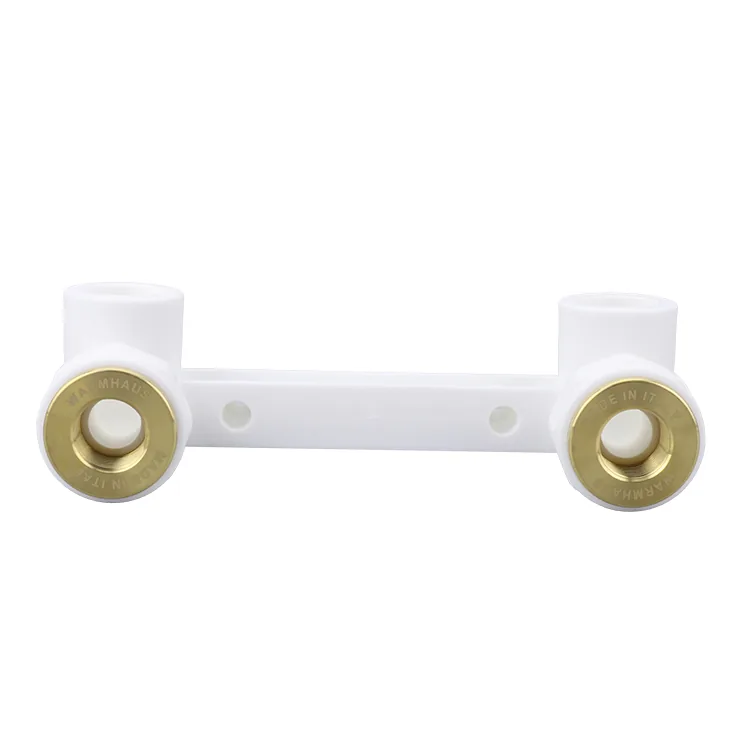
| Brass inserts | Inserts for PPR and PEX fittings | For PPR / PEX systems | Metal thread inside a plastic system — taps, valves, appliances | Matching plastic fitting series, thread standard |
| Brass ball valves | Full and reduced bore, lever and butterfly handles | Residential and light-commercial | Isolation at risers, branches, plant rooms | Bore type, stem seal, handle type, rating |
| Brass manifolds | Distribution bars with outlets | By outlet count | Underfloor heating and distribution cabinets | Outlet thread, centre spacing, adaptor compatibility |
Coverage and application notes are general industry guidance, not a WARMHAUS-specific specification. Configurations, dimensions and reducing combinations differ between manufacturers and between series. Always confirm against the size and specification datasheet of the fittings you are actually buying.
Two rows are the ones most often missed at quotation stage. Brass inserts are invisible until an installer connects a plastic system to a tap or a metal appliance, and they only work if the insert series matches the plastic fitting series it sits inside. Reducing tees are the item every job needs and every incomplete line lacks — ask for the combinations explicitly rather than assuming the size table implies them. Our family and size breakdown sits on the brass fittings range page, and the isolation side of the same system on the brass ball valves page.
III. Alloy, Thread and Rating — The Three Technical Decisions
Almost every technical rejection on a brass consignment traces back to one of three decisions, and all three are made before the order, not after.
I. The alloy
Brass for plumbing fittings is a copper-zinc alloy with small additions that make it machinable. Two properties matter to a specifier: lead content, because potable-water requirements in most markets now constrain it, and dezincification behaviour, because water chemistry in parts of the Gulf is aggressive and a susceptible alloy loses zinc from the matrix over time, leaving porous copper that eventually weeps.
Be precise about what the second one requires, because this is where submittals get rejected. The standard leaded hot-stamping brasses are not dezincification-resistant alloys. CW617N — the common European designation — is duplex in the as-forged condition, meaning it contains a zinc-rich beta phase that leaches preferentially; the same applies to comparable free-machining grades such as HPb57-3. Neither should be assumed resistant. Genuine DR behaviour comes from a different formulation: an adjusted copper content with a small arsenic addition, often with a controlled heat treatment after forming, and the recognised DR designations differ from the general-purpose ones. If your project’s water profile or specification calls for dezincification resistance, that is a separate material line on the enquiry, not something a general-purpose brass fitting satisfies by default. The mechanism, the two routes to resistance and the four questions to put to a supplier are set out in our guide to dezincification in brass fittings, and the grade-by-grade comparison in CW617N versus HPb57-3.
WARMHAUS machines fittings from 57-3 and CW617 brass — general-purpose leaded machining grades, which is what the large majority of threaded plumbing brass is made from, and which should not be presented to a consultant as DR material. Where a specification requires a dezincification-resistant grade, raise it at enquiry stage so the material can be addressed explicitly rather than assumed. What you need on paper either way is the specific grade, the mill certificate for the material supplied and the dimensional data sheet for the series — available on request.
II. The thread designation — G, R, Rp, Rc or NPT
This is the most common cause of a rejected box, and it is made worse by the habit of writing “BSP” on an enquiry as though that were a specification. It is not — it does not say whether the thread is parallel or tapered, and those seal by entirely different mechanisms. The designations you should be writing instead are these.
| Code | Standard | Form | How it seals |
|---|---|---|---|
| G | ISO 228 (BSPP, parallel) | Parallel, 55° Whitworth form | Not on the flanks — requires a washer, O-ring or flat seating face |
| R | ISO 7-1 (BSPT, external taper) | Tapered 1:16, 55° | Flank interference plus sealant or PTFE tape |
| Rp | ISO 7-1 (parallel internal) | Parallel, 55° | Sealed by an R male wedging into it, with sealant |
| Rc | ISO 7-1 (internal taper) | Tapered 1:16, 55° | Flank interference plus sealant |
| NPT | ASME B1.20.1 (American taper) | Tapered 1:16, 60° | Flank interference plus sealant or tape |
The rule that matters commercially: the 55° and 60° families do not mix. An NPT male into a G or Rp female engages for a turn or two and then binds, because both the flank angle and the pitch differ — the result is a leak path, not a tight joint. Within the 55° family, R into Rp is a normal and intended pairing, and R into Rc is the fully tapered version. A G male into a G female is a mechanical joint that needs a washer or O-ring to seal; no quantity of PTFE tape substitutes for the missing seal in the long run.
Decide the designation at enquiry stage, write it with the size on the purchase order in the standards form — G 1/2, Rp 3/4, R 1 — and require the same string on the packing list and the datasheet. If you sell into more than one thread market, treat the designation as a separate SKU dimension: restocking a wrong-thread pallet costs more than splitting the order properly.
Thread designations and standard references above are general industry guidance for specifying an order, not a WARMHAUS-specific specification and not a substitute for the standards. Confirm the designation, size and sealing method for each item against the manufacturer’s datasheet and the requirements of the project specification.
III. Pressure and temperature rating
A rating is meaningful only as a pair: a pressure at a stated temperature. The same fitting carries a lower working pressure on a hot line than on a cold one, which is why a bare bar figure with no temperature against it should be sent back for clarification. On the plastic side of the same system this relationship is what the PN classes encode, as our PPR pipe specifications guide sets out, and the logic carries over. For brass, ask for the manufacturer’s pressure-temperature statement for the specific series and read it against the design conditions of the project rather than a general catalogue figure.
IV. The Gulf Conformity Schemes — Which Country Runs What
This is the part most sourcing guides skip, and it is the reason a container sits at a port. The GCC states do not share one import approval. Each runs its own conformity assessment regime, administered by its own standards body, and the certificate that clears goods in one does not clear them in the next. Above them sits a layer of common regional standards. Know which layer you are dealing with before you quote.
| Market | Standards body | Conformity route commonly encountered | What it is |
|---|---|---|---|
| Regional layer | GSO — GCC Standardization Organization | GSO standards; the G-mark conformity marking scheme | Harmonised standards adopted across member states. The G-mark scheme applies to specified regulated product categories rather than to everything, so confirm whether your HS code falls inside it. |
| Saudi Arabia | SASO — Saudi Standards, Metrology and Quality Organization | SABER — the online platform through which a product certificate and then a shipment certificate are obtained | Two stages: a product certificate of conformity registered against the product, then a shipment certificate raised per consignment before clearance. |
| United Arab Emirates | MoIAT / ESMA — Emirates authority for standards and metrology | ECAS (Emirates Conformity Assessment Scheme); EQM for the voluntary quality mark | ECAS is the registration route for regulated products; EQM is a product quality mark applied for separately. |
| Qatar | QGOSM — Qatar General Organisation for Standards and Metrology | Conformity assessment against adopted QS/GSO standards | Requirements are set per product category; a pre-shipment conformity route may apply to regulated goods. |
| Kuwait | KOWSMD / PAI — Kuwaiti standards administration | A technical inspection and conformity certificate regime applied to regulated imports | Historically operated through appointed inspection bodies before shipment. |
| Oman | DGSM — Directorate General for Standards and Metrology | Conformity assessment against adopted GSO/OS standards | Applied per regulated product category. |
| Bahrain | BSMD — Bahrain Standards and Metrology Directorate | Conformity assessment against adopted GSO/BS standards | Applied per regulated product category. |
Scheme names, administering bodies and scopes above are general industry orientation, current at the time of writing and given so that you can ask your broker the right question. They are not a legal statement of import requirements. These regimes are set by national authorities, their scopes and platforms change, and whether a given regime applies depends on your HS code, the product category and the project. Establish the current requirement for your specific consignment with a licensed customs broker and the appointed conformity assessment body before you place an order.
Three practical consequences for a brass fittings order. First, conformity registration is the importer’s responsibility, not the factory’s — but it consumes the manufacturer’s documents, so the two have to be sequenced together. Second, the certificate is tied to a product and often to a consignment, which means it is not a one-time exercise you complete on the first container and forget. Third, the schemes consume test reports and technical files, so ask the manufacturer for those at enquiry stage rather than after the goods are made. Country-level notes for the wider region are in our guide to importing pipes into the Gulf and North Africa.
V. The Manufacturer’s Half of the Document File
The conformity schemes above run on evidence, and that evidence comes from the factory. This is the half of the file you can settle at enquiry stage — the consultant approves a submittal, the contractor buys against the approval, and the consignment clears on paperwork that matches it. Assemble it before production, not when a container is already at the port.
Management-system certificates
ISO 9001 for quality management, ISO 14001 for environmental management, ISO 45001 for occupational health and safety. These certify the company and its processes, not the individual fitting — a distinction consultants notice, and one that trips up buyers who present an ISO certificate as a product approval. Certificate documents and scope statements: available on request.
EU CE marking
Market-access marking for the European Union, based on the manufacturer’s declaration of conformity against the applicable directives. It is not a third-party audit and there is no public register to look it up in, so what you should hold is the declaration itself, not a logo on a brochure. What each mark does and does not prove is in our guide to ISO and CE certifications.
Third-party test reports
WARMHAUS products are tested by SGS, the Swiss inspection and testing group. A test report names the sample, the method and the result — which is what a consultant wants to see next to a material declaration, and it is also what a Gulf conformity registration consumes. Ask for the testing documentation covering the specific product range you are ordering, and check that the sample described in it is the item you are buying. Where a market operates its own approval regime, we also hold Russian PT market-access documentation. Certificate documents: available on request.
Material and dimensional data sheets
Alloy designation, whether the material is supplied as dezincification resistant, thread designation, pressure-temperature rating and dimensional drawings for the specific series. This answers a specifier’s questions directly, and it is the document most often missing from a trading-desk offer because the trader does not have it either.Material and size datasheets: available on request.
Shipping and conformity paperwork
Commercial invoice, packing list, certificate of origin and bill of lading, plus the conformity certificate from whichever national scheme applies — SABER in Saudi Arabia, ECAS in the UAE, the equivalent regime in Qatar, Kuwait, Oman or Bahrain, as set out in the table above. The commercial set is the manufacturer’s to issue; the conformity registration is yours, and it is fed by the technical documents in items i to iv. Sequence it so the registration is under way while the goods are in production rather than after they sail. Country notes are on our countries we supply page.
VI. Buying Brass as Part of a System, Not as a Separate Line
Brass fittings sit at the boundary between the plastic distribution system and everything metal: taps, valves, appliances, meters, manifolds. That boundary is where mismatches surface. A brass insert has to fit the PPR or PEX fitting it sits inside; a manifold outlet thread has to match the adaptor the installer brings. Buying brass separately from pipe makes each interface a negotiation between two suppliers’ tolerances rather than one internal standard.
There is a commercial argument on top of the technical one. Brass is dense and expensive per pallet; pipe is bulky and cheap per pallet. A container loaded only with brass hits its weight limit with the volume half empty, and one loaded only with PPR hits its volume limit well under weight. Planning them together fills a container to both limits at once — the practical reason many distributors consolidate brass, PPR and PEX purchasing with one manufacturer rather than three.
Brass fills the weight, pipe fills the volume. Order them from two suppliers and you pay to ship air.
VII. Eleven Questions to Put to a Brass Fittings Supplier
Send these as a single list at enquiry stage. The quality of the answers tells you more about a supplier than any sample does, and it costs one email to find out.
| # | Question to ask | What a factory answer looks like |
|---|---|---|
| 1 | Which operations run on your own lines? | Names the specific processes; offers a floor visit |
| 2 | What brass grade do you machine, and can I have the mill certificate? | Names the designation — CW617N, HPb57-3 or a DR grade — and sends the certificate for the material supplied |
| 3 | Is this material supplied as dezincification resistant, and by which route? | Answers plainly. “Good quality brass” is not an answer; a general-purpose leaded grade is not DR |
| 4 | Which thread designation is this series — G, R, Rp, Rc or NPT — and can it be supplied in another? | States the code, not “BSP”; explains what changes if you switch |
| 5 | What is the pressure rating, at what temperature? | Gives a pressure-temperature pair, not a single number |
| 6 | Which reducing combinations exist in the tee range? | Sends the combination list rather than “all sizes” |
| 7 | Do your brass inserts match your own PPR and PEX fittings? | Confirms the matching series by name |
| 8 | Which certificates do you hold, what is their scope, and what test documentation can support a SABER or ECAS registration? | Distinguishes management systems from market access, and knows that the conformity registration is the importer’s to file |
| 9 | What is the minimum order quantity per item? | A clear figure — or genuinely none |
| 10 | What is the standard lead time from confirmed order? | A stated number of days, planned into production slots |
| 11 | Can brass ship in the same container as pipe, and who plans the loading? | Offers a loading plan against weight and volume limits |
This checklist is general sourcing guidance. The answers you should accept depend on your destination market’s plumbing regulations and on the project specification you are supplying against. Confirm technical figures on the manufacturer’s own datasheet before you submit them to a consultant.
VIII. Sourcing Brass Fittings from WARMHAUS
WARMHAUS is a manufacturer of PPR, PEX and brass piping systems — not a trading company. The machining lines that produce our brass sockets, elbows, tees, compression fittings and inserts are our own, running from 57-3 and CW617 brass, alongside the extrusion and injection-moulding lines that produce the pipe those fittings connect to. That is the argument for buying brass and plastic from one source: the insert series, the thread designation and the pipe dimensions are held to one internal standard instead of averaged across three vendors.
Manufacturing since 1993 across three plants totalling 100,000 m² of building area, with over 500 staff and more than 50 technical and R&D personnel. Total monthly output is around 2,000 tonnes, of which roughly 600 tonnes is pipe, fittings and brass ball valves. ISO 9001 / ISO 14001 / ISO 45001 certified, EU CE marked, SGS tested, with Russian PT market-access documentation. Certificate documents and detailed test reports: available on request.
Two things matter to a distributor building a brass shelf. First, there is no MOQ, which makes it possible to carry the full family range without committing a container to each variant, and to add the reducing sizes that complete a range rather than skipping them for volume reasons. Second, the standard lead time is 45 days from confirmed order, planned into production slots rather than promised loosely, so a stock plan can be built around it. For an exclusive arrangement rather than transactional purchasing, terms are on our distributor partnership page.
Request the brass fittings size and specification table, alloy data sheets and distributor terms — tell us the thread designation your market uses, the sizes you sell, whether the specification calls for a dezincification-resistant grade, and whether the brass will travel with pipe, and we will send the matching range and a loading plan against it.