A brass fitting has no visible specification. Two elbows machined from different alloys, given the same plating and the same thread, are indistinguishable on a pallet and behave differently after years in a wall. The designation is the only thing that separates them, and the two you will meet across most water fittings and valve bodies are CW617N and HPb57-3. Both are leaded, hot-forging, free-machining brasses with published composition ranges. They are not the same material, and the differences — copper content, permitted impurity limits, the standards system each belongs to — decide how a fitting behaves in aggressive water and whether it satisfies the paperwork your destination market asks for. This guide is about specifying one deliberately instead of accepting whichever arrives.
Everything below is general industry guidance on how these designations are defined and used, not a WARMHAUS-specific specification. Composition ranges and permitted impurity limits are set by the published standard for each designation and are periodically revised; mill certificates report actual values within those ranges. Always confirm the figures against the material certificate and technical datasheet supplied with the fittings you are actually buying before writing an alloy into a tender or contract.
I. What Each Designation Actually Means
These two names come from different standards systems and describe the material in different ways, which is why they are not directly interchangeable even where their compositions overlap.
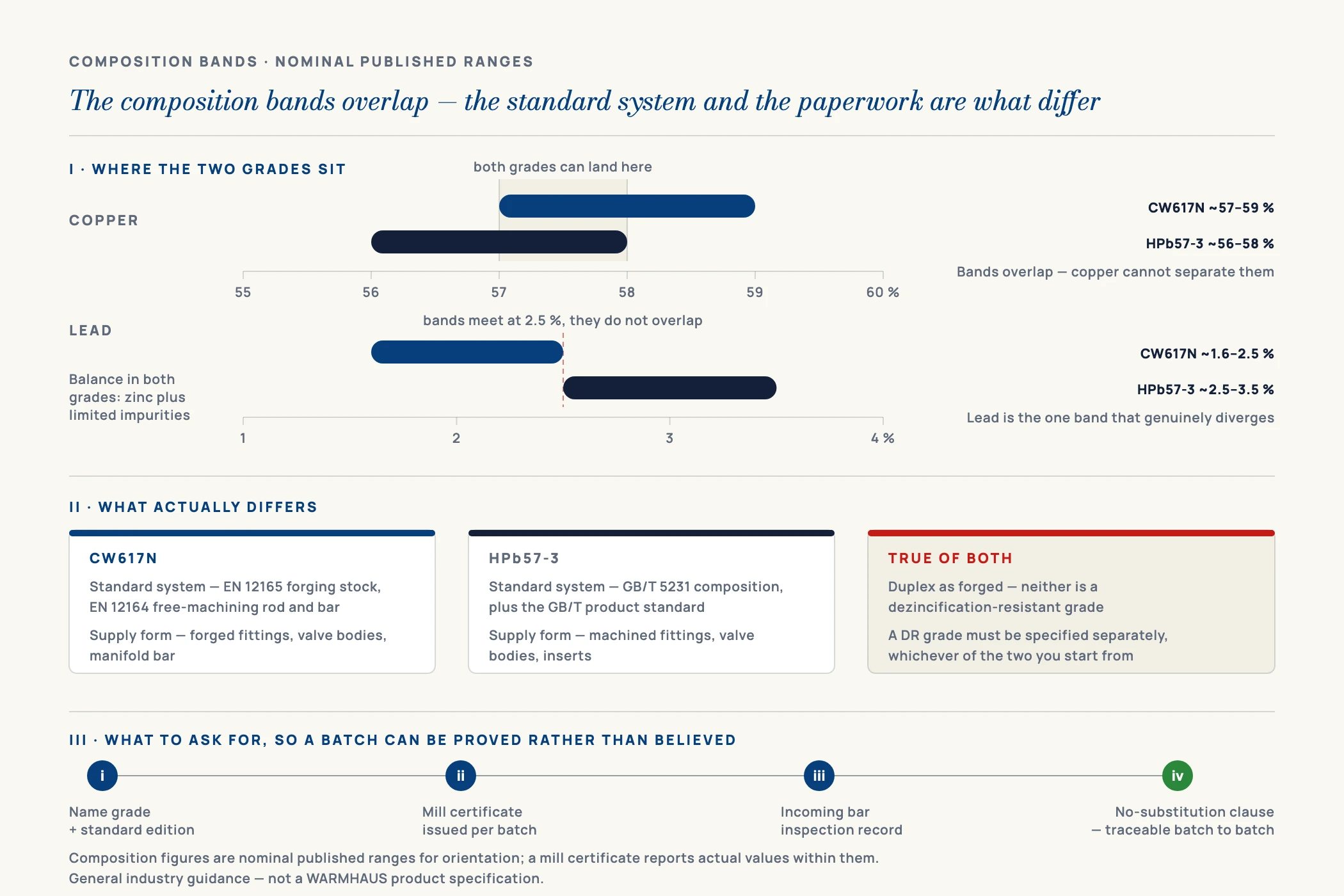
CW617N is a European material designation for a hot-stamping, free-machining copper-zinc-lead brass, defined in the EN 12164 / EN 12165 / EN 12167 family of wrought copper standards — EN 12165 covers the forging stock, EN 12164 the free-machining rod and bar, EN 12167 profiles and sections. The CW prefix identifies it as a wrought copper material in the European system; the number identifies the composition, and the standard document is where the permitted ranges are actually written down. It is the grade named in most European-market specifications for forged and machined water fittings, valve bodies and manifold bars. Nominally it sits around 57–59 % copper with a lead addition of roughly 1.6–2.5 %, the remainder zinc plus limited impurities.
HPb57-3 is a Chinese national designation for the corresponding free-machining leaded brass, with its composition ranges set out in the GB/T 5231 series covering wrought copper and copper-alloy chemical composition, and its rod and bar product forms in the associated GB/T product standards. The name is itself the composition: H for brass, Pb for the lead addition, 57 for the nominal copper percentage and 3 for the nominal lead percentage. So a nominal HPb57-3 sits around 56–58 % copper with a lead addition nearer 2.5–3.5 %.
A purchase order that says “brass” has not specified a material. It has specified a colour.
Name the standard document alongside the grade when you write the order. “CW617N” on its own is a name; “CW617N to EN 12165” tells the mill which table of permitted ranges and impurity ceilings applies, and gives the certificate something to be issued against. The same holds on the other side: “HPb57-3 to GB/T 5231” is a specification, “HPb57-3” alone is a label. Standards are revised, so cite the edition current at the time of order and expect the mill certificate to reference it back to you.
Read side by side, the divergence that is genuinely commercially useful is lead: HPb57-3 carries a higher nominal lead addition. The copper bands overlap so heavily that copper content is not a selection criterion between these two grades — treat the difference as noise and decide on lead level, documentation and market access instead. Neither is a defect; lead is what makes the material cut cleanly at speed. The supplier vetting questions that apply to a polymer line apply here too, with the alloy certificate taking the place of the resin certificate.
II. CW617N vs HPb57-3 — Side-by-Side Comparison
This is the table to work down when a supplier offers “brass fittings” and you need to turn that into a specification. The composition figures are nominal published ranges given for orientation only; actual values for a batch come off the material certificate.
| Property | CW617N | HPb57-3 | Why it matters to you |
|---|---|---|---|
| Designation system | European wrought copper designation | Chinese national (GB) designation | Decides which certificate format a specifier will accept |
| Where the range is written | EN 12165 (forging stock), EN 12164 (rod and bar) | GB/T 5231 (composition) plus the GB/T product standard | Cite the document, not just the grade name, on the order |
| Material family | Cu-Zn-Pb hot-stamping brass | Cu-Zn-Pb free-machining brass | Both are leaded forging brasses — same broad family |
| Nominal copper | ~57–59 % | ~56–58 % | Ranges overlap heavily — not a basis for choosing between the two |
| Nominal lead | ~1.6–2.5 % | ~2.5–3.5 % | The real difference: aids machining, regulated in potable use |
| Balance | Zinc plus limited impurities | Zinc plus limited impurities | Impurity ceilings differ between the two standards |
| Typical use | Forged fittings, valve bodies, manifold bar | Machined fittings, valve bodies, inserts | Overlapping application ranges in water systems |
| Machinability | Very good — designed for hot stamping | Very good — higher lead cuts faster | Affects cycle time and therefore unit cost |
| Hot forgeability | Excellent | Good | Relevant for forged rather than bar-turned parts |
| Dezincification resistance | Not inherently resistant unless a DR grade is specified | Not inherently resistant unless a DR grade is specified | Neither standard grade is a DR alloy — specify separately |
| Potable-water acceptance | Depends on the destination market’s own scheme | Depends on the destination market’s own scheme | Set by the country you sell into, not by the alloy name |
| Commercial availability | Standard across European-market supply | Standard across Asian-market supply | Affects lead time and bar-stock pricing |
| Documentation | Mill certificate against the European designation | Mill certificate against the GB designation | Ask for the certificate before the order, not after |
Composition ranges and properties are general industry guidance drawn from the published designations, not a WARMHAUS-specific specification. Standards are revised, and mill certificates report actual values within the permitted range. Always confirm against the material certificate and datasheet supplied with the fittings you are buying.
III. Dezincification — The Failure Mode That Alloy Choice Controls
Dezincification is the selective loss of zinc from a brass surface in contact with certain waters. The zinc leaves, a weak and porous copper structure stays behind, and the fitting keeps its shape while losing its strength. It shows as a pink or coppery discoloration on the wetted surface, sometimes with white powdery residue outside, and it ends either as a weeping leak or as a fitting that shears when someone puts a spanner on it.
The conditions that make it likely are well established as general industry knowledge: soft, acidic or high-chloride water, stagnant or intermittent flow, and elevated temperature. Hot-water circuits and coastal or desalinated supply are the classic environments — which is why this comes up so consistently on Gulf and North African projects.
Here is the part that catches buyers out: neither CW617N nor HPb57-3 is a dezincification-resistant alloy. Higher copper content generally helps at the level of alloy families, but between these two the published copper bands overlap almost completely — the gap is about one percentage point at the range edges, and a mill certificate for either grade can land above or below the other. Do not use copper content to choose between CW617N and HPb57-3 for dezincification reasons; there is no usable margin there. Genuine DR behaviour comes from a different formulation — a further adjusted copper content with a small arsenic addition, often with a controlled heat treatment after forming. If your water profile is aggressive, the correct action is not to argue about which of these two grades is marginally better. It is to ask whether a DR grade option exists for that item and specify it explicitly for positions that are buried, embedded in screed, or otherwise not serviceable without breaking a floor.
IV. Lead Content and Market Access
The second difference between these grades is lead, and it is now a commercial issue as much as a technical one. Lead is added to both alloys because it makes the material free-machining: it breaks up the chip, lets the tool run faster and gives cleaner threads. Remove it and machining costs rise. That is the whole reason it is there.
The complication is that a growing number of markets regulate how much lead may leach from the wetted metal parts of a drinking-water system, and each jurisdiction runs its own approval scheme with its own test method and limit. There is no single global number, and a fitting accepted in one market is not automatically accepted in another. For a distributor that means four concrete things:
Check the requirement of the country you sell into, not the country you buy from
The obligation attaches to the market where the product is installed. Establish what your destination market requires for potable-water metal components before you commit to a container — compliance cannot be retrofitted to stock already in a warehouse.
Ask for the material certificate and lead-content data, not an assurance
“Low lead” is a marketing phrase with no fixed meaning. A certificate naming the designation and reporting actual composition is a document you can put in a tender file; a verbal assurance is not. Ask at quotation stage, while you still have leverage.
Treat the low-lead option as a specification decision with a cost
Reduced-lead brasses machine more slowly and cost more per part — a legitimate trade-off to make deliberately for potable positions. What does not work is expecting a low-lead grade at a standard-brass price. A supplier who agrees to that is either not supplying it or recovering the cost elsewhere.
Split your specification by application, not by whole catalogue
Not every brass part touches drinking water. Heating-circuit bodies, non-potable service valves and mechanical components sit under a different requirement. Specifying one alloy across the whole range is simple, but usually means paying a potable-grade premium on items that never needed it.
On the WARMHAUS side of that conversation: brass bar stock for our fittings, valve and manifold programme is 57-3 and CW617 brass, machined on our own lines, and grade documentation, composition data and machining tolerances are issued with the technical datasheet. Certificate documents and detailed material documentation: available on request.
V. How to Write the Alloy Into a Specification
Most alloy disputes are really specification disputes: the supplier delivered something that satisfied the words on the order, and the words did not say enough. Six lines close that gap, and they belong on the purchase order rather than in an email thread.
| Line to specify | What to write | What happens if you leave it out |
|---|---|---|
| Alloy designation | Name the grade and its standard — e.g. CW617N to EN 12165, HPb57-3 to GB/T 5231, or the DR grade | You receive whichever bar stock was cheapest that month |
| Thread designation | State the code, size and seal — e.g. “G½ parallel male, O-ring seat” or “R½ taper male” | A container of fittings that will not seal in your market’s pattern |
| Application split | State which items are potable and which are not | One grade gets applied across the range, priced at the higher one |
| Documentation | Material certificate per batch, referenced to the designation | No evidence for the tender file when a consultant asks |
| Dezincification | DR grade required for buried and non-serviceable positions | Standard leaded brass in the one place you cannot replace it |
| Substitution clause | No alloy substitution without written approval | A mid-run grade change you only discover on the next container |
That last line does more work than it looks like it does. Bar-stock prices move, and on a long-running order the temptation to substitute a nominally similar grade is real. A written no-substitution clause turns a quiet change into a contractual one. Confirming that a supplier’s incoming material and dimensional inspection process checks the grade of the bar as it arrives is the other half of the same control.
VI. The Other Half of the Designation: Thread Codes
An alloy grade specifies what the fitting is made of. It says nothing about whether it will screw into anything on site. Threads are the second designation a brass order needs, and they are the one most often left as “1/2 inch BSP” — which is not a specification either, because BSP splits into two incompatible forms. The codes below are the ones that appear on drawings and catalogues, and they are worth writing out in full on the order.
| Code | Full name | Form | Thread angle / seal | Where you meet it |
|---|---|---|---|---|
| BSPP — G | British Standard Pipe Parallel | Parallel (straight) | 55°; seals on a washer, O-ring or bonded seat, not on the thread | European and Commonwealth-pattern plumbing; the “G” in G½ is the ISO 228 designation |
| BSPT — R / Rc | British Standard Pipe Taper | Taper male (R), taper female (Rc) | 55°; seals by thread interference, needs PTFE tape or a sealing compound | Same markets, used where a thread-seal joint is wanted; ISO 7 designation |
| Rp | Parallel internal thread to ISO 7 | Parallel female | 55°; designed to take an R taper male | The common female counterpart to R in European fitting ranges |
| NPT | National Pipe Taper | Taper | 60°; seals on the thread, sealant required | North American and North-American-influenced markets |
| NPSM / NPS | National Pipe Straight | Parallel | 60°; seals on a gasket or seat | North American mechanical joints, unions |
Thread designations are general industry guidance on the published systems, not a WARMHAUS-specific specification. Always confirm the thread form, size and sealing method against the datasheet and drawing for the fittings you are buying, and against the standard the destination market works to.
Three consequences follow, and they are the reason this belongs on a purchase order rather than in an installer’s head. First, the 55° and 60° families do not interchange — an NPT male into a G female will start, feel tight and leak, because the flank angles and pitches differ. Second, taper and parallel are not the same joint even within BSP: R seals on the thread, G seals on a face, and screwing a G male into an Rc female gives you neither. Third, a size number is not a diameter — G½ is nominally a half-inch bore designation with a measured outside diameter near 20.9 mm, so measuring a thread with a calliper and reading the number off the ruler leads people wrong. When in doubt, state the code, the size and the sealing method: “G½ parallel male, O-ring seat” leaves nothing to interpret.
VII. What This Means for a Purchase Decision
Set out plainly: both are credible, widely used free-machining brasses, and for most general plumbing applications either will perform. The reason to care which one you receive is not that one is good and the other bad. It is that they carry different nominal lead levels and different documentation, so they land differently against a market-access requirement — and that neither of them, on its own, solves an aggressive-water dezincification problem that needs a DR grade.
So the sequence is: destination-market requirement first, site water profile second, then the grade — chosen separately for potable and non-potable items. Doing it in the reverse order, picking a price and then discovering the requirement, is how containers end up unsellable. The same discipline behind an ISO and CE certification file applies here: the document exists so the claim can be checked rather than believed.
VIII. Specifying Brass With a Manufacturer That Machines Its Own
Every question above has a straightforward answer when the person you are asking owns the machining line, and an evasive one when they do not. WARMHAUS is a manufacturer of PPR, PEX and brass piping systems — not a trading company. The lines that produce our brass pipe fittings are our own, which is why the alloy grade, the bar supplier and the inspection record for an item trace back to one production route instead of averaging across whatever stock was available. Brass runs on 57-3 and CW617, with grade and composition data confirmed on the datasheet for each product line.
The whole brass system — fittings, ball valves and manifolds — is machined in the same plant, which matters commercially more than it sounds: one alloy conversation, one certificate set, one account. Manufacturing since 1993 across three plants totalling 100,000 m² of building area, ISO 9001 / ISO 14001 / ISO 45001 certified, EU CE marked and SGS tested. No MOQ — useful when you are trialling a DR-grade variant alongside a standard line rather than committing a container to it. Standard lead time is 45 days from confirmed order, planned into production slots. Request brass alloy grade data, material certificates and distributor terms — tell us the destination market and which items are potable, and we will come back with the grade options that fit. Certificate documents and detailed test documentation: available on request.