Sourcing Guide
How to Vet a PPR Pipe Manufacturer Before You Commit
A 2026 sourcing guide for importers: where to look, how to tell a real factory from a trading company, which certifications — SGS, CE, ISO — actually open doors, the red flags that should end a conversation, and a checklist you can reuse for every supplier.
Search “PPR pipe manufacturer” and you get thousands of results — most of them trading companies, marketplace listings, and factories that all look identical from a distance. If you want to sell on verifiable compliance rather than fight on the lowest price, the hard part is not finding suppliers. It is telling a real factory apart from a middleman, and knowing which certifications actually open doors in the Gulf, North Africa, Southern Europe and Latin America.
This guide walks through where to look, how to separate a genuine manufacturer from a trading company, which certifications to check, the red flags that should end a conversation, and a step-by-step sourcing checklist you can reuse for every supplier. It is written by a team that manufactures PPR, PEX and brass systems on its own certified production lines — so the standards below are the same ones our own buyers hold us to.
I. Why Certification Should Drive Your Shortlist
Before you evaluate any single factory, be clear on what you are actually buying. If your market is price-only, the cheapest supplier always wins and you have no defensible margin. Sourcing against certification is a positioning decision — you are buying documentation your customers, your tender officers and your customs broker can all check independently.
- Compliance you can sell up on. Buyers pay for evidence, not origin stories. Tenders and customs clearance ask for certificates and test documentation — a supplier who has them lets you compete on qualification instead of racing to the bottom.
- Third-party testing, not self-declaration. Marks such as CE and SGS mean material and process were assessed against published standards by an independent body rather than declared by the factory itself.
- Full-system thinking, not just pipe. A serious supplier offers PPR and PEX underfloor heating and brass fittings and valves from one source, so your distributors never lose a sale over a missing part.
- A partner, not a listing. Established factories are used to working with exclusive distributors and private-label partners, not just filling one-off orders.
WARMHAUS is one example of this profile: a manufacturer producing since 1993, running four systems across a complete product range, certified to ISO 9001:2015, ISO 14001:2015, ISO 45001:2018, EU CE, SGS and Russian PT. See which marks we hold and how to verify them.
II. Where to Look: 5 Channels to Find PPR Manufacturers
There is no single “right” place — good sourcing means triangulating the same factory across several channels. Use these five and cross-check what each one tells you.
- B2B directories (Europages, Kompass, industry portals) — good for building a longlist of producers; treat listings as leads to verify, not proof of a factory.
- Trade fairs — plumbing, HVAC and construction expos let you meet factory staff, see product in hand, and separate manufacturers from resellers fast.
- Search engines — search the specific term (“ppr pipe manufacturer”, “CE certified ppr fittings”) and study who ranks with real technical content versus thin listing pages.
- Certification bodies and industry associations — the bodies behind marks like CE and SGS publish registers you can search directly, which confirms a company exists and holds a live certificate.
- Referrals from other importers — distributors in a neighboring market will tell you quickly which factories deliver on time and which do not.
The goal of this stage is only a shortlist. The real work — proving each candidate is a genuine factory — comes next. Prefer to skip the search entirely? Talk to a certified manufacturer about your territory.
III. How to Tell a Real PPR Factory from a Trading Company
This is where most first-time importers lose money. A trading company can quote cheaper because it carries no factory cost — but you lose price control, batch consistency, and any real quality accountability. Use these signals to separate the two.
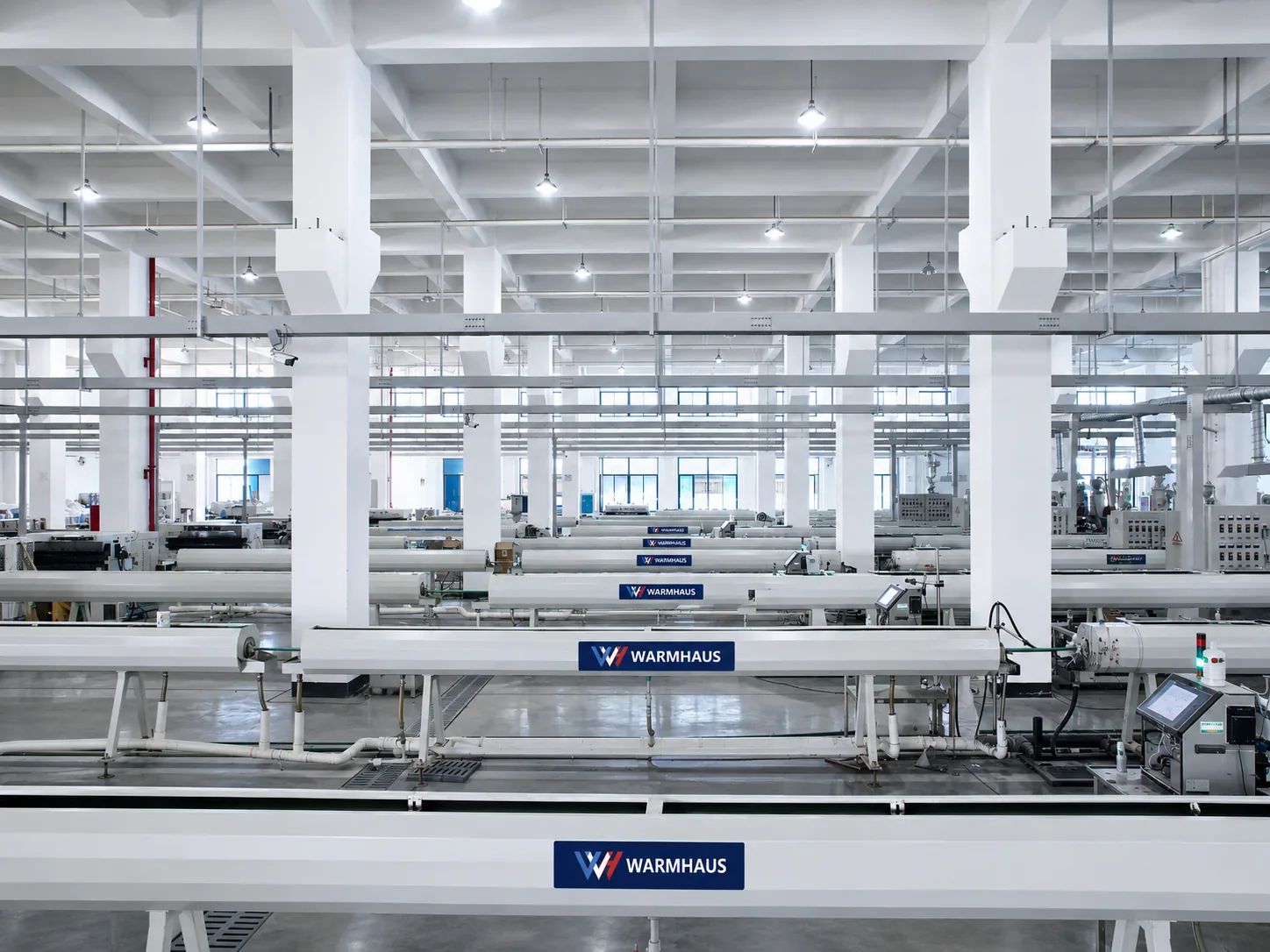
The Fast Test
Ask for the line, not the showroom
A showroom can be rented for a week. A production line cannot. Ask every candidate for a live video walk-through of extrusion and assembly, plus the technical data sheet for one specific SKU — then watch how they respond.
WARMHAUS runs its own extrusion, injection-moulding and machining lines for PPR, PEX and brass in-house, and is set up for exactly this kind of verification.
Book a video tour of our production lines| Signal | Real Manufacturer | Trading Company |
|---|---|---|
| Factory location | Names the specific plant it produces in and lets you see it | Vague, “our factory”, or a different address than the office |
| Certifications | Issued in its own company name (ISO 9001, CE, SGS) | Certificates in someone else’s name, or refuses to show them |
| Technical depth | Provides PN ratings, TDS, material data, test reports | Copies generic specs, can’t answer engineering questions |
| Product range | Deep in one system family it actually makes | Random mix of unrelated products from many sources |
| Audits | Welcomes video tours or on-site visits | Avoids factory visits, only shows a showroom |
| Consistency | Commits to batch-to-batch consistency and stock | Depends on whichever sub-supplier is cheapest that week |
The single fastest test: ask for a live video walk-through of the production line and a technical data sheet for one specific SKU. A real factory says yes without hesitation.
IV. Which Certifications Should a PPR Manufacturer Have?
Certifications are not decoration — for many buyers in the Gulf, North Africa and project tenders, the right marks decide whether your goods clear customs and get specified at all. Check for these, and always confirm they are issued in the manufacturer’s own name and still valid.
- ISO 9001 — Quality Management. Proves the factory runs a documented, audited quality system. The baseline; a manufacturer without it is a hard pass.
- ISO 14001 — Environmental Management. Increasingly required in European and project procurement; signals a mature, compliant operation.
- ISO 45001 — Occupational Health & Safety. Shows the plant manages worker safety to an audited standard — increasingly asked for in European and project procurement alongside ISO 14001.
- Third-party inspection, e.g. SGS. An independent inspection and certification body. Testing by a recognized third party is a stronger signal for PPR than a factory’s own self-declaration, because the material and the process are checked by someone with no stake in the result.
- CE, plus your destination-market marks. CE is the mark that lets your product into the European market and into many tenders at all. Alongside it, check what your own market enforces — requirements differ by country, and a market-specific approval your destination demands is your importer’s responsibility to confirm before you commit.
Ask for scanned certificates plus certificate numbers, then verify them with the issuing body — reputable factories provide these on request, and the serious bodies maintain public registers you can search yourself. WARMHAUS holds ISO 9001:2015, ISO 14001:2015, ISO 45001:2018, EU CE, SGS and Russian PT; certificate numbers are available on request and shared directly with qualified distributors and project buyers. Read how each mark is verified on our certifications page.
Note: your country may additionally require its own destination-market or drinking-water hygiene approval on top of the marks above — confirm exactly what your market demands before you commit to any supplier.
Walk-Away Signals
V. Seven Red Flags That Should End a Supplier Conversation
Some signals are not worth negotiating around — they predict problems after your money has shipped. If you see these, move to the next candidate.
Refuses a factory visit or video tour
The most reliable tell of a trader hiding behind a showroom.
Certificates in another company’s name
Or a “we can get any certificate you want” answer. Either way, the paperwork does not protect you.
A price far below every other quote
Usually thinner walls, off-spec material, or a mix of grades between batches.
No technical data sheet
Can’t or won’t give you PN ratings, dimensions, or material grade for a specific SKU.
Vague or shifting factory address
The office country and the “factory” country don’t match — a classic re-seller footprint.
Pressure to pay 100% up front by an untraceable method
Professional exporters work on documented, standard terms.
Poor, slow, or evasive English on specs
If pre-sale answers are this hard, after-sales will be worse.
None of these on their own proves fraud — but two or more together is your cue to walk. A legitimate manufacturer will pass every one of these without friction. Compare us against this list.
VI. The PPR Pipe Sourcing Checklist (Copy & Reuse)
Run every candidate through the same checklist so you compare like with like. Score each supplier — a real manufacturer should tick every box.
| Area | Checkpoint | What a pass looks like |
|---|---|---|
| Is it a real factory? | i. Names the specific plant it produces in | A named plant you can see on video — not “our factory, somewhere” |
| ii. Offers a live video tour or on-site audit | A yes without hesitation, scheduled within days | |
| iii. Product range is deep in the systems it actually makes | Full depth in its own lines, not a random catalogue | |
| Is it certified? | iv. ISO 9001 and ISO 14001, in its own name | Certificates match the manufacturer’s legal name |
| v. Product/process marks relevant to water systems (e.g. CE, SGS) | Marks your tenders and customs actually recognize | |
| vi. Provides scanned certificates and numbers you can verify | Documents you can check with the issuing body | |
| Can it serve your market? | vii. Ships full containers to your region | Gulf, North Africa, Southern/Eastern Europe, Latin America |
| viii. Provides export documents | Packing list, certificate of origin, certification scans | |
| ix. Confirms any destination-market approvals your country requires | A straight answer about what still needs checking | |
| Is it a good long-term partner? | x. Full system from one source | PPR + PEX + brass + underfloor heating together |
| xi. Options for exclusive distribution or private label | Exclusive territory per market; trial orders with no minimum order quantity | |
| xii. Clear technical support, warranty and after-sales terms | Straight answers in writing on lead time and commercial terms — ours are 45 days standard production lead time and no minimum order quantity |
Request the full checklist as a printable PDF — or see how the WARMHAUS PPR system scores on every box.
VII. Now You Know What to Look For — Let’s Talk
You came here to learn how to find and vet a PPR pipe manufacturer. If you now run WARMHAUS through your own checklist, here is what you’ll find: a manufacturer producing since 1993 on its own extrusion, injection-moulding and machining lines, making PPR, PEX and brass piping plus underfloor-heating systems across a complete product range, certified to ISO 9001, ISO 14001, ISO 45001, EU CE and SGS, shipping to importers, projects and private-label partners across the Gulf, North Africa, Southern and Eastern Europe and Latin America.
We’re happy to be verified the way this guide recommends — a video tour, technical data sheets, certification scans, and a straight conversation about your market.
FAQ Common questions
Finding and Vetting a PPR Pipe Manufacturer — FAQ
Build a longlist from B2B directories, trade fairs and search, then vet each candidate on four points — is it a real factory, does it hold certifications like ISO 9001, CE and SGS, can it supply your target market, and does it offer the full system. Shortlist only factories that pass all four and share technical documents openly.
A real manufacturer names its plant, shows in-house production, holds certifications in its own name, provides technical data sheets, and accepts video or on-site audits. Traders avoid factory visits and quote unrelated products from many sources. The fast test: ask for a live line tour and one SKU’s TDS — WARMHAUS welcomes both.
A certified manufacturer lets you sell on documented compliance instead of the lowest price. Tenders and customs ask for certificates, not origin stories — marks like ISO 9001, ISO 45001, EU CE and SGS are issued by independent bodies rather than self-declared. Add a full PPR + PEX + brass system from one source and you have the positioning importers in the Gulf, North Africa and Southern Europe use to defend their margins.
At minimum ISO 9001 (quality) and ISO 14001 (environmental), plus ISO 45001 for health and safety and the EU CE mark that can decide tender eligibility — then whatever approval your own destination market enforces on top. Confirm every certificate is issued in the maker’s own name and still valid. WARMHAUS holds ISO 9001:2015, ISO 14001:2015, ISO 45001:2018, EU CE, SGS and Russian PT, with certificate numbers available on request.
Yes. A capable factory ships full containers with export documentation — packing list, certificate of origin and certification scans — to the Gulf, North Africa, Southern and Eastern Europe and Latin America. WARMHAUS runs a single English international operation serving importers, projects and private-label partners across all these regions, and mixed containers across PPR, PEX, brass and underfloor heating are possible.
PPR suits hot and cold water supply, PEX is used for underfloor heating, and brass covers the valves and fittings that join and control the system. Distributors who stock all three lose fewer sales to “missing part” gaps. WARMHAUS supplies all three plus underfloor heating — a complete product range from one supplier. See our PPR vs PEX vs copper guide for detail.
Start Here Let’s talk
Run us through your checklist — Talk to WARMHAUS
Video tour, technical data sheets, certification scans and a straight conversation about your market — verified the way this guide recommends. Response time: within one working day.