If you import, distribute or specify piping, you have almost certainly seen the letters CE and SGS on a supplier’s spec sheet — and quietly wondered what they actually prove. Both signal quality, and both are easy to nod along to without really knowing what they cover. This guide explains, in plain English, exactly what the CE mark and an SGS certificate cover, how they differ from a management-system standard like ISO 9001, and why they can decide whether your goods clear customs, enter a retail channel, or qualify for a project tender.
No jargon, no sales pitch — just what a serious buyer needs to know before trusting a certificate. It is written by a manufacturer that holds these certifications itself: WARMHAUS produces PPR, PEX and brass piping systems on its own extrusion, injection-moulding and machining lines, certified to ISO 9001, ISO 14001, CE and SGS — full details on our certifications page.
I. What Is CE Certification?
CE stands for Conformité Européenne — the European conformity mark. It is the declaration that a product meets the requirements of the applicable EU directives and harmonised standards, and it is what allows goods to be placed on the market throughout the European Economic Area. When a pipe or fitting carries the CE mark, it means the manufacturer has established, and can produce on request, the technical file and conformity documentation showing the product meets those European requirements for its intended use.
The reason CE carries weight is simple: it is product-focused and legally anchored. It is not a marketing badge a supplier awards itself in a brochure — it is a regulatory obligation backed by a documented technical file that authorities and buyers can demand to see. For drinking-water and hot-water piping — where a failure means contamination or a burst wall, not just a return — buyers across Europe, Asia and Africa treat the CE mark as the baseline entry requirement. That is why you see it written into tender documents and asked for by importers who need to defend their sourcing to an end client.
A note on specifics: the certificate number, validity and exact product scope of the WARMHAUS CE certification are provided on request — never take any supplier’s scope on faith, ours included.
II. What Is SGS Certification?
SGS is a Swiss-headquartered inspection, testing and certification group and one of the most widely recognised third-party verification bodies in international trade. Where the CE mark is a declaration of conformity with European requirements, an SGS certificate is independent verification carried out by an outside laboratory. For a PPR or PEX pipe, that distinction matters: the polymer, its pressure and temperature behaviour, and its consistency batch to batch are exactly what an independent test house is engaged to check.
SGS certification means the product has been tested by a third party rather than self-declared by the manufacturer. For plumbing wholesalers and project engineers, that is the difference between “the supplier says it’s good” and “an independent international body checked it.” When a manufacturer pairs SGS with the CE mark and the ISO management standards, the quality claim stops being a story and becomes something a customer can actually check — certificate by certificate, against the issuing body. WARMHAUS also holds Russian PT certification for that market. See the full set on our certifications page.
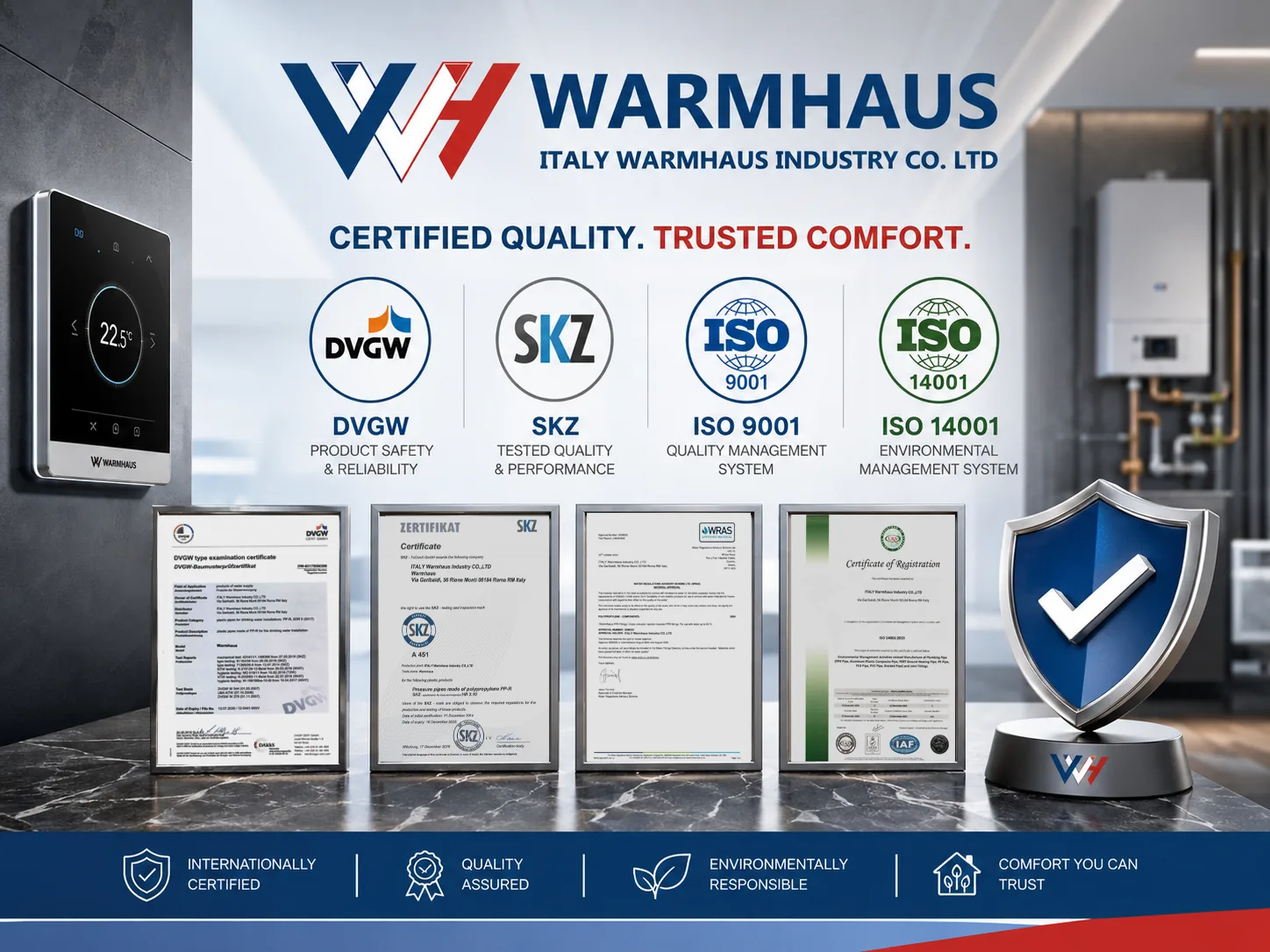
III. ISO 9001 & CE vs ISO 9001 — What’s the Difference?
This is where most buyers get confused, so it is worth being precise. ISO 9001 certifies a company’s quality-management system — how it documents processes, controls inputs and handles corrections. It is essential, but it certifies the way a company works, not any single product. The CE mark and SGS testing work at product and material level — they address the actual pipe against safety, hygiene and performance requirements. The cleanest way to hold them in your head:
| Certification | What it certifies | Focus | What it proves to a buyer |
|---|---|---|---|
| ISO 9001 | Quality-management system | The company / process | Reorders will be consistent; the firm is run to a documented standard |
| ISO 14001 | Environmental-management system | The company / process | Environmental controls are documented — often required in tenders |
| EU CE | Conformity with EU directives | The product | The pipe may legally be placed on the European market for its intended use |
| Swiss SGS | Third-party inspection & testing | The product / material | The product was checked by an independent international test house, not self-declared |
These certifications are not interchangeable — they stack. ISO 9001 tells you the factory is disciplined; CE and SGS tell you the specific pipe is compliant.
A supplier that holds all of them — as WARMHAUS does, with ISO 9001, ISO 14001, ISO 9001 for the process and EU CE for the product — covers both sides, which is exactly what a cautious importer or project buyer wants to see before committing. You can read how each one is applied on the factory floor on our quality-control page.
IV. Why Piping Certifications Matter for Projects & Imports
Certifications are not a wall decoration — for a B2B buyer they are working documents that move a deal forward or stop it dead. Here is where CE marking and SGS testing earn their keep in the real world:
- They de-risk the product. Drinking-water piping fails expensively — leaks inside walls, contamination, warranty claims across a whole shipment. A CE-marked, SGS-tested pipe has been assessed against recognised requirements for exactly the failure modes a distributor gets returns on, which is why certified sourcing protects your brand as much as your buyer’s building.
- They are verifiable, unlike a story. An origin claim is asserted; a certificate is issued by a named body and carries a reference, an issue date and a defined product scope. A buyer can take those details back to the issuing body and confirm them rather than taking the supplier’s word. For an importer selling against cheap uncertified stock, that check — not a marketing narrative — is what proves the premium is earned.
- They unlock channels. Plumbing counters, building-materials chains and large developers increasingly ask for third-party certification before they stock or specify a pipe. Certifications are what get you onto the shelf and into the drawing.
These are general truths of the trade, not claims about any single project. To see how certified systems enter real building supply, visit our project supply page — specific case references are published as they are cleared for release.
V. What ISO 9001 & CE Mean for Tenders & Customs
Translated into the two moments where buyers actually feel the pressure — clearing a container and qualifying for a tender — this is what these certifications do:
i. At customs and market entry
Importers routinely need certification copies alongside their commercial and origin documents to clear goods and satisfy retail-channel requirements. CE documentation and SGS reports help demonstrate that the piping conforms to European requirements and has been checked against recognised standards — useful for importers across the Gulf, North Africa, Southern and Eastern Europe, and Latin America who must show buyers and authorities the product is compliant.
ii. In project tenders
MEP contractors and developers frequently set certified, compliant piping as a hard prequalification requirement. CE- and SGS-backed products give a project buyer the documentation to specify a system into a building tender and pass the consultant’s or client’s pre-award review — instead of being disqualified for an incomplete compliance file.
The practical rule for buyers: ask for the certificate copies before you commit, and check the issuing body and the product scope, not just the logo. A supplier that can hand over ISO 9001, ISO 14001, CE and SGS copies on request — with issuing details and validity — is a supplier whose compliance will survive your customer’s scrutiny.
VI. The Bottom Line: Read the Certificate, Not Just the Logo
ISO 9001, CE and SGS are not marketing badges — they are the documents a serious buyer actually reads. The CE mark shows a pipe may legally be placed on the European market for its intended use; an SGS certificate shows the product was checked by an independent international test house rather than self-declared; and ISO 9001 shows the company behind them is run to a documented standard. Together they let a buyer trust a pipe without taking the seller’s word for it. The next time a supplier claims certification, do the professional thing: ask for the certificate copy, confirm the issuing body, and check what product it covers.
WARMHAUS builds these certifications into every system it ships — a manufacturer with its own extrusion, injection-moulding and machining lines, producing since 1993, certified to ISO 9001, ISO 14001, CE and SGS, with certificate copies available to importers, distributors and project buyers on request.
- See WARMHAUS certifications & request the Certificate Pack → Certifications
- See how certified piping goes into real projects → Project Supply