Dezincification is the one brass failure mode that does not announce itself. A fitting under attack holds pressure for years while the zinc is stripped out of the alloy, leaving a porous copper skeleton that looks like brass and has almost none of its strength. Then a thread shears at normal torque, or a bore blocks with white debris, or a body splits with nothing to blame. It is governed by alloy chemistry and water chemistry together, and it is preventable at the specification stage — worth understanding before an order rather than after a claim.
Everything below is general industry guidance on a documented corrosion mechanism, not a WARMHAUS-specific specification or a test result — always confirm against the datasheet of the fittings you are buying and your water authority’s published analysis before committing an alloy to a project. Our guide to brass fittings for plumbing systems covers the range itself.
I. What Dezincification Actually Is
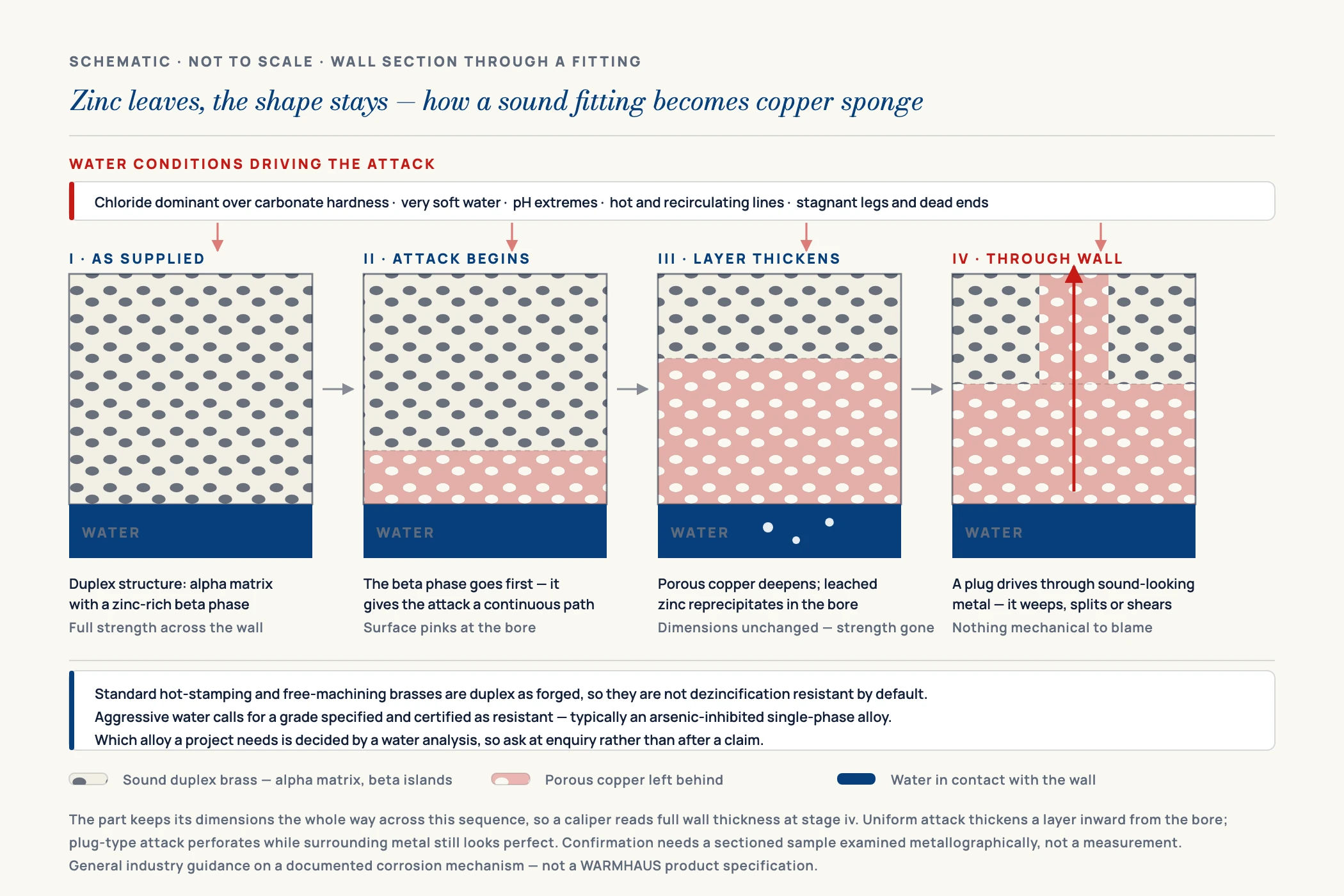
Brass is a copper-zinc alloy. Dezincification is selective leaching: zinc is preferentially removed while the copper stays behind. Zinc is the less noble metal, so in the presence of an electrolyte — water — it dissolves first. What remains is a porous, spongy copper residue occupying the same volume as the sound alloy. The part keeps its dimensions. It loses its strength almost completely.
The fitting does not shrink, and it does not visibly corrode. It simply stops being metal on the inside.
Two patterns are recognised. Uniform (layer) dezincification attacks the wetted surface evenly, producing a thickening pink layer that eats inward from the bore. Plug-type dezincification is more dangerous: it drives a localised plug deep into the wall while the surrounding metal looks perfect, and it perforates. A wall that measures full thickness with a caliper can be copper sponge in the middle of sound brass.
II. Which Alloys Are at Risk
Susceptibility is decided by structure. Brasses above roughly 15 % zinc are generally at risk, and the risk rises sharply once the microstructure becomes duplex — containing both an alpha and a beta phase. The zinc-rich beta phase dezincifies preferentially and rapidly, giving the attack a continuous path through the section. Single-phase alpha brasses dezincify far more slowly, and are the starting point for any resistant grade.
The two grades that dominate plumbing hardware are CW617N, the standard hot-stamping brass used across fittings and valve bodies, and HPb57-3, a comparable free-machining leaded brass. Both are duplex as forged — which is why neither should be assumed dezincification resistant unless the supplier states specifically that it is. In a market with aggressive water, that discussion belongs before the quotation.
Two routes deliver resistance. Inhibition adds a small amount of arsenic to an alpha brass, suppressing the leaching mechanism. Structural control adjusts composition and applies heat treatment so the beta phase is largely eliminated. Both need process control at the mill — the real reason DZR carries a premium.
III. Water Conditions That Trigger Attack
Alloy alone does not cause dezincification; water does. The same CW617N fitting can run for decades in one city and fail early in another.
| Water characteristic | Lower risk condition | Higher risk condition | Why it matters |
|---|---|---|---|
| Chloride content | Low chloride, low salinity | Elevated chloride, coastal or desalinated supply | Chlorides break down the protective film |
| Chloride-to-carbonate ratio | Carbonate hardness dominant | Chloride dominant over carbonate hardness | Carbonate builds protective scale; chloride works against it |
| Total hardness | Moderate to hard water | Very soft or demineralised water | Soft water deposits little scale |
| pH | Neutral to mildly alkaline | Acidic water, or strongly alkaline water | Both extremes destabilise the surface film; no single threshold value applies |
| Temperature | Cold service | Hot water and recirculating hot lines | Rate of attack rises with temperature |
| Oxygen and CO₂ | Low dissolved gas, closed system | High dissolved oxygen and free carbon dioxide | Dissolved gases sustain the corrosion cell |
| Flow regime | Regular flow, well-flushed | Stagnant legs, dead ends, seasonal buildings | Stagnation concentrates aggressive species |
| Disinfection residual | Controlled residual chlorine | High or fluctuating chlorination | Adds to the chloride load |
Conditions above are general industry guidance, not a WARMHAUS-specific specification and not a substitute for a water analysis. Risk depends on the combination of factors, not any single value. Always confirm against the datasheet of the fittings used and a current analysis of the water they carry.
A warning about how to read that table: it is a set of directions, not a set of pass/fail thresholds. Dezincification risk is not triggered by any one parameter crossing a published number — it emerges from the combination, chiefly the balance between chloride and carbonate hardness, modified by temperature and stagnation. Be sceptical of any source, including a supplier’s datasheet, that offers a single trigger value for pH or chloride and invites you to screen a water report against it. Where a genuine numerical assessment is needed, that is work for a corrosion engineer with the full analysis in front of them, not a line in a buying guide.
Two patterns drive most of the commercial questions we get. Coastal and desalinated supplies — common across the Gulf and North Africa — combine elevated chloride with variable hardness, the classic higher-risk case. And hot water recirculation raises the risk on any water, which is why a project can run standard brass on the cold side for years and lose fittings on the hot return.
IV. How Failures Present on Site
Dezincification is usually diagnosed late, because its early signs get read as something else. Below is the sequence roughly in the order complaints arrive.
Pink or copper-coloured patches on a yellow fitting
The earliest and most direct indicator. Where zinc has been leached the surface takes on the reddish colour of the copper left behind, showing on a cut section as a distinct band inward from the wetted surface. A yellow fitting turning pink at the bore is not tarnish — it is the alloy changing composition, and the depth of that band measures how far the attack has gone.
White or greenish powdery deposits blocking the bore
Known as meringue dezincification: the leached zinc reprecipitates downstream as a bulky deposit that restricts flow, fouls cartridge inlets and seizes valve mechanisms — usually reported as low pressure, or a mixer gone stiff. If you find it, look upstream for the fitting losing its zinc rather than replacing the component that seized.
Threads that shear at normal tightening torque
A thread on a dezincified body has lost most of its strength while keeping its dimensions, so it strips or snaps under a torque it would have carried when new. This is how a latent failure usually surfaces during unrelated maintenance — and it is often misread as installer error.
Weeping or splitting with no mechanical cause
Plug-type attack perforates. A body that has neither frozen, been over-torqued nor been struck weeps or splits, because the wall there is porous copper. Failures that cluster on one water system and one alloy — rather than one installer’s work — point to material rather than workmanship.
Failures concentrated on hot lines or dead legs
The distribution of failures is diagnostic in itself. Attack appearing first on hot water returns, on infrequently used branches, or in a building empty half the year matches the temperature and stagnation rows above.Alloy and material documentation: available on request.
V. Prevention: What to Specify Before You Order
Prevention is a specification exercise, and almost all of it happens before a purchase order exists. Four decisions cover the risk.
I. Get a water analysis before you choose an alloy
The step most often skipped, and the cheapest. Chloride content, carbonate hardness, pH and temperature together decide whether standard brass is reasonable for a market or a liability. Most water authorities publish an analysis; for a project, the client’s own is better. Specify the alloy against the water, not the price list.
II. Ask for dezincification resistance as a stated property
“Brass fitting” is not a specification. Ask the supplier to state the alloy designation, whether the material is supplied as dezincification resistant, and which route delivers it — inhibited alpha brass, or heat treatment suppressing the beta phase. A supplier who answers in those terms is working from real material documentation. One who says “good quality brass” is not.
III. Ask how resistance is verified, and on what sampling basis
Resistance is verified by a recognised laboratory method that exposes a prepared sample to a corrosive solution for a defined period at a defined temperature, then sections it and measures the maximum depth of dezincification under a microscope against an acceptance limit expressed in micrometres. The method most often cited in this field is ISO 6509, the standard test for dezincification resistance of copper alloys; some markets add their own variant or acceptance criteria on top of it.
What matters commercially is not that a test exists but how often it is run and on what — per melt, per lot, or once at type approval years ago. So ask two separate questions and expect two separate answers: which method and acceptance limit, and what is the sampling rule. Then ask what documentation actually accompanies a shipment, because the honest answer from many suppliers is a mill certificate for composition plus a type-test report, not a lot-by-lot corrosion test. That may be perfectly adequate — but you should know which of the two you are buying before the container ships, not after a failure.
IV. Keep alloy traceability from bar to carton
Resistant material only protects a project if the resistant parts reach it. Where a factory runs several brass grades through the same lines, the control that matters is segregation and lot traceability — bar stock identified on arrival, kept separate through machining, and carried to a lot mark that traces a carton back to a melt. Without that chain, a DZR specification is a statement of intent. Ask any prospective supplier to walk you through that chain concretely — where the grades are separated, what the lot mark is, and what record sits behind it — and compare the answer against their wider quality control process.
Material selection is not the only lever, either. Eliminating dead legs, avoiding unnecessary recirculation temperatures and flushing idle systems all reduce the load on the fitting — no substitute for the right alloy, but useful in marginal cases.
VI. Dezincification and the Other Two Brass Failure Modes
Dezincification is worth separating from the two problems it gets confused with: prevention differs for each, and specifying against the wrong one wastes money.
| Failure mode | What drives it | How it presents | Primary prevention |
|---|---|---|---|
| Dezincification | Zinc leached by aggressive water chemistry | Pink layer, white deposits, strength lost at full dimensions | Resistant alloy chosen against a water analysis |
| Stress corrosion cracking | Tensile stress plus ammonia or amine exposure | Intergranular cracks near threads or forged transitions | Stress-relief annealing; control the ambient environment |
| Erosion corrosion | Excessive velocity, turbulence, entrained solids or air | Horseshoe grooves and scouring downstream of restrictions | Design velocity limits; correct bore sizing |
Comparison above is general industry guidance for diagnosis, not a WARMHAUS-specific specification. More than one mechanism can act on the same component.
The practical point for a buyer: a dezincification-resistant alloy is not immune to the other two. A DZR body at excessive velocity still erodes; in an ammonia-rich plant room it still cracks. In a warranty conversation, establishing which mechanism is at work comes first — and that needs a sectioned sample, not a diagnosis from photographs.
VII. Specifying Brass With a Manufacturer
Most of the above comes down to one question: can your supplier tell you what alloy you are buying, and prove it for the lot in the container? WARMHAUS is a manufacturer of PPR, PEX and brass piping systems — not a trading company. The machining lines producing our brass pipe fittings and the rest of the brass piping system are our own, and the raw material is stated rather than left vague: CW617N and 57-3 brass. Both are the standard leaded machining brasses described in Section II — and, to be explicit about it, neither is a DZR-designated grade. If the water analysis for your market sits in the higher-risk band of the table above, what you need is an alloy specified and certified as dezincification resistant, typically an arsenic-inhibited single-phase grade such as CuZn36Pb2As (CW602N). Ask that question at enquiry rather than after the first claim: we would rather tell you what we run and what it is not than let a specifier discover it three years into a coastal installation.
Manufacturing since 1993 across three plants totalling 100,000 m², ISO 9001 / ISO 14001 / ISO 45001 certified, EU CE marked and SGS tested. No MOQ — which matters when you want to trial a range in one market before committing volume. Standard lead time is 45 days from confirmed order. Request alloy specifications, material documentation and distributor terms — and if dezincification resistance is a requirement in your market, say so in the first message: it decides whether we are the right supplier for that particular line. Certificate documents: available on request.