Ask ten specifiers whether a stainless steel underfloor heating manifold beats a brass one and you will get ten confident answers pointing in both directions. The honest answer is that both bodies carry hot water reliably when made properly, and the decision is settled by four practical variables instead: water chemistry on site, the accessory ecosystem the body was designed around, the port range you actually sell, and landed cost per manifold. This guide compares them on those terms, so an importer can decide what belongs in the warehouse rather than argue metallurgy.
Across the Middle East, North Africa, Southern Europe and Latin America, hydronic underfloor heating is specified by contractors who buy on availability and price, and serviced years later by installers who buy on what fits. A body that cannot be matched to actuators, thermostats and floor-loop pipe from one source creates an expensive problem long after the invoice is paid. Everything technical below is general industry guidance — confirm figures against the datasheet of the manifold and pipe you are buying.
I. What the Manifold Body Actually Has to Survive
A hydronic underfloor heating manifold is not a high-pressure component. It sits on a closed circuit at flow temperatures well below those of a radiator system, splitting one supply into several floor loops and collecting the returns. The stresses that actually shorten its life are mundane: thermal cycling, corrosion driven by water chemistry in a circuit that was never properly flushed, galvanic interaction where dissimilar metals meet at the connections, and mechanical load from pipework hung off the outlets instead of properly clipped.
Manifolds rarely fail because the metal was wrong. They fail because the water was dirty, the circuit was never flushed, or the accessories never really fitted.
That reframes the question. Neither metal fails under normal closed-circuit conditions in the way a buyer imagines. What differs is how each behaves at the margins — aggressive water, chloride content, oxygen ingress through non-barrier pipe — and how each is built into a system around it. If you are mapping the component set, the underfloor heating manifold range shows how bars, valves, brackets and gauges should arrive as a matched set rather than a parts hunt.
II. The Case for a Stainless Steel Manifold
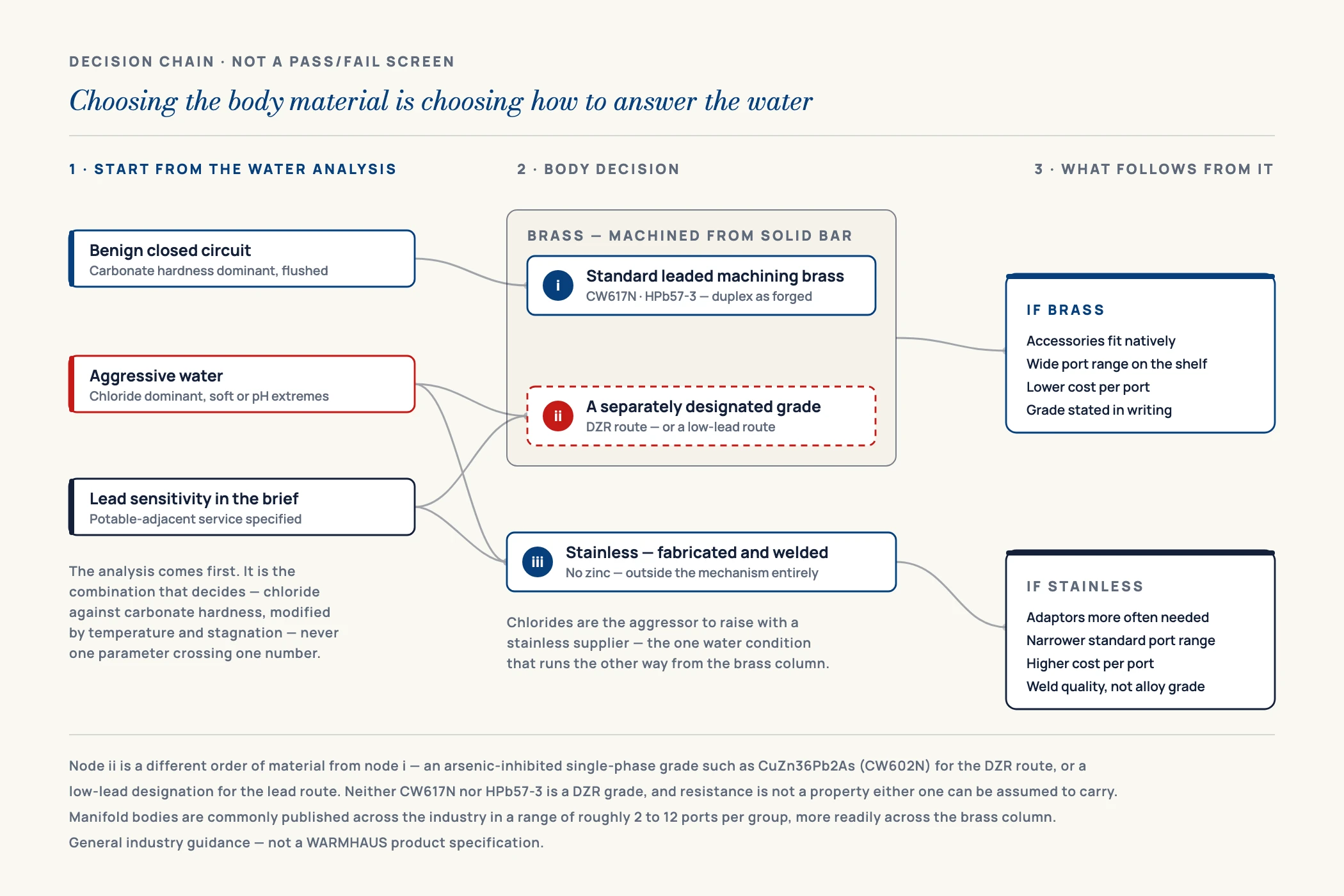
Stainless steel bodies earned their reputation on corrosion behaviour and lead-free composition. Be precise about the first, because it is routinely oversold: dezincification is the selective leaching of zinc out of a zinc-bearing alloy, so austenitic stainless is not resistant to it — it is simply outside the mechanism, having no zinc to lose, in the same way a plastic pipe is not “resistant” to galvanic corrosion. That is a genuine difference in failure modes, not an extra layer of protection, and a correctly specified dezincification-resistant brass is not exposed to the mechanism in service either. The stronger and simpler stainless argument is composition: austenitic stainless contains no lead at all, which removes an entire conversation on potable-adjacent installations.
A smaller second argument is weight, and it is worth stating the reason correctly. A fabricated stainless bar is usually lighter than a machined brass bar of equivalent port count, but that is structural, not metallurgical: the densities are close (stainless around 8.0 g/cm³ against roughly 8.4–8.5 for brass), so nothing meaningful comes from the material itself. The weight comes from how each is made — thin-walled tube and sheet welded into a hollow body, versus a body turned from solid bar that retains more metal. Change the wall thickness and the comparison changes with it, which is why it rarely decides a purchase.
The trade-offs are equally real. Stainless manifolds are typically fabricated and welded rather than machined from solid bar, so the quality question moves from alloy grade to weld integrity and internal finish. Chloride content in the circuit water is the failure mode to ask about — chlorides are the classic aggressor for stainless in a way they are not for brass. Commercially, the accessory ecosystem is thinner: flow meters, actuator adaptors and end fittings are more often sourced from a different maker than the bar itself — exactly the fragmentation an importer is trying to avoid.
III. The Case for a Brass Manifold
Brass bodies dominate the installed base for unglamorous reasons. The first is machinability. A brass manifold is typically turned from solid bar, so ports, threads, seats and the flow-meter housing are cut into one continuous piece of metal with no weld seam in the pressure envelope. Dimensional control becomes a machining tolerance rather than a fabrication tolerance — the same reason our own machined brass manifolds are produced on in-house turning lines.
The second is the accessory ecosystem, which for a distributor usually decides the question. Brass bodies are the format that actuators, thermostatic heads, flow meters, air vents, drain valves and mounting brackets were designed around. Standard connection formats let an installer replace a failed actuator years later without hunting for a proprietary adaptor.
The third is alloy control, where the real diligence sits — and this is where most buyers accept a vaguer answer than they should. Brass is not one material, and three separate properties get collapsed into the word “brass”: lead content, dezincification resistance and machinability. They are not the same axis, and a grade can be good on one and ordinary on another.
Start from what the standard designations mean, since these are the codes that belong in a purchase order. CW617N (CuZn40Pb2) is the workhorse hot-stamping and machining brass across European plumbing hardware — and it is a leaded alloy, with lead typically in the region of 1.6–2.5% added deliberately as a machining aid. It is not a low-lead grade, and any supplier implying otherwise is worth a second question. Where low lead is required, the market moves to separate designations — the CuZn21Si3P silicon brasses (such as CW724R) and the low-lead CuZn grades developed for potable service — while dezincification resistance is its own property again, marked DZR or CR and achieved through alloy chemistry and heat treatment, as in the arsenical CW602N (CuZn36Pb2As).
So ask three questions rather than one: which designation is the body machined from, what is its lead content, and is it dezincification-resistant? A manufacturer that machines its own bar answers all three immediately; a trader answers the first vaguely and the other two not at all. To be equally concrete about our own position: our brass programme runs on 57-3 and CW617 brass, both of which are leaded machining alloys, and a low-lead option is available as a separate grade — not as a property of those two. The designation supplied against any given line is confirmed on its datasheet, and we would rather put it in writing than have it assumed. The alloy comparison is set out in detail in our guide to CW617N versus HPb57-3 brass, and the corrosion mechanism in dezincification in brass fittings.
IV. Stainless Steel vs Brass Manifold — Side by Side
The table sets the two bodies against each other on the criteria that change a purchase decision. These are general industry characteristics of the two body types, not a specification of any single product, and they describe well-made examples of each — a poorly welded stainless bar or an unsuitable brass alloy will underperform both columns.
| Criterion | Stainless steel manifold | Brass manifold | What it means for the buyer |
|---|---|---|---|
| Construction | Usually fabricated and welded from tube or sheet | Usually machined from solid bar | Weld integrity is the stainless quality question; alloy grade is the brass one |
| Corrosion behaviour | Strong general corrosion resistance; outside the dezincification mechanism entirely (no zinc); chlorides are the aggressor to check | Strong in closed circuits; specify a dezincification-resistant grade for aggressive water | The two have different failure modes, not better and worse — match the body to site water chemistry |
| Lead content | Lead-free by composition | Depends on alloy — low-lead grades available | Ask for the alloy designation in writing before ordering |
| Weight per port | Generally lighter — thin-walled fabricated body | Generally heavier — solid turned body | A construction difference, not a density one; marginal freight effect and rarely decisive |
| Accessory compatibility | Narrower ecosystem; adaptors more often needed | The format most actuators, flow meters and heads are built around | Decides how easily the system is serviced in year five |
| Port range availability | Commonly offered in a narrower standard range | Commonly offered across a wide port range | Affects how many jobs one stocked line can cover |
| Typical unit cost | Generally higher per port | Generally lower per port | Compare landed cost with accessories included, not bar price alone |
| Field familiarity | Less common in many installer markets | The default installers expect and know how to service | Drives return rates, support load and repeat orders |
Values are general industry guidance, not a WARMHAUS-specific specification. Actual corrosion performance, weight, port range and pricing vary by manufacturer, alloy or steel grade, and product line. Always confirm against the technical datasheet of the manifold and pipe you are buying.
Request the manifold specifications and current price list — port range, brass grade, flow-meter options and distributor terms for your market.
V. How to Choose — Four Questions That Settle It
Strip away the metallurgy and the decision comes down to a short list of questions. Most buyers reach a clear answer by the third.
What is the water actually like?
If the circuit water carries significant chloride content, raise that with a stainless supplier. If it is aggressive in other ways, that is the case for a dezincification-resistant brass grade rather than an unspecified one. Either way the answer is a written designation, not a reassurance. Ask for the grade in writing.
Can you buy the accessories from the same source?
A manifold bar on its own is not a sellable product. Actuators, flow meters, heads, brackets, air vents and drain valves have to fit it and be re-orderable years later. If body and accessories come from different suppliers, you own the compatibility risk — and so does every installer who buys from you. Quote the assembled system, not the bar.
Does the port range cover what you actually sell?
Count the jobs you quote in a normal quarter. Most residential work lands between three and six loops, while villa and small commercial floors run higher. Manifold bodies are commonly offered across roughly 2 to 12 ports per group as general industry practice, so one well-chosen body design can answer most of an enquiry mix from a single stocked line. Our manifold sizing guide works through how to convert a loop count into a port count. Match the range to your enquiry mix.
What is the landed cost of a complete, fitted manifold?
Compare like with like: body, valves, brackets, end caps, flow meters if specified, plus freight and duty — not the headline price of a bare bar. A cheaper body needing a proprietary adaptor on every actuator is not cheaper. Price the assembly, delivered.
And one that is not about material at all
Whichever body you choose, the circuit has to be flushed clean and kept sealed against oxygen ingress by barrier pipe. More manifolds are ruined by construction debris than by the wrong metal. Commissioning discipline outranks material choice.
VI. Where the Two Bodies Realistically Sit in a Distributor’s Range
Most importers in our markets do not stock both. They stock the body the local installer base already knows, and special-order the other when a specifier insists. In the Middle East, North Africa, Southern Europe and Latin America that default is overwhelmingly brass — not because stainless is inferior, but because the accessory and service culture is built around brass connection formats.
The stainless case gets stronger where a project specification names it explicitly, or where the client is sensitive about lead content. Those are real segments, simply narrower than the brass base, and they usually arrive as project-specific orders rather than shelf stock. If you are structuring the shelf, the complete product range shows how a manifold programme sits alongside floor-loop pipe, controls and fittings so one container covers a system rather than a component.
VII. What WARMHAUS Supplies — and What We Do Not
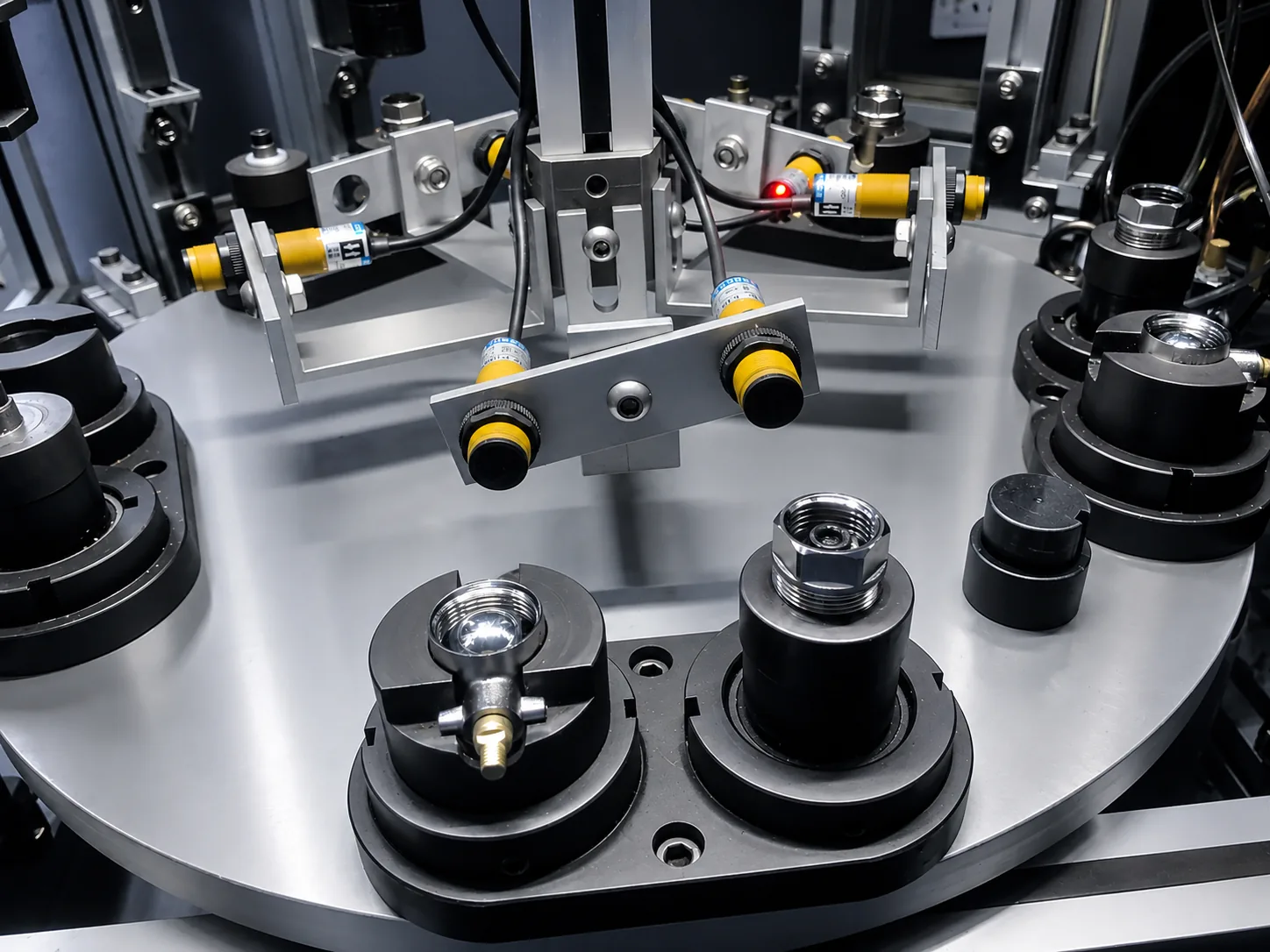
A comparison guide from a manufacturer is only useful if it says where the manufacturer stands. WARMHAUS builds brass manifolds. We are a manufacturer of PPR, PEX and brass piping systems, not a trading company — the machining lines are our own, and manifold bodies are turned from solid 57-3 and CW617 brass, with a low-lead option. We do not produce stainless steel manifolds, and this guide is not an attempt to talk you out of one if your specification calls for it.
What we do offer is what decides most of these purchases: the whole system from one source. Machined brass manifolds with a flow-meter version, the PEX floor-loop pipe that connects to them, the actuators and thermostats on top, and the brass fittings and ball valves around them — specified against each other rather than averaged across three suppliers. Manufacturing since 1993, ISO 9001 / ISO 14001 / ISO 45001 certified, EU CE marked and SGS tested, certificates available on request. There is no MOQ, so a first order can be a trial mix rather than a container commitment, and the standard lead time is 45 days from confirmed order.
Tell us your market and the port counts you quote most often, and we will send manifold specifications, the brass grade, certifications and distributor terms. Pricing, alloy designations and certificate documents — available on request.