Every other part of a radiant floor can be replaced. The manifold sits in a cabinet, the actuators unscrew, the thermostat comes off the wall — but the loop pipe is buried in screed for the life of the building. That single fact should govern how you specify it: a pipe costing a few cents less per metre saves a rounding error on the order and risks a floor that has to be opened up. This guide is written for the person signing the purchase order — what the letter after PEX actually means, why the oxygen barrier is not optional in a closed circuit, how diameter and wall thickness interact with loop length, and which lines on a technical data sheet decide the answer.
Two audiences read a page like this. The importer or distributor is deciding what to stock — which diameters cover the market, how many coils fit a container, whether the pipe connects to the manifolds already in the warehouse. The installer is deciding what unrolls without fighting back and survives a pressure test before the pour. Both questions come down to the same specification sheet, read from different ends. All figures below are general industry guidance for planning; the binding numbers are on the technical data sheet of the pipe you actually buy.
I. PEX-A, PEX-B, PEX-C: What the Letter Means
PEX is cross-linked polyethylene. Cross-linking bonds the polymer chains to one another, turning a thermoplastic that would soften and creep at heating temperatures into a material that holds pressure at elevated temperature for decades. The letter does not grade quality — it names the method used to create the cross-links, and the methods differ in process, not in whether the finished pipe suits radiant duty.
PEX-A is cross-linked with peroxide while the polymer is still molten, during extrusion. PEX-B is silane cross-linked, the reaction completed after extrusion in a warm, moist environment. PEX-C is cross-linked by electron beam irradiation after the pipe is formed. Each route reaches a different typical degree of cross-linking and handles slightly differently on site — but all three are manufactured to the same dimensional and performance standards for heating pipe.
That degree of cross-linking is the one line on a PEX specification that is objectively measurable and independently auditable, which makes it worth understanding. It is expressed as a percentage of gel content, measured by solvent extraction, and the product-standard framework for PEX pipe sets a different minimum for each route, because each route reaches a different level. As general industry reference values, the commonly cited minima are:
| Type | Cross-linking route | Minimum degree of cross-linking | Practical note |
|---|---|---|---|
| PEX-A | Peroxide, during extrusion | ≥ 70 % | Highest minimum of the three; most flexible, heat-repairable |
| PEX-B | Silane, completed after extrusion | ≥ 65 % | Cure conditions after extrusion decide whether the figure is met |
| PEX-C | Electron beam irradiation | ≥ 60 % | Uniformity through the wall depends on beam control |
Minimum cross-linking percentages are general industry guidance drawn from the widely used product-standard framework for PEX pipe, not a WARMHAUS specification. Required minima and the applicable test method should be confirmed against the current edition of the product standard applying in your market. Always confirm the measured figure against the test report for the pipe you are buying.
A lower minimum is not a lower quality pipe — the figures differ because the processes differ, and each is set at the level that route needs to deliver the same long-term performance. What matters commercially is simpler: a supplier should be able to produce a test report stating the measured gel content for the pipe you are buying, with the cross-linking method stated next to it. A report quoting 66 % is a pass for silane and a failure for peroxide, so a percentage without its method attached tells you nothing. Under-cured silane pipe is the classic failure mode on the PEX-B side, and it is invisible on a pallet. Ask for the figure, not the letter. The three routes are compared in more depth in our guide to PEX-A vs PEX-B vs PEX-C.
The letter after PEX describes how the cross-links were made, not how good the pipe is. Buy against the data sheet, not against the letter.
Where the letter does matter in practice is flexibility, coil memory and repair behaviour. PEX-A is the most flexible of the three and is commonly described as having thermal memory: that is what supports the expansion-fitting joining method, and it means a kink can usually be heat-repaired with a hot-air gun rather than cut out. PEX-B is typically stiffer in the hand and retains more coil memory — it springs back toward the coil radius as it is unrolled, so it needs more clips or staples to hold a set-out, and it is the more awkward of the two to lay single-handed on a large floor. A kink in PEX-B is generally cut out and the section re-run, not heat-repaired. PEX-C sits between the two. Neither behaviour makes a pipe unsuitable for radiant duty; they change labour and fixing density, which is a site-planning question rather than a quality one. None of this changes the rule that a correctly designed floor has no joints at all inside the screed: every loop runs continuous from manifold flow port to return port. If your layout requires a buried joint, the loop is too long or the coil too short — a design problem, not a fitting problem.
WARMHAUS manufactures PEX-B covered pipe for underfloor heating on its own extrusion lines. We do not claim one cross-linking route outperforms another — that is a debate the data sheet settles pipe by pipe.
II. The Oxygen Barrier — the Line You Do Not Skip
A radiant floor is a closed circuit, and what quietly destroys closed circuits is oxygen. Bare polyethylene is permeable: oxygen diffuses through the pipe wall into the heating water, where it attacks every metal component the circuit touches — pump body, boiler heat exchanger, steel fittings, manifold. The pipe is unharmed. Everything metal downstream is not.
The answer is a covered pipe with an oxygen-barrier layer — a co-extruded or applied layer, usually EVOH, built into the pipe wall to limit diffusion. Barrier pipe for closed heating circuits is commonly specified against the DIN 4726 diffusion limit, and that limit is a public number worth quoting in an enquiry: as a general industry reference, oxygen permeation is required not to exceed 0.32 mg per litre of water per day at 40 °C — the figure is also seen expressed per square metre of pipe surface per day, so check which basis a datasheet is using before comparing two of them. Some markets and specifications additionally quote a tighter figure at 80 °C.
Two things follow. First, “oxygen barrier” on a price list is a claim, not a specification — the meaningful question is whether the pipe is stated to meet the DIN 4726 limit and whether there is a test report behind it. Second, the barrier is a thin layer in the wall, so it can be compromised by rough handling, prolonged UV exposure or over-tight clipping; store coils covered and out of direct sun. The exact construction and measured diffusion figure for any given pipe belong on its technical data sheet — ask for it, in writing, at enquiry stage. The subject is covered in full in our explainer on the PEX oxygen barrier.
Two buying consequences follow. First, never substitute plumbing PEX for heating PEX because the price list looks better — potable-water PEX is frequently supplied without a barrier, and it looks identical on a pallet. Second, if installers in your market mix brands mid-project, check that every coil in the warehouse is barrier pipe: a single non-barrier loop feeds oxygen to the whole circuit. This is the one line on the data sheet where “close enough” has no meaning — the pipe either has the layer or it does not.
III. Selection Table — Reading a PEX Heating Pipe Specification
Run this checklist down before a purchase order goes out. Left column is the specification line, middle is what it controls on site, right is typical general industry practice for underfloor heating loops. A planning reference, not a product datasheet.
| Specification line | What it controls | General industry practice — UFH loops |
|---|---|---|
| Cross-linking type | Process route; coil handling and joining method | PEX-A / PEX-B / PEX-C all used; state the class you require |
| Oxygen barrier | Corrosion protection for pump, boiler, manifold | Barrier pipe required for closed circuits; DIN 4726 commonly referenced |
| Outside diameter | Flow capacity, pressure drop, bend radius | 16 mm is the mainstream residential loop size; 20 / 22 mm for long or high-load loops |
| Wall thickness | Pressure rating and internal bore | 2.0 mm is the common wall on 16 mm heating pipe |
| Application class | Duty the pipe is designed against | ISO 10508 Class 4 covers underfloor heating and low-temperature radiators; Class 5 is higher-temperature radiator duty — state the class, see the table in section IV |
| Operating temperature | Whether the pipe suits the heat source | Design temperature comes from the class, not a single headline number. UFH flow is typically 35–45 °C; Class 4 design temperature is 60 °C |
| Malfunction temperature | Short-duration fault condition, hours-limited | Class 4: 100 °C for 100 h total over the design life. Not a continuous rating |
| Working pressure | Test pressure and system margin | Stated as a PN class at a stated temperature; derate for hot service per the TDS |
| Design life reference | Basis of the long-term rating | 50 years total, but apportioned across a temperature profile — not 50 years at peak. See the class table in section IV |
| Minimum bend radius | Whether the pipe turns at the loop end without kinking | Expressed as a multiple of outside diameter; stated on the TDS |
| Coil length | Loop layout — one coil should cover one loop | Match coil length to your longest planned loop plus tails |
| Pipe marking | Traceability, site inspection, tender compliance | Printed line with size, class and metre marks |
Values are general industry guidance, not a WARMHAUS-specific specification. Standards are cited as public industry references only. The binding temperature, pressure, bend radius and barrier figures are those printed on the technical data sheet of the pipe you are buying — always confirm against it before you specify or install.
If you want the corresponding lines for our own pipe, request the PEX-B technical data sheet and coil specification — sizes, barrier construction, coil lengths and packing data, with certificate copies available on request.
IV. Application Class — the Line That Actually Sets the Rating
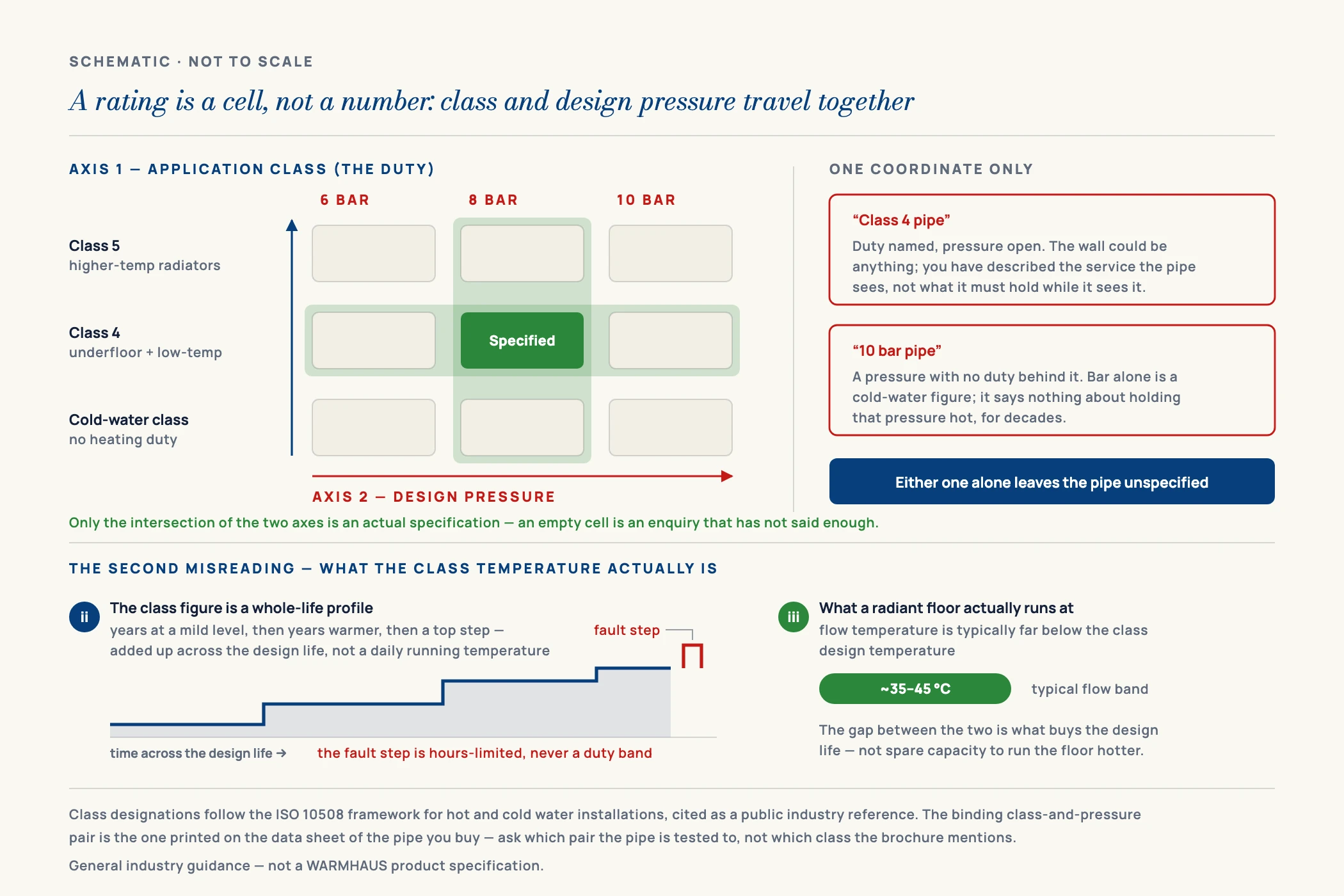
Buyers ask “what temperature is this pipe rated for?” and expect one number. There is no one number, and the reason is worth ten minutes of any specifier’s time: a plastic heating pipe is rated against a service condition class, which is a profile of temperatures over time, not a single figure. ISO 10508 defines those classes for hot and cold water installations, and the class designation is the single most useful thing you can put in an enquiry.
| Class | Typical application | Design temperature | Maximum design temperature | Malfunction temperature |
|---|---|---|---|---|
| Class 1 | Hot water supply at 60 °C | 60 °C / 49 years | 80 °C / 1 year | 95 °C / 100 h |
| Class 2 | Hot water supply at 70 °C | 70 °C / 49 years | 80 °C / 1 year | 95 °C / 100 h |
| Class 4 | Underfloor heating and low-temperature radiators | 20 °C / 2.5 y + 40 °C / 20 y + 60 °C / 25 y | 70 °C / 2.5 years | 100 °C / 100 h |
| Class 5 | Higher-temperature radiator systems | 20 °C / 14 y + 60 °C / 25 y + 80 °C / 10 y | 90 °C / 1 year | 100 °C / 100 h |
| Class XD | Cold water only | 20 °C / 50 years | — | — |
Class profiles are general industry guidance summarising the structure of ISO 10508 for planning purposes; ISO 10508 is cited here as a public industry reference only. Class 3 is omitted as it does not apply to these systems. Confirm the exact profile and the class a given pipe is tested to against the current edition of the standard and the technical data sheet of the pipe you are buying.
Read the Class 4 row across and the whole design logic becomes visible. The 50 years is a total service life, apportioned across a temperature profile — 2.5 years at 20 °C plus 20 years at 40 °C plus 25 years at 60 °C, and those add to 47.5 years, with 2.5 years at the 70 °C maximum making up the balance. Nobody is claiming 50 years at 60 °C, let alone at 95. A pipe quoted as “50-year design life” with no class attached has told you almost nothing.
A temperature rating without a class and a duration is marketing. Class 4 is what an underfloor heating pipe should say.
The malfunction temperature is the most misread line of all. Class 4 allows 100 °C, but for 100 hours in total across the entire 50-year life — that is a boiler-control fault condition the pipe must survive, not an operating range. Any supplier describing 95 or 100 °C as continuous duty has misunderstood their own datasheet, and it is a useful question to ask precisely because of that.
For a buyer this reduces to three lines in an enquiry: state the class (Class 4 for underfloor heating), state the design pressure alongside it, since the class is always paired with a pressure such as 6, 8 or 10 bar, and ask which class the pipe is actually tested to rather than which class the brochure mentions. Actual flow temperatures in a radiant floor sit far below the class design temperature — typically 35–45 °C, set by the floor construction and covering — which is why the mixing group on the manifold matters; that side is covered in our guide to manifold flow temperature.
V. Diameter and Wall Thickness — Sizing the Loop
Diameter ripples furthest through a radiant design, because it sets pressure drop per metre, and pressure drop sets how long a loop can be before the circulator cannot push design flow through it. Go one size down to save on pipe and you shorten the maximum loop — more loops, more manifold ports, a bigger cabinet. The coil saving is spent twice on the manifold.
16 mm outside diameter with a 2.0 mm wall is the mainstream residential loop size across most markets: it balances flow capacity against bend radius, suits standard clip rails and screed depths, and keeps loop lengths within a single coil. Sizes such as 20 or 22 mm appear where loops are long, the load per square metre is high, or on trunk runs to a distant manifold. Larger pipe also demands deeper screed cover and a wider bend radius at loop ends, so the decision is not purely hydraulic.
Wall thickness works with diameter, not against it. A thicker wall raises the pressure rating and narrows the bore; a thinner wall does the reverse. This is why 16 × 2.0 is quoted as a pair rather than a diameter alone — an installer clipping down “16 mm pipe” from two suppliers with different walls is laying two different hydraulic systems into the same floor. Specify both numbers on every purchase order and check the coil marking against the invoice.
Diameter also sets the practical ceiling on loop length, which sets how many circuits a room needs and therefore the port count. That arithmetic runs opposite to the way most people plan: you do not choose a manifold and then lay pipe. The underfloor heating manifold is dimensioned from the loop schedule, not the other way round.
VI. Coils, Packaging and What a Distributor Actually Stocks
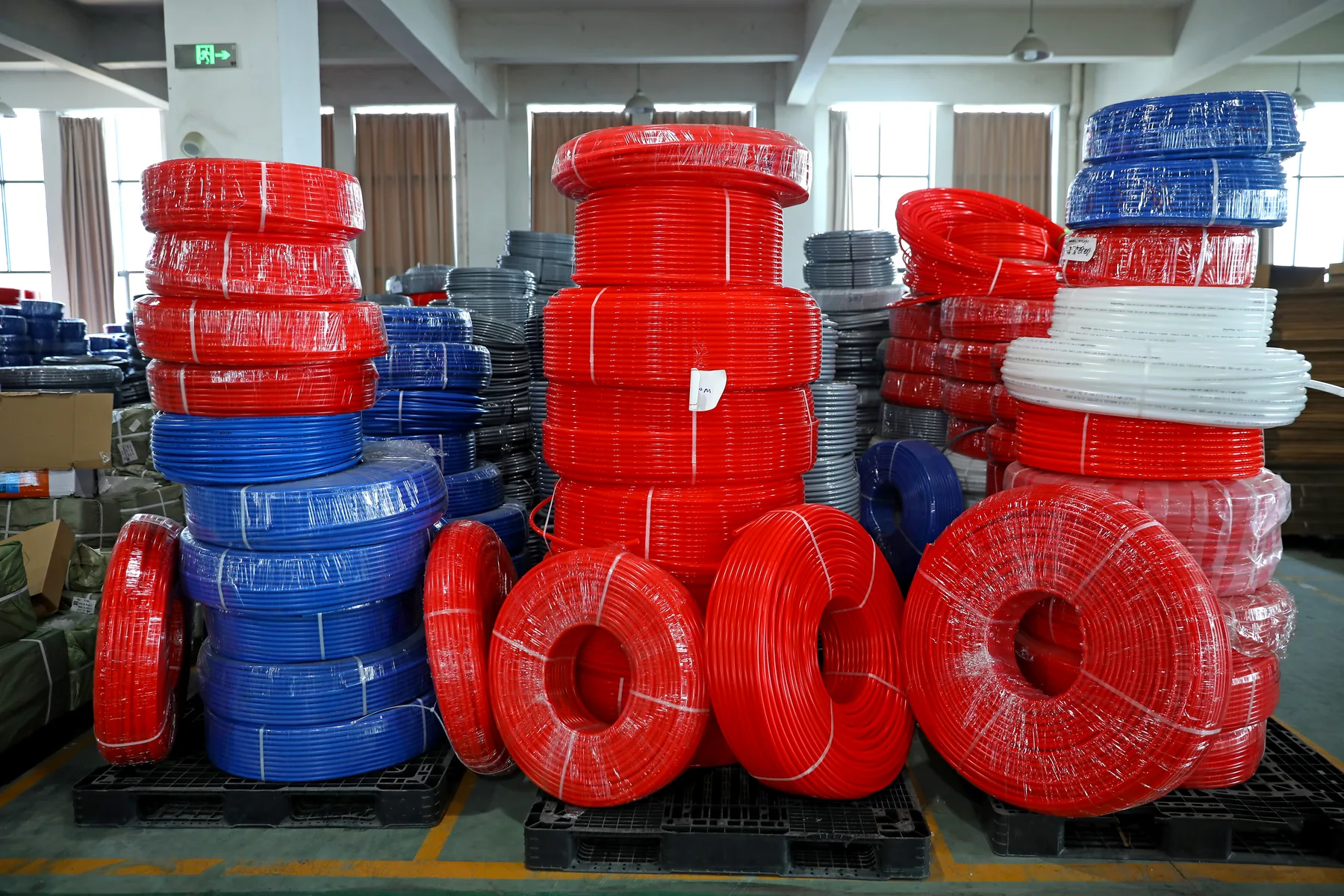
PEX for radiant floors ships on coils, and coil length is a design parameter, not a packaging detail. One coil should cover one loop — a loop that runs out of pipe mid-floor becomes either a buried joint or a re-planned layout with the screed team already on site. Build the stock list backwards from the longest loop your projects require, tails to the manifold included.
For a distributor the second question is freight. Coils are bulky relative to their weight, so container utilisation depends on coil diameter, cartoning and whether they stack. Ask for coil length, coils per carton, carton dimensions and container-load quantity before you model landed cost — price per metre tells you little until freight is loaded onto it. Mixed loads matter too: if pipe, manifolds, actuators and thermostats come from four suppliers, that is four accounts, four sets of documents and four shipments to consolidate. From one manufacturer, a single container carries the whole underfloor heating system in the proportions your market actually sells.
The last stocking question is compatibility, and it generates the most site complaints. Because we produce both the PEX-B pipe and the brass manifolds on our own lines — extrusion for the pipe, machining for the manifold — pipe sizes and outlet connections can be specified together against one drawing rather than sourced separately and hoped into alignment. Confirm the diameter, the outlet thread designation and the compression insert for your order in writing; that is what removes the adaptor drawer from the van and the mismatched-thread argument from the handover.
VII. Six Specification Mistakes That Show Up After the Pour
These are the errors that survive procurement and only appear when it is expensive to fix them. Each one is caught at the purchase order stage by reading one line on a data sheet.
Non-barrier pipe in a closed circuit
Plumbing PEX bought on price instead of heating PEX. The pipe performs; the pump, boiler and metal fittings corrode from the inside over years. Fix: require an oxygen-barrier covered pipe on every line item, and check the coil marking on delivery.
Diameter chosen before loop lengths
The pipe is ordered, then the layout shows loops too long for the pressure drop that diameter allows. Fix: settle the loop schedule first, then size the pipe, then count the manifold ports.
Diameter quoted without wall thickness
Two coils marked 16 mm with different walls have different bores and different ratings. Fix: specify 16 × 2.0 as a pair on the order and verify against the printed pipe marking.
Coil length shorter than the longest loop
Forces a buried joint or an on-the-spot redesign with the screed crew waiting. Fix: match coil length to the longest planned loop plus manifold tails, and confirm the length before shipment.
Pipe and manifold from unrelated sources
Outlet dimensions and thread forms do not agree, so the job stalls on adaptors that then become the leak points. Fix: buy pipe and manifold dimensioned to each other, from a supplier that makes both.
Pressure test skipped or shortened before the pour
A kinked or damaged loop is discovered after the screed has set, when the only access is a saw. Fix: pressurise every loop, hold it through the pour, and record the result before the concrete arrives.
Most of these are procurement errors, not installation errors. The installer inherits whatever arrived on the pallet; the decision was made weeks earlier by someone reading a price list. That is the case for treating the data sheet, not the quotation, as the buying document.
VIII. Sourcing the Loop Pipe — What WARMHAUS Supplies
WARMHAUS is a manufacturer of PPR, PEX and brass piping systems — not a trading company. Extrusion, injection-moulding and machining lines are our own, which is why PEX-B covered pipe with an oxygen-barrier layer, supplied on coils, and our brass underfloor heating manifolds can be specified as one set against a single drawing rather than matched after the fact. For a distributor that means one compatible system in the warehouse instead of a compatibility matrix: pipe, manifold, actuators and thermostats from a single source, one shipment, one set of certification files for tender and customs paperwork. Tell us the diameters and wall thicknesses your market installs and we will confirm what is available against them.
Manufacturing since 1993, with ISO 9001, ISO 14001 and ISO 45001 management systems, EU CE marking and SGS testing — third-party marks a specifier can ask to see rather than take on trust. We operate with no minimum order quantity, which matters when you are trialling a new market or a new size. Standard lead time is 45 days from confirmed order, planned into production slots.
Tell us the diameters your market installs, the coil lengths your layouts need and the port counts you sell most, and we will send the PEX-B technical data sheet, the coil and packing specification, and distributor terms. Certificate copies, per-coil lengths and container-load quantities: available on request.