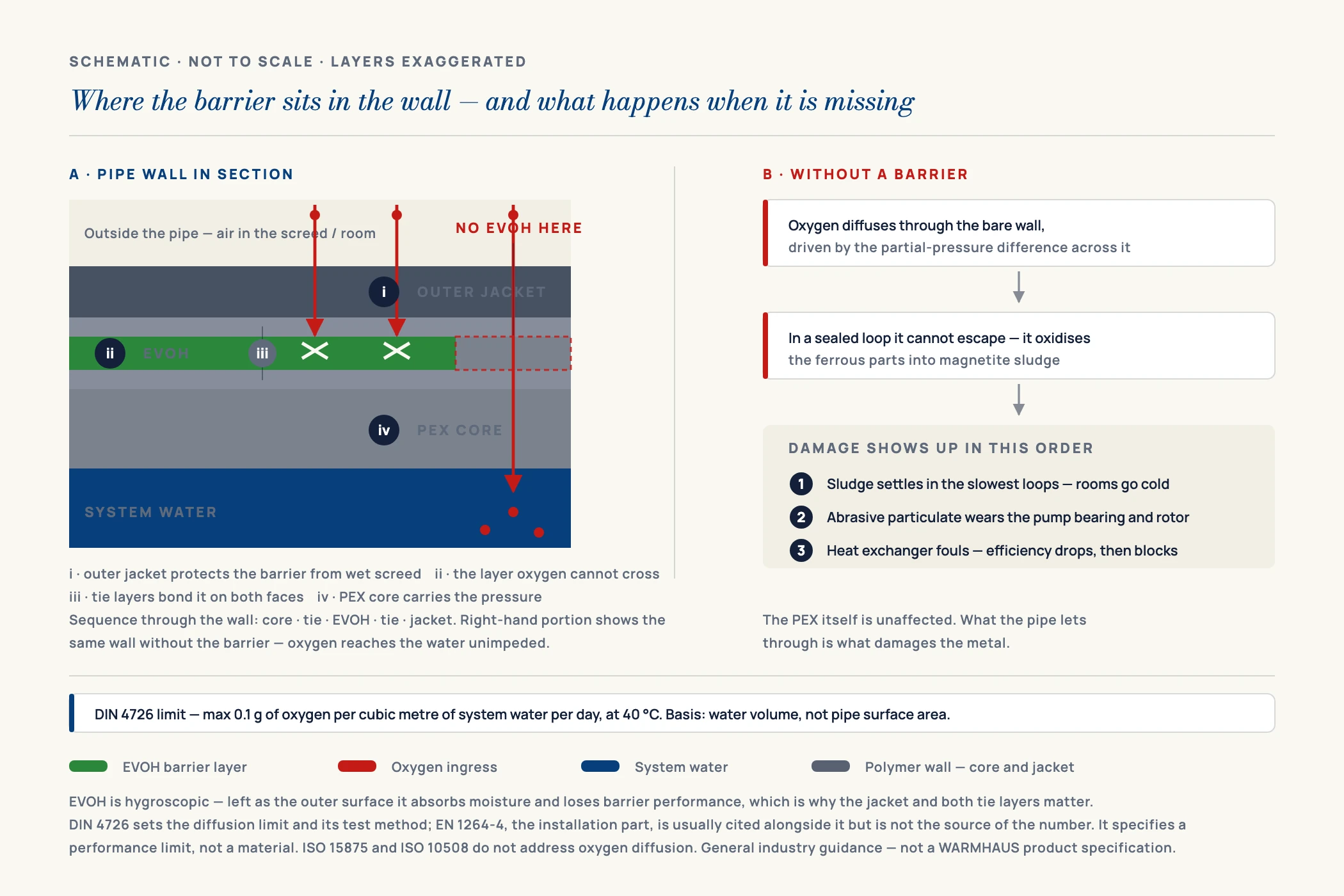
Polymer pipe is not airtight. That single fact is the whole subject. Oxygen molecules pass through the wall of bare crosslinked polyethylene by diffusion — slowly, continuously, driven by the difference in oxygen partial pressure between the room and the water inside. In a domestic hot-and-cold water line nobody cares, because the water is drawn off and replaced constantly. In a sealed underfloor heating circuit the same water is pumped around the same loop for years, so every oxygen molecule that crosses the wall stays in the system and reacts with the first ferrous surface it meets. That is why a heating pipe carries an oxygen barrier and a plumbing pipe usually does not.
This guide is for the people who make the call on a purchase order: specifiers writing a heating spec, importers comparing two PEX offers that look identical on price, and installers explaining why the cheaper coil is not the same product. Technical figures here are general industry guidance, not WARMHAUS-specific specifications — always confirm against the datasheet of the pipe you are actually buying.
I. What Oxygen Diffusion Does to a Heating System
Oxygen in a closed heating circuit is a reagent looking for iron. System water in a typical hydronic installation touches several ferrous components: the boiler heat exchanger, the circulating pump body and impeller, steel pipework in the primary circuit, radiator panels on a mixed system, and the steel parts of some valve assemblies. Dissolved oxygen oxidises those surfaces. The result is not a dramatic failure but a slow accumulation of magnetite sludge — a fine black iron-oxide particulate that circulates with the water.
The damage shows up in three places, in this order. First, flow resistance rises: sludge settles in the slowest parts of the circuit — in an underfloor system, the long loops and the lower manifold ports — so some rooms quietly stop heating properly. Second, the pump degrades, as abrasive particulate in a wet-rotor pump wears the bearing and the rotor can. Third, the heat exchanger fouls, dropping efficiency and eventually blocking. None of this is the pipe’s problem — the PEX itself is unaffected by oxygen. The oxygen it lets through is what damages the metal.
The pipe never corrodes. Everything the pipe is connected to does.
A second, less visible consequence is microbiological growth: oxygenated water at heating temperatures supports bacterial films that add to fouling and can produce localised pitting. Barrier pipe suppresses both mechanisms the same way — it keeps oxygen out of the water rather than treating the water afterwards.
II. What the EVOH Barrier Layer Actually Is
The barrier in almost all barrier PEX is EVOH — ethylene vinyl alcohol copolymer. It is a thin thermoplastic film, typically measured in tens of microns, co-extruded onto or into the pipe wall during production. EVOH has an extremely low oxygen permeability compared with polyethylene, so a layer that adds almost nothing to the wall thickness cuts oxygen ingress by orders of magnitude.
EVOH has one well-known weakness: it is hygroscopic. Absorbed moisture raises its permeability, which is why the barrier is never left exposed on the outside of a pipe destined for wet screed. In a properly built pipe the EVOH is sandwiched between polyethylene layers, with tie layers on both sides. A pipe carrying a bare EVOH skin as its outermost surface will lose barrier performance once buried — the reason to read the layer construction rather than the words “oxygen barrier” printed on the coil.
Two variants are worth distinguishing when comparing offers. Co-extruded barrier is applied in-line during extrusion, bonded through tie layers, and is the mainstream construction for heating PEX. Coated barrier is applied to finished pipe as a secondary operation; it is simpler to produce, but adhesion and coverage at the coil bends are what to check. Either performs if made properly; neither performs if tie-layer adhesion is poor and the barrier delaminates when the coil is straightened on site.
III. Barrier vs Non-Barrier PEX: The Comparison Table
The table below sets out how barrier and non-barrier PEX differ across the properties that matter on a purchase decision. The oxygen-diffusion figure in the first row is the requirement most heating specifications reference, and it is the number worth quoting in a tender.
| Property | Barrier PEX (PEX/EVOH) | Non-barrier PEX |
|---|---|---|
| Oxygen diffusion limit | Specifications commonly reference ≤ 0.1 g/(m³·d) at 40 °C water, per DIN 4726 | No barrier requirement — diffusion orders of magnitude higher |
| Wall construction | Multi-layer: PEX core + tie + EVOH + tie + PE jacket | Single layer of crosslinked PE |
| Typical barrier thickness | Tens of microns, co-extruded | None |
| Intended application | Sealed circuits: underfloor heating, radiators, snow melt, fan coils | Open-ended: hot & cold potable water, compressed air, irrigation |
| Ferrous components in circuit | Protected — oxygen ingress suppressed at source | At risk of magnetite sludge and pump wear |
| Identification | Barrier standard and layer construction printed on the pipe | Print reference typically potable-water standards only |
| Diameter range offered | Barrier construction does not restrict the range — see the PEX pipe for underfloor heating guide for the diameters used in heating loops | |
| Relative cost per metre | Higher — additional layers and extrusion complexity | Lower |
| Consequence of the wrong choice | None — barrier pipe is safe in an open system too | Corrosion damage to boiler, pump and valve internals |
Values are general industry guidance, not a WARMHAUS-specific specification. Diameters, wall thicknesses and layer constructions differ between product families and production runs. Always confirm against the technical datasheet of the pipe you are ordering before you specify it in a tender.
One asymmetry in that table decides most sourcing arguments. Using barrier pipe in an open system is harmless — you pay slightly more per metre for a property you do not need. Using non-barrier pipe in a closed heating system is a defect that stays invisible for two or three heating seasons and cannot be corrected once the pipe is under screed. Where a project runs both potable and heating circuits and the coils risk being mixed on site, the low-risk answer is to specify barrier pipe throughout. Our guide to PEX pipe for heating circuits covers diameter, coil length and crosslinking method alongside the barrier question.
IV. What DIN 4726 Requires, and What It Does Not
The reference nearly every European heating specification uses is DIN 4726, which sets the oxygen-tightness requirement for plastic pipes in warm-water heating circuits. The limit is expressed against the volume of water in the system, not against pipe surface area: a maximum oxygen permeation of 0.1 g per cubic metre of system water per day, measured with water at 40 °C. EN 1264-4, the installation part of the underfloor heating series, is what specifications usually cite alongside it, but the numeric diffusion limit and its test method come from DIN 4726 — worth getting right, because a supplier who quotes the limit against the wrong basis has not read either document. Where a system is fully non-ferrous, or where the water is chemically treated and monitored, the requirement can be handled differently — but on a normal project with a steel heat exchanger and a wet-rotor pump, that figure is the line.
Two things the standard does not do get misrepresented in sales material. First, it does not certify a manufacturer — it defines a performance requirement a pipe is tested against. Second, it does not specify EVOH; it specifies a diffusion limit, and EVOH is simply what the industry uses to meet it. A supplier saying “our pipe is DIN 4726” is describing a result their pipe is made to meet, and the follow-up question is which test report supports it, and at what date. Apply that test to us as well as to anyone else: ask which document covers the diameter and production run you are being quoted, and judge the answer on what actually arrives rather than on what is promised.
Related standards on the print line of a heating coil include ISO 15875 for PEX pipe systems for hot and cold water and ISO 10508 for classification of service conditions. Neither addresses oxygen diffusion — they cover pressure, temperature classes and long-term hydrostatic strength. A pipe can be fully compliant with both and still have no barrier at all. Reading the print line means reading which standard is claimed for which property.
Two of those properties are worth knowing in detail, because they are the ones a buyer can actually audit on paper alongside the barrier.
Degree of crosslinking. This is the hard number behind PEX quality, and the minimum differs by production method because each method crosslinks differently. ISO 15875-2 sets minimum degrees of crosslinking of ≥ 70 % for PEX-a (peroxide, crosslinked in the melt), ≥ 65 % for PEX-b (silane, crosslinked by moisture after extrusion) and ≥ 60 % for PEX-c (electron beam, crosslinked after extrusion). The different figures are not a quality ranking — they reflect what each process can achieve and be measured at. A test report quoting a crosslinking percentage should also state the method, because a number without a method cannot be judged against the right minimum. The trade-offs between the three are set out in our comparison of PEX-a, PEX-b and PEX-c.
Service class. ISO 10508 classifies systems by duty rather than by a single temperature, and the class is what determines whether a pipe suits your circuit. Class 1 and Class 2 cover hot water supply at 60 °C and 70 °C design temperature; Class 4 covers low-temperature underfloor heating together with low-temperature radiators; Class 5 covers higher-temperature radiator heating. Underfloor heating normally falls under Class 4, and each class is defined as a sequence of temperature-and-duration steps over a nominal 50-year design life, with a malfunction temperature and an associated design pressure. Specify the class and the design pressure together — “Class 4 / 6 bar” is a specification; “PEX pipe for underfloor heating” is not. Class definitions, their step profiles and design pressures must be read from the current edition of the standard.
Crosslinking minima and service-class definitions are general industry references to published standards, not WARMHAUS-specific specifications or test results. Values are revised between editions — confirm against the current standard and against the datasheet and test report of the pipe you are buying.
V. Five Checks Before You Approve a Barrier PEX Order
These are the questions that separate a barrier claim you can rely on from one printed for marketing. Run them before a sample is approved, not after a container has landed.
Ask for the layer construction, in order
A supplier who makes barrier pipe can tell you the sequence — core, tie layer, EVOH, tie layer, jacket — without hesitating. If the answer is only “yes, it has EVOH”, you have not learned whether the barrier is protected from moisture on the outside. Check: request the construction diagram, not just a yes.
Cut a sample and look at the wall
A clean cross-section under magnification shows the barrier as a distinct film within the wall. A cut end also shows whether the layers are bonded or whether the barrier lifts away from the core when the section is flexed. Check: cut, flex and inspect a coil end from every sample lot.
Read the print line against the application
The pipe should carry the diffusion standard it is made to meet, alongside the pressure and temperature class. A print line that shows only potable-water standards is telling you what the pipe is for. Check: photograph the print line on the sample and keep it with the approval file.
Ask what happens at the coil bend
Barrier integrity is tested where the pipe is worked — uncoiled, bent to loop pitch, and pushed into pipe clips. Delamination shows up at tight radii first. Check: bend a sample to the minimum radius on the datasheet and inspect the inner and outer wall of the bend.
Confirm the test report, and its date
A diffusion test is a point-in-time result for a production run, not a permanent property of a brand. Check: ask which report covers the material and diameter you are buying, and how recent it is. Where a supplier cannot produce one, treat the claim as unverified.
VI. Where the Barrier Fits in the Rest of the System
Barrier pipe protects the water, but only as part of a circuit designed to stay closed. Three points follow. Fittings and manifold connections must be sound — a weeping joint topped up with fresh water feeds the system far more oxygen than any pipe wall. Automatic air vents should be positioned to remove air, not admit it, since a poorly seated vent on a negative-pressure section can draw air in. And make-up water should be a monitored event: a system needing regular refilling has a leak, and repeated fresh-water charging can carry more corrosion risk than the diffusion the barrier was specified to prevent.
The manifold is where this meets the hardware. It is where every loop is joined, isolated, balanced and vented, and the metal it is made from is part of the corrosion question — a brass manifold body brings no ferrous surface into the loop side of the circuit. Our guide to the underfloor heating manifold covers port count, flow metering and valve arrangement, and the wider underfloor heating system page sets out how pipe, manifold and controls are specified together.
A last note for installers: barrier PEX is jointed and handled exactly like non-barrier PEX. The barrier changes nothing about the fitting method, bend radius discipline, pipe-clip spacing or pressure-test procedure. It is a property of the wall, not a different installation technique.
VII. Sourcing Barrier PEX From One Manufacturer
Most sourcing problems with barrier PEX are not about the pipe alone. They arise when the coil comes from one supplier, the manifold from a second and the fittings from a third, and nobody owns the interface between them. WARMHAUS is a manufacturer of PPR, PEX and brass piping systems — not a trading company. The extrusion, injection-moulding and machining lines are our own, which is why the PEX coil, the brass manifold it lands on and the fittings that join them are held to one internal set of tolerances rather than averaged across three vendors. Raw material comes from Hyosung, Borealis and LG.
Three practical consequences for distributors and project buyers. There is no MOQ, so a first order can be a mixed container of PEX coils, manifolds and controls rather than a full pallet of one line. Standard lead time is 45 days from confirmed order, planned as production slots rather than promised away. And the certification file — ISO 9001, ISO 14001 and ISO 45001 management systems, EU CE marking and SGS testing — comes from the same source as the goods, which is what tender and customs paperwork asks for. Manufacturing since 1993, across three plants totalling 100,000 m² of building area, with over 500 staff and 50+ technical personnel.
Tell us the diameters, coil lengths and loop configuration your projects run, and we will put together the PEX specifications, the matching manifold options and the certification file. Request PEX barrier specifications and a quotation — tell us which documents your tender requires and we will confirm what we can supply for the specification in question before you commit to a sample.