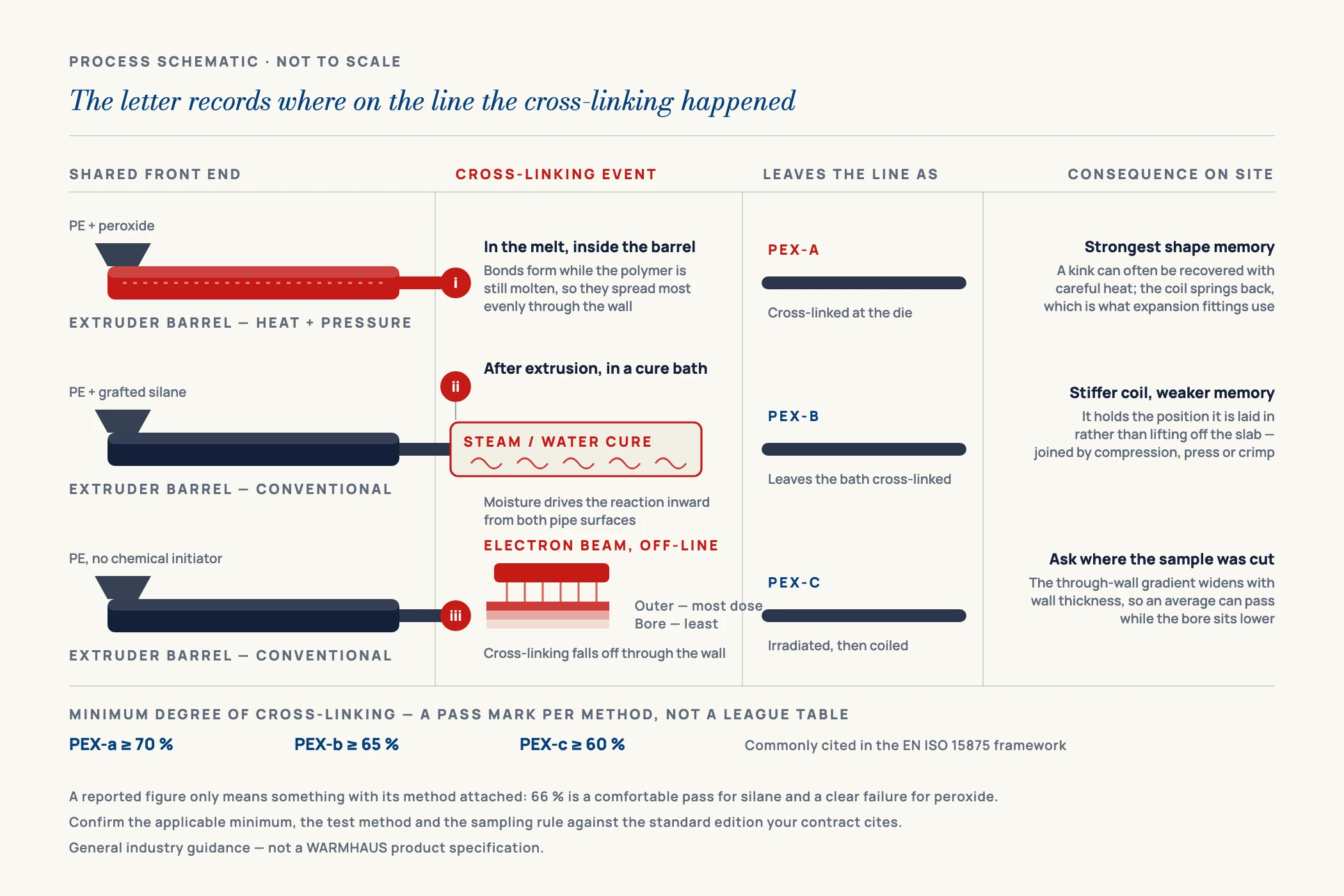
The a, b and c in PEX-a, PEX-b and PEX-c are not grades. The letters were not assigned in order of quality — they record which process was used to cross-link the polyethylene, and nothing else. PEX-a is peroxide cross-linked in the melt, PEX-b is silane (moisture) cross-linked after extrusion, PEX-c by electron beam after extrusion. All three end up as thermoset cross-linked polyethylene, all three are covered by the same family of product standards, and all three must hit a minimum degree of cross-linking to be sold as PEX at all — a different minimum for each method, which this guide sets out in full. What genuinely differs is coil memory, fitting practice, price, and who will supply it in the volumes you need.
Much of what circulates online about the three types is marketing written by producers who make only one of them, and it overstates the practical gap. The useful reading is narrower: the cross-linking method changes the manufacturing route and the handling characteristics; the product standard sets the performance floor all three must clear. A buyer who understands that stops asking “which letter is best” and starts asking “which suits my market, my installers and my fitting system”.
I. What Cross-Linking Actually Does
Ordinary high-density polyethylene is a thermoplastic: heat it enough and it flows, which makes it unsuitable for a heating circuit that runs warm for decades under pressure. Cross-linking chemically bonds the polymer chains to each other, converting the material into a thermoset network. The result no longer melts and flows — it holds shape and pressure at elevated temperature, resists slow crack growth, and recovers its form after deformation. That last property is why a kinked PEX pipe can often be recovered with careful heat.
The degree of cross-linking is the percentage of polymer converted into that bonded network — a controlled property with a minimum value written into the product standards. Each method reaches it differently, and the minimum differs by method, which is the single most misread point in the whole subject. A PEX-b figure must be judged against the PEX-b minimum, not against a PEX-a one. The commonly cited minima in the ISO 15875 framework are:
| Type | Cross-linking method | Minimum degree of cross-linking |
|---|---|---|
| PEX-a | Peroxide, in the melt | ≥ 70 % |
| PEX-b | Silane / moisture, after extrusion | ≥ 65 % |
| PEX-c | Electron beam, after extrusion | ≥ 60 % |
Minimum degree-of-cross-linking values are general industry guidance drawn from the widely used product-standard framework for PEX, not a WARMHAUS-specific specification. The applicable minimum, the test method and the sampling rule are set by the standard edition your contract cites. Always confirm against that standard and against the test report for the pipe you are actually buying.
Two things follow from that table. First, a higher percentage is not a better pipe — the numbers are pass marks for three different processes, not a league table, and a PEX-b at 68 % and a PEX-a at 72 % have both simply passed. Second, the figure is only meaningful with its method attached: a test report quoting 66 % is a comfortable pass for silane and a clear failure for peroxide. It matters commercially because it is a testable, reportable number — when auditing a supplier, expect to see it on a test report against a named method, rather than in a brochure.
The letter tells you how the pipe was cross-linked. The test report tells you whether it was cross-linked enough — and “enough” is a different number for each letter.
I. PEX-a — peroxide cross-linked
Peroxide is blended with the polyethylene and the reaction happens in the melt, during extrusion, under high temperature and pressure. Because the material is molten while it cross-links, the bonds distribute relatively evenly through the wall and PEX-a typically reaches the highest degree of cross-linking of the three. In practice it is the most flexible at room temperature, has the greatest shape memory, and is the type associated with expansion fittings, where the pipe end is mechanically expanded and shrinks back onto the fitting. It is also the slowest and most expensive route, and the cost gap comes from several directions at once rather than one: line speed is held back by the reaction time in the melt, the peroxide-modified compound costs more than a silane-grafted one, the extrusion equipment for the process is specialised and capital-intensive, and the tighter processing window means more material is lost at start-up and changeover. Any single one of these could be absorbed; together they are why the type carries a persistent premium rather than a temporary one.
II. PEX-b — silane (moisture) cross-linked
A silane compound is grafted onto the polymer, the pipe is extruded conventionally, and cross-linking completes after extrusion in a warm, humid environment — a steam or water bath, or a controlled sauna room. Because the extrusion step is conventional, PEX-b lines run faster and the process is more tolerant, which is why PEX-b dominates on cost and availability worldwide. The finished pipe is slightly stiffer than PEX-a with less shape memory, so it is normally joined with compression, press or crimp/clamp fittings rather than expansion fittings. For underfloor heating loops laid on a flat slab and clipped down, that stiffness is largely irrelevant — arguably an advantage, since the pipe holds its laid position rather than trying to lift.
III. PEX-c — electron-beam cross-linked
The pipe is extruded first, then passed through an electron beam that cross-links the material by irradiation — a physical process with no chemical initiator and no curing bath. It is clean and continuous, but the beam penetrates from the outside in, so cross-linking through the wall is the hardest to keep uniform: the outer surface receives the highest dose and the bore the lowest, and the gap between them widens as the wall gets thicker. On the thin walls used for radiant loop pipe — around 1.8 to 2.0 mm — that gradient is manageable and routinely controlled by rotating the pipe through the beam or irradiating from more than one side. It becomes a question worth asking on heavier walls and larger diameters, where a single reported average can sit above the minimum while the bore sits below it. The practical audit line is therefore not “is PEX-c acceptable” but ask where in the wall the sample was taken and whether the method reports an average or a through-wall profile. PEX-c is the least common of the three in the heating-pipe trade, largely because the irradiation equipment is a heavy capital item. Where it is available it is usually joined the same way as PEX-b.
II. PEX-a vs PEX-b vs PEX-c — Comparison Table
Here is the short version, framed for a purchasing decision rather than a materials-science lecture. Treat every entry as general industry guidance describing the three process families, not a specification of any particular product — the actual figures for any pipe you buy sit on that pipe’s technical data sheet, and that is the document to specify against.
| Property | PEX-a | PEX-b | PEX-c |
|---|---|---|---|
| Cross-linking method | Peroxide, in the melt | Silane / moisture, after extrusion | Electron beam, after extrusion |
| When cross-linking happens | During extrusion | Post-extrusion cure (steam or water) | Post-extrusion irradiation |
| Minimum degree of cross-linking | ≥ 70 % | ≥ 65 % | ≥ 60 % |
| Uniformity through the wall | Most even — cross-links in the melt | Even — cure penetrates from both surfaces | Hardest to keep even — beam penetrates outside in |
| Flexibility at room temperature | Highest | Moderate — stiffer coil | Moderate |
| Shape / thermal memory | Strongest | Present but weaker | Present but weaker |
| Usual jointing method | Expansion fittings, also press / crimp | Compression, press, crimp / clamp | Compression, press, crimp / clamp |
| Relative production cost | Highest | Lowest | Middle to high (capital-intensive) |
| Global availability | Concentrated among fewer producers | Widest — most producers, most sizes | Narrowest |
| Oxygen-barrier versions | Available | Available | Available |
| Common application | Plumbing and heating, expansion systems | Underfloor heating loops, plumbing | Heating and plumbing, niche volumes |
Values are general industry guidance describing the three cross-linking process families, not a WARMHAUS-specific specification. Pressure class, continuous temperature rating, minimum bend radius and degree of cross-linking vary by producer, wall thickness and product standard. Always confirm against the technical data sheet of the pipe you are actually buying.
The pattern is clear: the differences are real but bounded. There is no row where one type fails and another passes — only rows where one type is easier to install by hand, and rows where one type is easier to buy in quantity. Those are the two axes a buyer trades off. For the equivalent comparison across material families rather than within PEX, the companion piece on PPR vs PEX vs copper vs PVC covers when to reach for PEX at all.
III. Is PEX-a Better Than PEX-b? The Honest Answer
A direct answer: PEX-a is not a higher grade of pipe than PEX-b. It is a different manufacturing route with a different handling profile and a higher cost. The claim that PEX-a is “better” rests on two genuine properties — greater flexibility and stronger shape memory — then quietly extends them into a claim about durability or pressure performance that the product standards do not support. All three types must meet the same long-term hydrostatic requirements for the class they are sold in.
The flexibility argument holds real weight in tight-radius plumbing inside occupied buildings: threading pipe through joists and minimising fittings inside a wall. It holds much less weight for the case most buyers here are sourcing for — underfloor heating loops laid to a spacing pattern on a flat slab and clipped down. There the pipe is unrolled, walked into place and fixed at intervals; a stiffer coil is no handicap, and a pipe that wants to spring back is no advantage. Installation speed on that job is set by loop spacing and fixing method, not by the cross-linking letter — see our guide to underfloor heating system design.
The differences between PEX-a and PEX-b are real. They are also much smaller than the price gap between them.
The second point buyers miss is that the letter constrains your fitting options more than your pipe performance. PEX-a with expansion fittings commits your installers to a specific tool and supply chain; PEX-b with compression or press fittings uses methods plumbers already own tools for.
IV. What Buyers Should Actually Specify
If the letter is the wrong place to focus, here is the right place. When you write an enquiry or a submittal for heating pipe, these lines determine whether the pipe performs and whether it clears customs and consultant review. Each is answerable from a supplier’s technical data sheet and test reports — and if a supplier cannot answer them, that is the finding, not the pipe type.
Oxygen barrier — present or absent
For any closed heating circuit with steel or cast-iron components an oxygen-diffusion barrier layer is not optional; without it, dissolved oxygen migrates through the pipe wall and corrodes boilers, pumps and manifolds from the inside. In European heating specifications the limit normally quoted is the one in EN 1264-4 — 0.10 mg of oxygen per square metre of pipe surface per day at 40 °C water — and that is the reference to write into a tender; our guide to the PEX oxygen barrier sets out what that figure does and does not cover. Specify it explicitly, in writing — barrier versions exist in all three types, and “PEX” alone does not imply one.
Dimension and wall thickness, not just diameter
16 × 2.0 mm and 16 × 1.8 mm are both “16 mm pipe” and they are not interchangeable at the fitting. State outside diameter and wall thickness on every line of the order, and check that the manifold connection set you are buying matches that combination.
Degree of cross-linking, on a test report
This measurable number tells you the cross-linking step was completed to specification. Ask for it as a reported value on a test report rather than a claim in a catalogue — and check it against the minimum for that method: broadly 70 % for PEX-a, 65 % for PEX-b, 60 % for PEX-c. A report quoting 66 % is a pass for silane and a failure for peroxide, so a figure without its method attached tells you nothing. Confirm the applicable minimum against the standard edition your contract cites.
Class and design conditions
Heating pipe is classified by service condition under ISO 10508, not by a single maximum temperature. Underfloor heating and low-temperature radiators sit in Class 4; higher-temperature radiator circuits sit in Class 5. Quote the class together with the design pressure — “Class 4, 6 bar” is a specifiable line, “rated to 95 °C” is not. See the class table in our PE-RT vs PEX comparison for what each class actually contains.
Fitting system, decided with the pipe
Pipe and fitting are one purchasing decision, not two. Confirm the fitting type your installers use, that the pipe is dimensioned for it, and that the manifold outlets accept the same connection set. Mixing brands at this interface is where leaks and site disputes originate.
Coil length and packaging
Coil length drives waste on site and cube in the container. Long coils cut fewer joins into a floor; short coils suit smaller rooms and mixed loads. Decide it against your loop lengths before the order is fixed.
Certification files your customs and consultants need
Ask which management-system and product marks the manufacturer holds, and request the documents themselves. WARMHAUS is certified to ISO 9001, ISO 14001 and ISO 45001, EU CE marked and SGS tested; certificate documents and copies are available on request. Check what your destination market requires before the container ships.
V. Which Type Suits Which Buyer
Sorting by buyer rather than by chemistry makes the decision faster.
The importer or distributor building a heating range. Your constraint is availability, price and installer familiarity, and on all three the answer usually points at PEX-b: the widest set of manufacturers, the widest set of sizes, the lowest cost per metre, joined with fitting systems your customers’ installers already own. That is a range you can quote without explaining a price premium first. If it is going out under your own brand, the complete product range across PPR, PEX and brass is the practical starting point — it lets you mix one container rather than open several supplier accounts.
The specifier or consultant. Your constraint is defensibility. Write the specification around the product standard, the service class, the barrier requirement and the dimension, and leave the cross-linking method open unless there is a project reason to close it. Specifying a single letter narrows the bidder pool without improving the installed result, and invites a substitution request you have to assess anyway.
The contractor pricing an underfloor heating package. Your constraint is installed cost, and loop spacing, manifold count and screed depth move that number far more than the pipe letter does. Fix the design first, then buy the pipe that fits the fittings your team already carries.
VI. Sourcing PEX Pipe from a Manufacturer, Not a Trader
Whichever letter you settle on, the supplier question sits underneath it. WARMHAUS is a manufacturer of PPR, PEX and brass piping systems — not a trading company. The extrusion, injection-moulding and machining lines are our own, which is why the pipe, fittings and brass manifolds we quote are dimensioned against one internal standard instead of averaged across three suppliers. We manufacture PEX-B pipe with a co-extruded oxygen-barrier layer for radiant floor duty, alongside the brass underfloor heating manifolds it connects to, so pipe and manifold are dimensioned against each other rather than sourced separately — full specification on the PEX-B pipe page and on the data sheet supplied with the pipe. Tell us the diameters and wall thicknesses your market designs around and we will confirm what we run against that list.
Three things matter to the buyers who work with us. There is no minimum order quantity, so a distributor testing a market can order a real assortment rather than a pallet of one item. Standard lead time is 45 days from confirmed order, quoted plainly so you can plan production slots into your own schedule. And the company has been manufacturing since 1993, with over 500 staff across three plants, on raw material from suppliers including Hyosung, Borealis and LG. Certification is ISO 9001, ISO 14001 and ISO 45001, with EU CE marking and Swiss SGS testing; certificate documents and copies are available on request.
Tell us the sizes, the coil lengths, the fitting system your installers use and the destination market. Request the PEX-B technical data sheet and distributor terms — and the quotation will arrive with the matching manifold and fitting range and the certification files already attached.