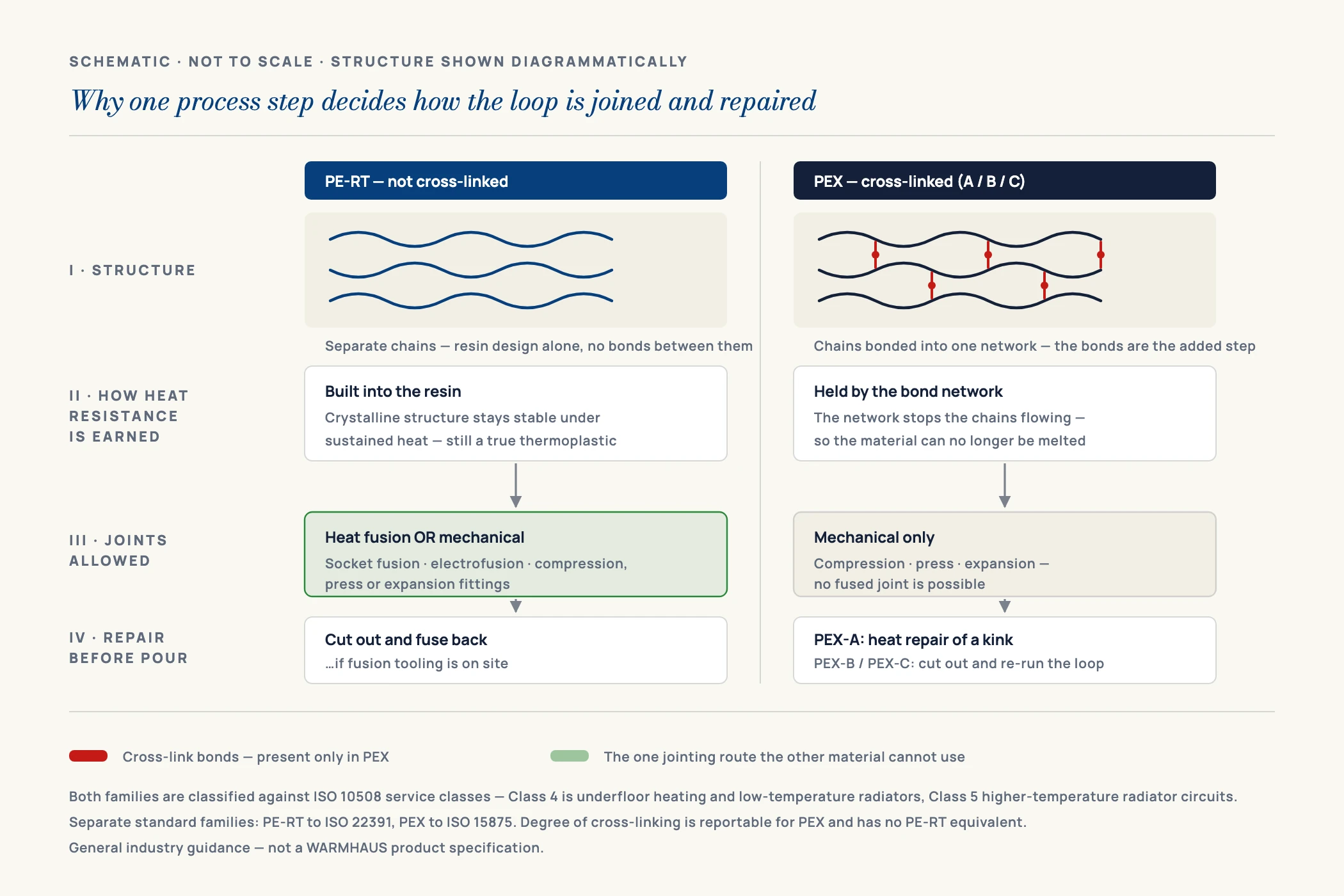
The difference between PE-RT and PEX is one process step: PE-RT is not cross-linked, PEX is. Everything else — how the pipe unrolls, how you join it, whether a damaged loop can be repaired, what the temperature class on the print line means — follows from that single fact. Both are polyethylene, both are laid as continuous loops in screed, both are specified daily for radiant floors across the Middle East, North Africa, Southern Europe and Latin America. Choosing between them is not a quality ranking. It is a question of what your project needs from the pipe and what your installers can execute reliably.
This page is written for the two people who actually make the decision: the importer or distributor deciding which coil to stock, and the specifier or mechanical consultant writing a line into a tender. Both are looking for the same thing — a defensible reason to prefer one material over the other on a given job. All figures below are general industry guidance for planning. The binding numbers are on the technical data sheet of the pipe you actually buy, and on the design temperatures in your project specification.
I. What PE-RT and PEX Actually Are
PEX is cross-linked polyethylene. A separate process step bonds the polymer chains to one another so the material can no longer melt and flow. That is what lets a thermoplastic hold pressure at elevated temperature for the design life of a building instead of creeping. The cross-linking route is named by the letter: PEX-A by peroxide during extrusion, PEX-B by silane with the reaction completed after extrusion in a warm, moist environment, PEX-C by electron beam after the pipe is formed. The letter names the method, not a grade.
PE-RT — polyethylene of raised temperature resistance — reaches comparable elevated-temperature performance without any cross-linking step at all. The resistance is built into the resin itself: a controlled molecular architecture, typically a copolymer with a specific comonomer distribution, gives the crystalline structure enough stability under sustained heat and pressure to be classified for heating service. PE-RT is generally supplied in two families, commonly designated Type I and Type II, with Type II resins formulated for the more demanding temperature and pressure classes.
PEX earns its temperature resistance in a process step. PE-RT is born with it in the resin. That is the whole difference — and every practical consequence flows from it.
The practical consequence is that PE-RT remains a true thermoplastic. It can be melted, so it can be socket-fused or electrofused like other polyolefins. PEX cannot be melted back into a homogeneous joint, so it is joined mechanically — compression, press, or expansion fittings depending on the type. This single distinction drives most of the field-level arguments on both sides. Keep one qualification attached to it from the start: in a radiant floor the fusibility of PE-RT matters far less than the sales argument suggests, because a correctly designed loop has no joints in the screed for it to make. It earns its keep on pre-pour repairs and on connections outside the floor, and section V returns to that.
II. PE-RT vs PEX: Side-by-Side Comparison
The table below sets out the practical differences that matter when specifying loop pipe for a radiant floor. Read it as a decision aid, not as a scorecard: for a standard residential or light commercial floor operating at typical design flow temperatures, both materials are widely used and both are specified into the same standards families. Where the columns diverge is in handling, jointing and repair — the things that show up on site, not in the pressure test.
| Property | PE-RT | PEX (PEX-A / B / C) | Why it matters on the job |
|---|---|---|---|
| Cross-linked | No — raised-temperature resin | Yes — peroxide, silane or e-beam | Decides whether the pipe can be heat-fused |
| Degree of cross-linking | Not applicable | Minimum values set by type in the product standard | A PEX data sheet line; PE-RT has no equivalent figure |
| Jointing method | Socket fusion, electrofusion, or mechanical fittings | Mechanical only — compression, press, expansion | Fusion tooling vs press tooling changes site kit |
| Typical flexibility | Generally more flexible; low bend resistance | Stiffer in the hand; varies A > C > B | Single-installer loop laying and tight bend radii |
| Coil memory | Low — tends to lie flat once unrolled | PEX-A has thermal memory; PEX-B low memory | How hard the pipe fights the clip rail |
| Kink repair | Damaged section cut out and fused back | PEX-A kinks can be heat-repaired; B and C cut out | What happens when a coil is stepped on pre-pour |
| Temperature classes | ISO 10508 class per resin type and wall | ISO 10508 class per type and wall | Underfloor heating is Class 4 — must match the specification |
| Oxygen barrier | EVOH layer, co-extruded | EVOH layer, co-extruded | Non-negotiable in a closed circuit either way |
| Common loop sizes | 16 × 2.0, 20 × 2.0 mm | 16 × 2.0, 20 × 2.0 mm | Same manifold outlets, same clip spacing |
| Reference standards | ISO 22391 series | ISO 15875 series | Different families — quote the right one in tender |
Values and characterisations are general industry guidance, not a WARMHAUS-specific specification. Temperature and pressure classes, wall thicknesses and permitted bend radii vary by resin, by wall and by manufacturer. Always confirm against the technical data sheet of the pipe you are using and against the design conditions of the project.
Where the two are genuinely not interchangeable
The last row of that table is the one people skim, so it is worth spelling out. ISO 22391 and ISO 15875 are parallel standards, not alternative names for the same requirement. They classify pipe against the same ISO 10508 service classes, which is why both can be specified for the same floor — but they are separate documents with separate test regimes, and a pipe certified to one is not thereby certified to the other. Three consequences follow for a buyer:
First, a submittal that says “PEX to ISO 22391” is incorrect on its face and a reviewing consultant will reject it — the series number must match the material. Second, the degree of cross-linking is a required, reportable property under ISO 15875 and does not exist under ISO 22391 at all: asking a PE-RT supplier for a cross-linking percentage marks you as unfamiliar with the material, since the correct PE-RT questions are the resin type and the class. Third, the jointing method is not a free choice within each standard — heat fusion is available to PE-RT and unavailable to PEX, so a specification written around fused joints silently excludes PEX no matter what the class line says. That is the practical meaning of “not interchangeable”: same duty, same class, different paperwork and different site method.
III. Temperature Class Is the Line That Matters
Buyers routinely ask which material “handles more heat”. It is the wrong question, and it produces the wrong purchase. Plastics pipe for heating is not rated by a single maximum temperature — it is classified by an application class that combines a design temperature, a duration at that temperature, a malfunction temperature, and a design pressure, over a stated design life. The classification system both material families use is ISO 10508, and its classes are the vocabulary a specification is actually written in.
| Class | Typical application | Design temperature | Malfunction temperature |
|---|---|---|---|
| Class 1 | Hot water supply (60 °C) | 60 °C | 95 °C |
| Class 2 | Hot water supply (70 °C) | 70 °C | 95 °C |
| Class 4 | Underfloor heating and low-temperature radiators | 20 / 40 / 60 °C in combination | 100 °C |
| Class 5 | Higher-temperature radiator circuits | 20 / 60 / 80 °C in combination | 100 °C |
Class definitions are general industry guidance summarising the ISO 10508 service-condition framework, not a WARMHAUS specification. Each class is defined by a sequence of temperatures held for stated durations across a 50-year design life, together with a design pressure — the table above is an abbreviation, not the full definition. Specify against the standard text and the pipe’s technical data sheet.
Underfloor heating is Class 4. That is the line to put in a tender: “PE-RT or PEX to ISO 10508 Class 4 at the project design pressure”, commonly 6, 8 or 10 bar. Both material families are routinely classified to Class 4 and to Class 5, so on this axis neither is disqualified — the class is a property of the specific pipe, its resin and its wall, not of the letter on the coil.
Underfloor heating is by design a low-temperature emitter, and a correctly sized radiant floor runs at flow temperatures well below a radiator circuit, which is why both materials sit comfortably in Class 4. That comfort is conditional, not automatic. Where the floor is fed directly from a high-temperature source with no mixing group, where a heat pump runs a high-temperature defrost or legionella cycle through the same circuit, or where the same coil is used for both radiant and radiator duty, the loop can become the limiting component — and that is precisely why PE-RT is split into Type I and Type II, with Type II resins formulated for the more demanding classes and pressures. If the design conditions push past Class 4, check the class of the specific PE-RT type on offer rather than assuming the family covers it. The class designation printed on the pipe stops being paperwork at exactly that moment.
Two practical rules follow. First, quote the class, not the material: “PE-RT to ISO 10508 Class 4 at 6 bar” is a specifiable line, “PE-RT because it is stronger” is not. Second, remember that class is a function of wall thickness as well as resin, so a 16 × 2.0 and a 16 × 1.8 in the same material are not the same product. If you are building a stock list, treat wall thickness as part of the item code, not as a tolerance.
IV. The Oxygen Barrier Is Not a Differentiator
Both PE-RT and PEX are permeable to oxygen in their bare form. In a closed heating circuit that oxygen reaches steel and cast-iron components — boiler heat exchangers, circulator bodies, valve internals — and drives corrosion, sludge and, eventually, blocked loops. The answer is the same for both materials: a co-extruded EVOH oxygen barrier, usually placed under a thin outer protective layer so it is not scuffed off during installation.
This means the barrier is never a reason to choose one material over the other. It is a reason to reject a coil of either material that does not have one. When you compare quotations, check that both are barrier pipe: a barrier coil and a bare coil in the same diameter are different products at different prices, and a like-for-like comparison that misses this is the most common way a radiant floor tender gets undercut by a specification that does not meet it. The detail is covered further in our guidance on the underfloor heating system as a whole.
V. Six Decision Points When You Are Choosing
Rather than a verdict, here is the sequence a specifier or buyer can actually run. Work through it in order; by point four or five the answer is usually obvious.
What does the project specification already say?
If the tender names a standard family, a class and a wall, the material question is closed before it opens. Check this first — the cheapest hour of engineering on any job is reading the spec before pricing the coil.
What tooling do your installers already own?
PE-RT can be fused, but only if there is a fusion machine and a trained hand on site. PEX needs press or expansion tooling matched to the fitting brand. Be honest about how much this is worth on a radiant floor: since a correctly designed loop contains no buried joints at all (see point iii), fusibility is not a benefit inside the screed. Its real value is at the margins — a damaged coil repaired before the pour instead of re-run, connections outside the floor, and crews who already fuse PPR daily. Weigh it there, not as a headline advantage.
Are there joints inside the screed at all?
In a correctly designed floor there are none — every loop runs continuous from manifold flow port to return port. If your layout needs a buried joint, the loop is too long or the coil too short. Fix the design, not the fitting.
Who is laying the loop, and alone or in pairs?
Low coil memory matters more than any data sheet line when one installer is unrolling 100 metres onto clip rail. Both PE-RT and PEX-B behave well here; PEX-A springs back toward its coil radius until it is fixed.
What happens when a coil is damaged before the pour?
Ask this before the site does. PEX-A allows a heat repair of a kink. PE-RT allows a cut-and-fuse repair if the tooling is present. PEX-B and PEX-C generally mean cutting the section out and re-running the loop.
Can you get pipe, manifold and controls from one source?
Loop pipe that matches the manifold outlet, adaptors that match the pipe wall, actuators that match the manifold thread. Mixed sourcing is where dimensional drift and adaptor hunting start. See the full WARMHAUS product range for how the four lines fit together.
VI. What This Means for Stock Planning
For a distributor, the material question is really a stock-breadth question. Every additional material family you carry in loop pipe multiplies across diameters, wall thicknesses and coil lengths, and each variant occupies a warehouse position that has to turn. Two rules keep the list disciplined.
First, let the installed base decide, not the catalogue. If the contractors in your market press PEX and own press tooling, a PE-RT line will sit. If fusion is the local habit because it is how PPR is joined for hot and cold water anyway, PE-RT slots into an existing skill set. Second, standardise the sizes before you standardise the material: 16 × 2.0 mm covers the large majority of residential loop work and 20 × 2.0 mm covers longer loops and larger rooms, and those two sizes serve the same manifold outlets regardless of which material you settle on.
Coil length is the third variable and the one most often left to chance. Match coil lengths to the loop lengths your market designs so installers are not cutting long tails off 600 metre coils or splicing to finish a room. If you are also planning the container mix, remember that loop pipe, manifolds, valves and fittings ship well together — Request the underfloor heating range specifications and coil formats and we will send the size and packing detail alongside the certification files.
VII. One Manufacturer for the Whole Floor
A radiant floor is only as coherent as its weakest interface. The loop pipe has to match the manifold outlet, the adaptors have to match the pipe wall, and the manifold thread has to match the actuator. When those parts come from three suppliers, tolerances drift, adaptors get hunted down mid-installation, and the person who signed the purchase order gets the call.
WARMHAUS is a manufacturer of PPR, PEX and brass piping systems — not a trading company. The extrusion, injection-moulding and machining lines are our own, which is why the loop pipe, the brass manifold, the valves and the controls are held to one internal standard rather than averaged across three vendors. We produce PEX-B pipe with a co-extruded oxygen barrier for radiant floor duty, alongside the manifolds and controls that complete the circuit. Manufacturing since 1993, over 500 employees across three plants, ISO 9001 / ISO 14001 / ISO 45001 certified, EU CE marked and SGS tested. Raw material from Hyosung, Borealis and LG. No MOQ — you can trial a size before you commit a container to it. Standard lead time is 45 days, planned against production slots.
Tell us the design conditions, the diameters and the coil lengths your market uses, and we will send the specifications for the underfloor heating range, the certification files and distributor terms. Certificate documents, detailed technical data sheets and pricing — available on request.Detailed resin and wall-thickness data sheets: available on request.