Radiator Keeps Collecting Gas After Bleeding
If a radiator repeatedly collects gas after bleeding, record the recurrence, refill history and pressure behaviour before deciding on another chemical. Repeated venting establishes a recurring symptom. Its timing and sound cannot identify the gas or prove that corrosion, a leak or bacteria caused it. A heating professional needs the system and treatment records to choose the next investigation.
The most useful distinction is between a circuit that is also losing pressure or needing repeated make-up water and one with a credible stable-pressure record. The first calls for investigation of water loss and pressure control. The second leaves a persistent gas problem requiring its own assessment. Neither record supplies a chemical prescription.
Key Takeaways
- Record how often gas returns and whether heating performance changes.
- Keep refill and comparable pressure observations beside the venting record.
- Arrange professional investigation when pressure falls or refilling recurs.
- A stable gauge reading does not identify hydrogen or exclude every fault.
- Treatment identity, concentration and water condition need their own evidence.
- Keep flames and improvised gas tests away from vented gas.
Manufacturer background on system-water symptoms
Spirotech’s “Check your system on symptoms of poor water system quality” provides general background. Apply the article’s investigation boundaries to the actual system. Manual playback has not been verified.
Start with the symptom, then identify the missing evidence
A homeowner in a public DIYUK discussion described gas returning to a bathroom radiator every couple of weeks after a previous power flush. The question was whether corrosion could produce it that quickly. That account demonstrates the uncertainty a reader faces. It supplies no verified chemical analysis, inspection result or explanation for the particular system. Replies proposing an immediate additive or component replacement cannot fill those gaps.
The account also included an improvised ignition test. Keep flames, sparks and such tests away from vented gas. If flammable gas is suspected, seek qualified assistance. This guide concerns the information needed for an investigation, with sampling and any servicing left to competent personnel following the actual equipment instructions.
A recurring hiss is a poor label for the investigation because it has already turned an observation into an assumed substance. Write “gas collected again” and describe the circumstances. Record which emitter was affected, whether it followed maintenance or refill, and what happened to heat delivery. Leave the gas identity open until appropriate investigation supplies it.
Build a history that a professional can use
Spirotech’s air-removal explanation distinguishes free air, microbubbles and dissolved gases. Temperature and pressure changes can release dissolved gases, and repeated bleeding is among the symptoms it describes. This supplies several possible system processes, without identifying the contents of a particular radiator.
Connect the symptom to an event history. A note saying “bled again” loses the distinction between gas following recent work and a persistent pattern without an obvious intervention. Service dates, refill events and actual pressure observations let the professional assess that distinction. Use existing gauges and records safely. Boiler covers, expansion vessels and pressurised parts belong to the service procedure.
| Record | Useful information | Question it leaves open |
|---|---|---|
| Recurring symptom | Affected emitter, dates, heating effect and recent work | Gas identity and cause |
| Pressure observations | Reading, time and comparable operating condition | Whether pressure control or water loss needs investigation |
| Make-up water | When refilling occurred and why it was needed | Source of any continuing loss |
| Treatment history | Exact product, additions, tests and relevant service records | Current protection and whether the method used was appropriate |
Pressure comparisons need context. A warm-system observation and a cold-system observation represent different conditions. Preserve their circumstances instead of declaring a loss from two unexplained numbers. The professional can determine which observations are comparable and which limits apply to the actual installation. A generic internet pressure target would discard the system height, arrangement and appliance requirements.
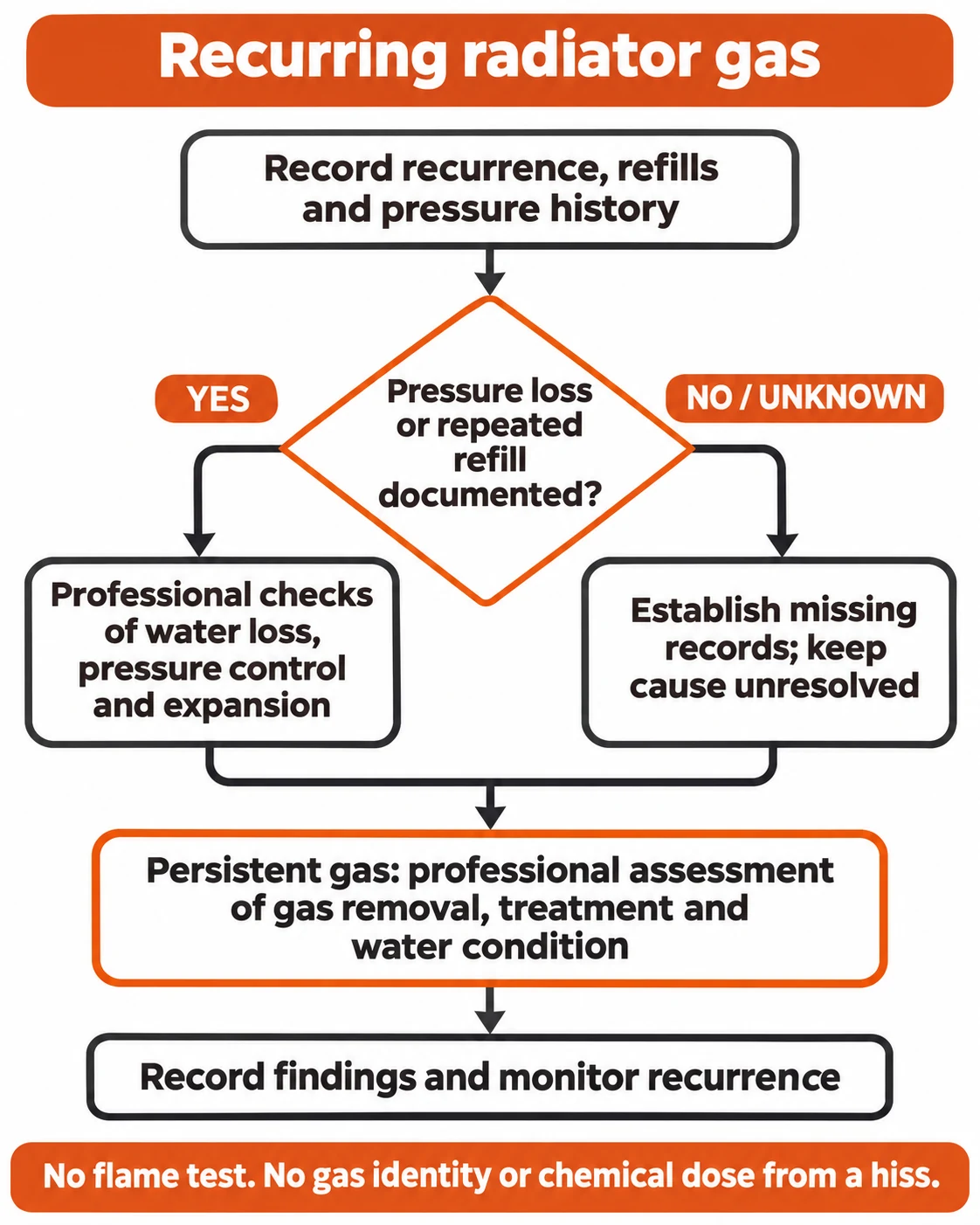
- Record recurrence, refill history and comparable pressure observations.
- If loss or repeated refill is documented, arrange professional checks of water loss, pressure control and expansion.
- If pressure appears stable or the history is unknown, establish missing records and keep the cause unresolved.
- Arrange competent assessment of persistent gas, treatment and water condition.
- Record findings and monitor recurrence under the agreed programme.
Repeated refill or documented pressure loss changes the next check
Spirotech’s pressure-maintenance guidance identifies regular refilling as a reason to investigate loss, including possibilities involving pipework, an expansion vessel or a discharging safety valve. Some losses may be concealed. The useful response is a professional assessment of the pressure and water-loss history, rather than deciding which of those parts to replace from the symptom alone.
Give the professional the recurrence record and refill history together. Ask them to establish the actual arrangement, assess pressure control and determine whether water is being lost. Report any observed discharge or visible leakage as an observation, with its time and operating circumstances. Leave valve operation, vessel checks and adjustments to the applicable service process.
A bottle of inhibitor does not explain why a circuit needs refilling. Likewise, a new air-removal device needs an application assessment. Its selection cannot be settled by how frequently one radiator collects gas. Investigating the hydraulic condition supplies the missing input that a generic additive recommendation would overlook.
Stable pressure leaves the gas question open
A credible record of stable pressure with no refill narrows the documented starting condition. It still does not prove that hydrogen caused the recurrence. Recover the treatment record, recent service history and actual material and equipment information, then ask the responsible professional what further gas-removal and water-condition assessment is appropriate.
Fernox describes microbiological fermentation as one possible source of gas in heating systems. Its discussion concerns a particular mechanism and treatment context. It cannot establish bacteria from venting frequency, water colour or an odour reported online. Those observations require competent interpretation before a treatment programme can be chosen.
Similarly, Sentinel’s commercial X100 Triple Power product facts describe inhibiting hydrogen gassing within that product’s scope. This explains why chemical protection can be relevant to an investigation. It supplies no identification test for the gas in an unrelated circuit, and no reason to transfer that commercial product’s dose to an unidentified domestic treatment.
Keep the existing inhibitor programme identifiable. Our mixed-brand top-up guide deals with the separate compatibility decision. The inhibitor-strip explanation separates a valid named test result from wider water acceptance. Recovering those inputs helps a professional assess protection without turning an unknown fluid into an improvised mixture.
Two handovers with different next decisions
Record A has repeated refill and pressure loss
In this illustrative case, the same radiator repeatedly collects gas. The owner has also documented repeated refilling after comparable cold-system readings fall. Treatment identity is known, but no investigation of the water loss has been recorded.
Completed decision — arrange a professional pressure-control and water-loss investigation, carrying both histories into the visit. Do not close the case with another inhibitor addition. The professional still needs to determine the loss mechanism and any necessary action. The record does not prove a failed expansion vessel, safety valve or leaking pipe.
Record B has stable observations but unidentified treatment
Here, gas repeatedly collects at an emitter, while comparable observations show stable pressure and the owner records no refilling. The last service invoice says “water treated” without identifying the product or test.
Completed decision — recover the service and treatment details, and arrange competent assessment of the persistent gas problem. Decline a proposed biocide dose based only on the recurring hiss. Stable pressure gives the professional a different starting record, while gas identity and water condition remain unresolved.
Both are fictional evidence exercises. Their value is the choice each record permits. Record A prioritises a documented hydraulic issue. Record B calls for missing treatment information and investigation of the continuing symptom. If later evidence changes either record, the professional can revise the investigation accordingly.
| Starting record | Next decision | Keep unresolved |
|---|---|---|
| Recurring gas and repeated refill | Professional water-loss and pressure-control investigation | Exact failed part and gas identity |
| Recurring gas, comparable stable pressure, no refill | Recover treatment history and assess persistent gas professionally | Hydrogen, bacteria or other case-specific cause |
| Pressure history absent | Establish a usable record with the responsible professional | Whether the apparent stability or loss is real |
Leave a record that shows what was established
After assessment, record the professional’s actual findings, work performed, identified treatment programme and agreed follow-up observations. Separate a finding from a proposed explanation. If a component was changed, keep its identity and service record. If the treatment was assessed, retain the applicable method and result. A later reader should be able to see which uncertainty was resolved.
Monitor recurrence under the agreed programme. A brief period without gas is an observation over that period. Its meaning depends on the work, operating conditions and follow-up scope. Avoid assigning a universal time-to-cure or guaranteeing that one action has permanently solved the problem.
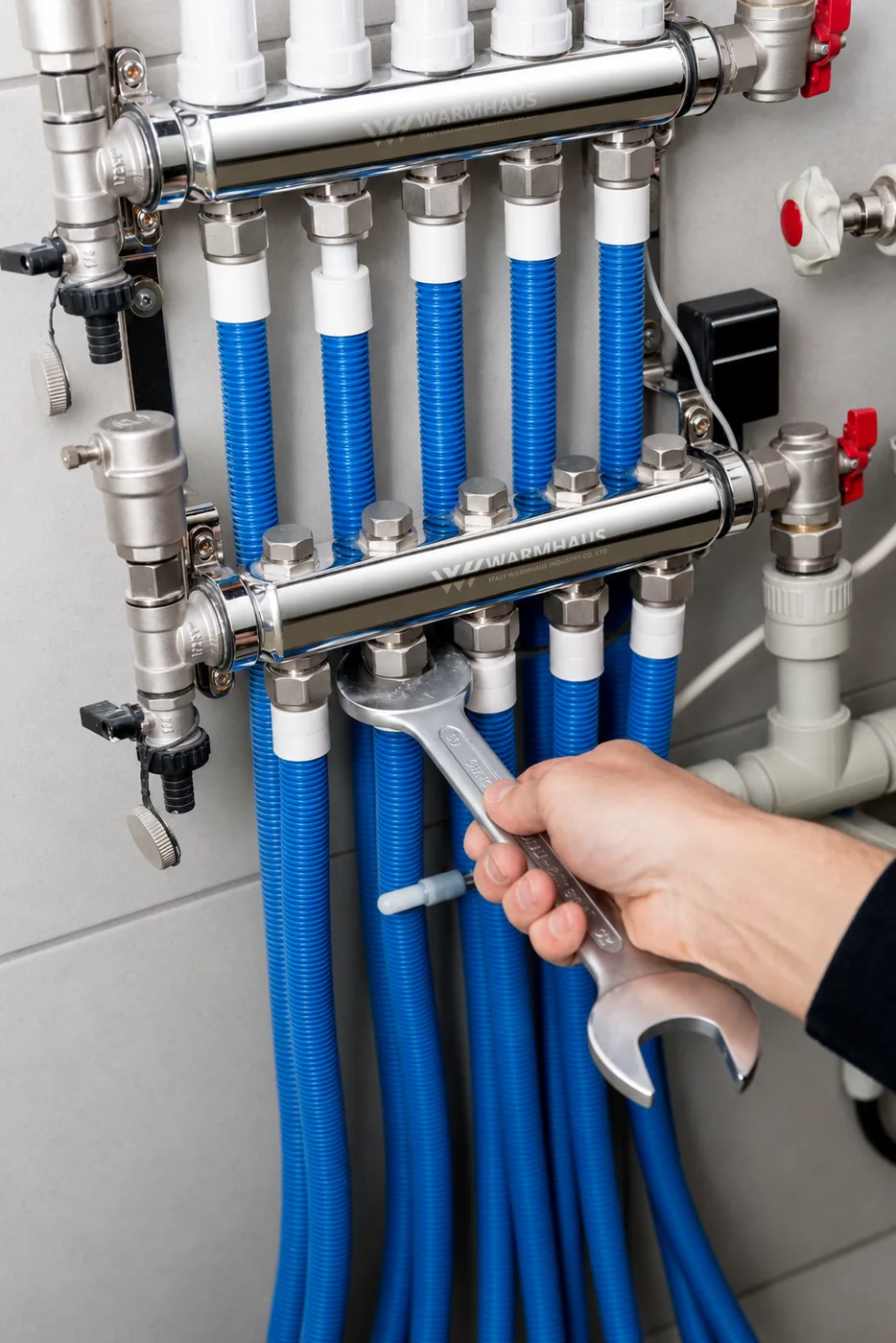
Where a heating component is being specified, send WARMHAUS the component specification, intended fluid and project destination for an availability and documentation check. Confirm the actual configuration and supporting information before procurement. The system investigation and chemical programme remain with the responsible heating professional.
Conclusion
Recurring radiator gas deserves a connected record of recurrence, refilling, pressure behaviour and treatment history. Documented loss or refill directs attention to a professional hydraulic investigation. Stable observations still leave gas identity and water condition open. Carry those distinctions into the service handover so the next action follows the evidence.
Frequently asked questions
Does a hiss mean the gas is hydrogen?
No. Sound and recurrence do not identify the gas. Keep ignition sources away and seek qualified assessment if flammable gas is suspected.
Does stable pressure prove there is no problem?
No. A comparable stable-pressure record is useful context, while persistent gas still needs appropriate investigation.
Should I add biocide when gas keeps returning?
Venting frequency does not establish biological contamination. The treatment decision needs competent assessment and the actual chemical and equipment requirements.
What should I send the heating professional?
Provide recurrence dates, refill history, pressure observations with operating conditions, recent work, treatment records and actual equipment details.
By WARMHAUS Editorial Team · Public-source editorial guidance. Sources reviewed 6 November 2026.