Can You Mix Heating Inhibitor Brands When Topping Up?
Do not assume a different heating inhibitor brand is a suitable top-up: identify the existing treatment, check the proposed product’s instructions, and follow the actual heat generator’s requirements.
One radiator comes off for cleaning. Some system water is lost, the radiator goes back on, and the bottle available locally has a different name from the treatment that might already be circulating. That small maintenance job has created two separate questions: how much protection was lost, and whether the proposed addition belongs with what remains.
For a documented Sentinel X100 circuit, the manufacturer’s published guidance gives a practical route: check concentration after component replacement and replenish as necessary. It also says mixing X100 with other inhibitor products is not recommended. For unidentified old fluid, adding a familiar brand does not identify the mixture. Recover the treatment record, or arrange a controlled replacement programme against the actual equipment instructions.
This guide works through both choices. It does not establish that every mixed inhibitor will gel, prescribe a universal dose, or approve chemicals for WARMHAUS components. The chemical and boiler examples retain their own product and market scope.
Key takeaways
- Loss of treated water can dilute protection; it does not justify an arbitrary new bottle.
- For identified X100, check concentration after component replacement and replenish as required by its instructions.
- X100’s published guidance does not recommend mixing it with other inhibitor products.
- Fernox compatibility with other Fernox products is not cross-brand mixing permission.
- A boiler manual’s list of recommended suppliers can coexist with an explicit instruction not to mix brands.
- For unknown fluid, choose record recovery or a controlled treatment replacement, rather than a blind cross-brand top-up.
See an X100 concentration check
Sentinel Performance Solutions Ltd’s “Step by Step | Sentinel X100 Quick Test” illustrates the named product’s checking context. It does not certify a mixed or unidentified treatment. Playback has not been manually verified.

Provider: YouTube · Channel: Sentinel Performance Solutions Ltd. Watch on YouTube.
Separate dilution from compatibility
A partially drained heating circuit is not an empty circuit. Taking one radiator off can remove treated water while leaving treatment in the rest of the system. Replacing the lost liquid with water changes the concentration. Adding another treatment introduces a separate compatibility question; the fact that both bottles say “central heating inhibitor” does not resolve it.
The Watts/AERCO Sentinel X100 page specifically describes dilution after radiators have been removed, emptied and reconnected. It calls for checking X100 concentration after replacement of components such as boilers or radiators, and replenishing as necessary. That is more useful than treating the system’s age as the only reason to add a bottle.
Keep the measurement tied to the identified product. A test used to assess X100 concentration addresses that protection question under its instructions. It does not certify that a mixture of unidentified treatments is compatible. Nor does clear water, an absence of sludge, or an acceptable pH establish the identity of every chemical already present.
Do not calculate a replacement dose from radiator count alone. The lost volume, the remaining concentration, the actual product and the equipment’s requirements all matter. This article supplies the choice of route; the relevant instructions and system information supply the amount.
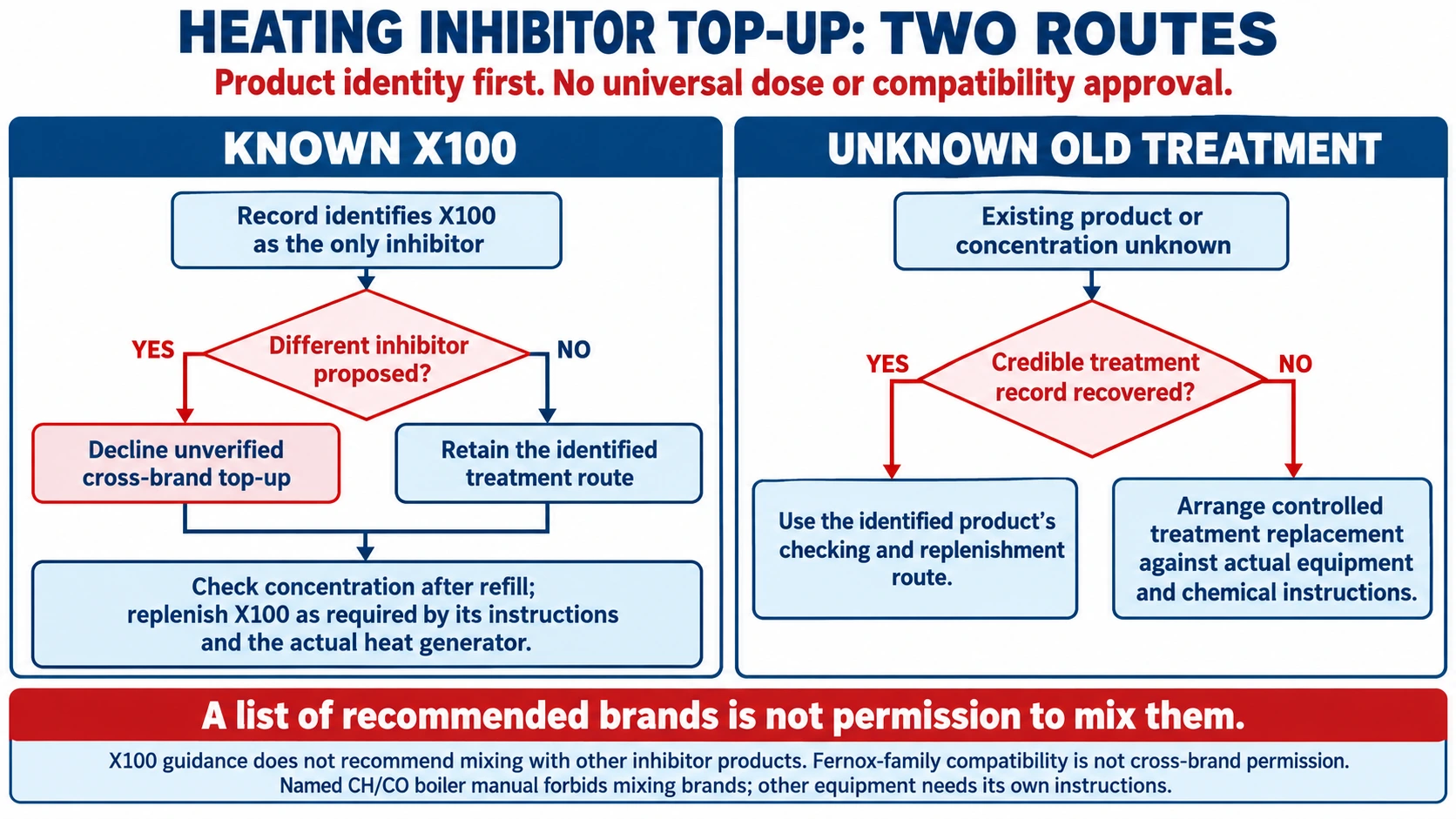
Open the full-size flowchart image.
- For documented X100, decline an unverified different-brand top-up; check concentration after refill and replenish X100 as its instructions and the actual heat generator require.
- For unknown old treatment, recover a credible record and use that product’s checking route; if no credible record is available, arrange controlled treatment replacement against the actual equipment and chemical instructions.
- Read product-family compatibility within its stated scope; a list of recommended brands does not override an instruction not to mix them.
Read the actual product statements
The X100 page answers the cross-brand question directly. It says the effects on system protection and component function cannot be predicted when X100 is added to a system containing other chemical inhibitors, and mixing with other inhibitor products is not recommended. That statement supports declining an unverified mixed-product addition. It does not explain a universal chemical reaction or establish that damage has already occurred if products were previously mixed.
Fernox uses different wording on its US Protector F1 Express page, product code 62673: compatibility is stated with other Fernox products. Read that boundary literally. It is not a statement that F1 Express can be added to any other manufacturer’s inhibitor, or that all possible system fluids and equipment are covered.
The same Fernox page calls for concentration to be maintained and checked annually as part of boiler or system servicing, in line with local requirements and practice. That is an ongoing maintenance instruction, not proof of cross-brand compatibility. Its pack coverage and dosing details belong to that exact regional product; they are not transferred here into a generic UK or WARMHAUS dose.
| Published statement | What it supports | What it does not establish |
|---|---|---|
| X100: check concentration after component replacement; replenish as necessary. | A measured replenishment route for an identified X100 circuit. | The amount needed in a circuit with unknown volume or old treatment. |
| X100: mixing with other inhibitor products is not recommended. | Decline a proposed unverified cross-brand top-up. | Every possible mixture will gel or has already damaged the system. |
| F1 Express: compatible with other Fernox products. | Compatibility wording within the named manufacturer’s product family. | Permission to add F1 Express to an unidentified or X100-treated circuit. |
Check the boiler’s instructions separately
A treatment manufacturer’s statement is only one part of the decision. The actual heat generator can impose its own requirements. Match the boiler or heat pump model and applicable manual rather than selecting the most convenient instruction from a different appliance.
A clear example appears in the Dunkirk-hosted CH/CO Installation and Service Manual. Its cover identifies residential CH-80, CH-100, CH-120, CH-150 and CH-180 boilers, and CO-90, CO-150 and CO-200 boilers. On PDF page 44, it explicitly says not to mix treatment chemicals from different brands, or antifreezes from different brands, because compatibility cannot be ensured.
The same page includes a table of corrosion/scale inhibitors and recommended suppliers, including products from Fernox and Sentinel. Those entries are alternatives in a product schedule. They do not override the adjacent mixing prohibition. Finding both brand names in one manual is not evidence that the two bottles belong in one circuit together.
This is a named boiler-manual example, not a WARMHAUS boiler instruction or a universal rule for every heat generator. Use it to understand how to read a table alongside its restrictions. For the actual job, the applicable equipment manual and treatment instructions must agree with the proposed programme.
Completed decision: known X100, proposed F1
Illustrative situation: the service record identifies X100 as the only inhibitor in the circuit. A radiator has been emptied and reconnected. Someone proposes topping up protection with F1 Express because it is already on the van. For this example, the connected boiler is one covered by the CH/CO manual cited above.
Decision: reject the proposed F1 Express addition. X100’s published mixing advice does not support it, and the named boiler manual expressly rules out mixed-brand treatment chemicals. A Fernox statement about compatibility within its own family does not change either condition.
The replacement route is specific: assess X100 concentration after refill using the applicable product instructions, then replenish the identified X100 as necessary, within the actual appliance’s treatment requirements. There is no need to prescribe an entire system drain solely because a radiator was removed. Equally, there is no basis for assuming that whatever inhibitor quantity fitted in that radiator is automatically the required replacement dose.
The completed choice is between two proposals: decline the different-brand bottle, and retain an identified, checked treatment programme. The installer still needs the actual concentration result and system information to determine the amount. No fictional concentration, volume or field result is claimed here.
Completed decision: unidentified old treatment
The real reader question behind this guide comes from a homeowner who bought a house without knowing the existing inhibitor brand or concentration. They planned to remove one radiator with a cold spot for mechanical flushing, then wondered whether to add Sentinel while Fernox, ADEY or Flomasta might already be present. Online replies disagreed, including unsupported claims about particular brands deliberately reacting with others.
Decision: do not use a blind X100 addition to resolve that uncertainty. A new bottle identifies only what you are adding. It does not establish the composition or protection level of what remains. The manufacturer’s X100 statement supplies no permission for that unknown combination.
First try to recover the identity from the commissioning record, previous service invoices, a treatment label or the installer’s records. If those records establish the product and treatment history, use its own checking and replenishment route with the actual equipment instructions. A label saying a treatment was once added is useful evidence, but it does not by itself establish today’s concentration or rule out later additions.
If the existing programme cannot be established, arrange a controlled treatment replacement with the responsible installer against the actual appliance and chemical instructions. That is a concrete maintenance route: establish what programme will be used, how the previous fluid will be removed or dealt with, how the circuit will be refilled, and how protection will be checked and recorded. It is not an instruction to add a random cleaner or perform a generic full-system flushing procedure.
Do not interpret “no blind top-up” as permission to leave a system indefinitely without suitable protection. Schedule the identification or replacement work as part of the maintenance plan. Nor does a cold radiator spot alone establish its cause or prove that a particular cleaning programme is appropriate; diagnosis and the chemical replacement decision remain separate.
| Starting condition | Completed choice | Next practical action |
|---|---|---|
| Documented X100; proposed F1 Express; cited CH/CO boiler example. | Reject mixed-brand top-up. Retain the identified treatment route. | Check X100 concentration after refill and replenish as needed under the applicable instructions. |
| Old treatment unknown; proposed new X100 bottle. | Decline blind addition to an unidentified mix. | Recover credible records; if identity remains unresolved, arrange a controlled replacement programme with the installer. |
| Product identified, but strength or lost volume unknown. | Do not invent the replacement amount. | Use the identified product’s assessment and dosing instructions with the actual system information. |
Leave a useful record for the next service
Record the exact treatment name and regional product version, what maintenance removed water, what was added, and how protection was checked. Keep the date and the relevant equipment instructions with that entry. The next installer should be able to distinguish a known product needing replenishment from a circuit with an uncertain chemical history.
Keep this separate from the original fill-water assessment. Our softened versus demineralised fill-water guide concerns hardness, conductivity, pH and matching water-quality criteria to the appliance. An accepted fill-water record does not establish permission to mix two inhibitors. Likewise, the manifold commissioning sequence documents hydraulic preparation and settings; completing it does not certify a chemical blend.
For an equipment enquiry, WARMHAUS publishes PEX-B loop pipe and brass-manifold heating components. If specifying or replacing those components, provide the component schedule, intended fluid, duty and project market so the exact configuration and applicable documentation can be checked. This is equipment application context, not an offer of inhibitor chemicals, treatment services, compatibility testing or approval of the connected boiler.
Conclusion
Before topping up, identify the old treatment, read the proposed product’s compatibility statement, and check the actual heat generator’s instructions. Known X100 has a concentration-check and replenishment route; it does not need a different-brand bottle simply because water was lost. Unknown fluid calls for record recovery or a planned treatment replacement, rather than an indefinite hold or an improvised mix. Record the resulting programme so the next service starts with facts.
Frequently Asked Questions
Can I mix Fernox F1 and Sentinel X100?
Do not assume so. The cited X100 guidance does not recommend mixing with other inhibitor products. Fernox family compatibility does not approve that pair; the actual heat generator’s requirements also apply.
Will mixing inhibitor brands always create sludge or gel?
The sources here do not establish that universal reaction. X100’s statement concerns unpredictable protection and component effects. Do not turn a forum anecdote into a chemical rule.
Does draining one radiator mean draining the whole system?
Not automatically. An identified treatment can have a checking and replenishment route. Unidentified fluid requires record recovery or a controlled replacement plan, not an automatic generic flushing prescription.
Can an acceptable pH prove that the mixture is compatible?
No. A pH result does not identify the existing treatment or establish permission to combine products. Follow the identified chemical and equipment instructions.
By Justin · WARMHAUS piping and heating-system content