Hydronic Fill Water: Does the Treatment Record Pass?
A fill-water certificate arrives marked “softened” and the hardness result passes the proposed criterion. That does not prove demineralisation or complete water-quality acceptance. Before signing, match the record to the actual heat generator and document revision, then check hardness, conductivity and pH separately wherever those instructions require them. Missing conductivity or an unidentified appliance revision means HOLD, even with a hardness pass.
Key Takeaways
- Softening removes hardness-forming ions by exchange; it does not establish low dissolved-salt content.
- Conductivity and hardness answer different acceptance questions.
- Identify the exact equipment and applicable instructions before choosing a limit.
- Keep the two Viessmann document examples separate; their hardness-table bands differ.
- A certificate needs sample identity and results, not just a treatment name.
- Record later top-up water so the original fill record remains interpretable.
Conductivity: the measurement behind the record
Illinois-Indiana Sea Grant explains conductivity as a water-quality parameter. This neutral background video does not establish a hydronic equipment limit or treatment approval.
Play related video: Conductivity
Identify the equipment requirement before reading the certificate
Start with the equipment schedule, not the treatment supplier’s heading. Record the heat-generator model, output configuration, applicable instruction document and revision, system volume and relevant materials. A certificate can describe water accurately while answering a different equipment requirement. “Suitable for heating” does not identify which requirement the reviewer checked.
The distinction is visible within one manufacturer’s documentation. The Viessmann Vitodens 200-W commercial technical guide, document 5822432, printed page 75, discusses hardness, electrical conductivity and pH separately. It says potable-quality tap water is the filling basis and that softening is normally sufficient, while also identifying conditions requiring further attention. Its statement that full desalination is unnecessary without aluminium components cannot be detached from the page’s other water-quality requirements.
For example, that page calls for desalination when heating-water conductivity exceeds 1500 µS/cm because of high salt content. Its pH ranges also differ according to aluminium-alloy presence. Those are named-document examples, not acceptance limits for every hydronic installation or a summary of all VDI 2035 requirements. VDI 2035 is guidance concerning damage prevention in water-heating installations; this article does not reproduce or certify compliance with it.
A second source, Vitodens 200-W 120–150 kW installation and service instructions, document 5775654, printed page 27, gives a different hardness table. Its specific-system-volume columns use boundaries at 20 and 50 litres per kilowatt; document 5822432 uses boundaries at 20 and 40, alongside additional distinctions. Do not select a convenient cell from each. These documents do not establish which revision applies to an unidentified appliance.
Choose the applicable instruction first. A familiar product-family name is not a document-revision check.
Send an unresolved document match to the equipment manufacturer or project designer. Ask them to identify the applicable instruction and acceptance criteria for the installed configuration. If the schedule omits system volume or material information needed by that instruction, retain an open item rather than choosing a less demanding column.
Compare hardness and conductivity as separate evidence
Hardness describes the hardness-forming content, especially calcium and magnesium. Conductivity describes how readily water carries electrical current and responds to dissolved ions. A low hardness result cannot stand in for a conductivity measurement: changing which ions are present is different from removing dissolved salts.
Caleffi’s automatic water-treatment unit technical brochure 01360_EN illustrates the mechanism. Its softening process exchanges calcium and magnesium for sodium while dissolved salts remain in the treated water. Its demineralisation process uses cation and anion exchange resins to remove dissolved ions. The brochure also specifies softening capacity using hardness and demineralisation capacity using residual conductivity. These are Caleffi treatment descriptions, not a WARMHAUS treatment offer.
| Record supplied | What it can support | What remains separate |
|---|---|---|
| Softening identification plus hardness result | Assessment of the recorded hardness against the applicable criterion | Conductivity, pH and equipment applicability |
| Demineralisation identification plus conductivity result | Assessment of the recorded ionic-content indicator against its criterion | Other required results and final system-water acceptance |
| Treatment name alone | Identification of the proposed process | Measured output and acceptance against the actual instructions |
Keep the sample location visible. A result at a cartridge outlet identifies that sample; it does not automatically describe the final circulating water after mixing with residual water. Request the measurements and sampling stage required by the applicable equipment instructions. Likewise, preserve the reported units and measurement conditions rather than copying an unlabelled number into an acceptance sheet.

Apply the check to a filled decision record
The following is a logical review example, not a project test or a fabricated certificate. Its starting condition is deliberately limited: a proposed hardness criterion has a stated pass, but the record omits conductivity and the applicable appliance revision. There is no measured value to invent. The useful result is the reviewer’s disposition and the exact request needed to resolve it.
| Review field | Illustrative record entry | Disposition / next evidence |
|---|---|---|
| Equipment identity and instruction revision | Vitodens 200-W family named; exact appliance/revision not confirmed | HOLD: obtain nameplate/configuration and applicable instruction |
| Hardness | Pass reported against proposed criterion; underlying value not supplied in this example | Provisional only: attach result, units and criterion after document match |
| Conductivity | Unknown; no result supplied | HOLD: obtain required sample result and assess against matched instructions |
| pH and system materials | Unknown | Confirm materials and required pH assessment |
| Sample identity | Final circulating-water sample not identified | Resolve sample location, stage, date and method |
| Top-up record | Not attached | Provide log and ongoing recording responsibility |
| Overall decision | HOLD — water-quality acceptance unresolved | Do not convert hardness pass into full acceptance |
Now change just one fact: conductivity arrives and meets a proposed limit. The appliance revision is still unknown, so the overall decision remains HOLD. A successful measurement does not prove that the reviewer selected the right limit. Conversely, identifying the correct revision would not fill the missing conductivity field. Close both gaps separately.
Once the applicable requirements and all required results are available, the responsible project reviewer can record acceptance or rejection against them. If a result fails, refer the treatment decision to the equipment instructions and qualified specialist. The Viessmann technical guide reserves chemical-water-treatment planning and execution for appropriately qualified specialist companies; this record is not a dosing recipe.
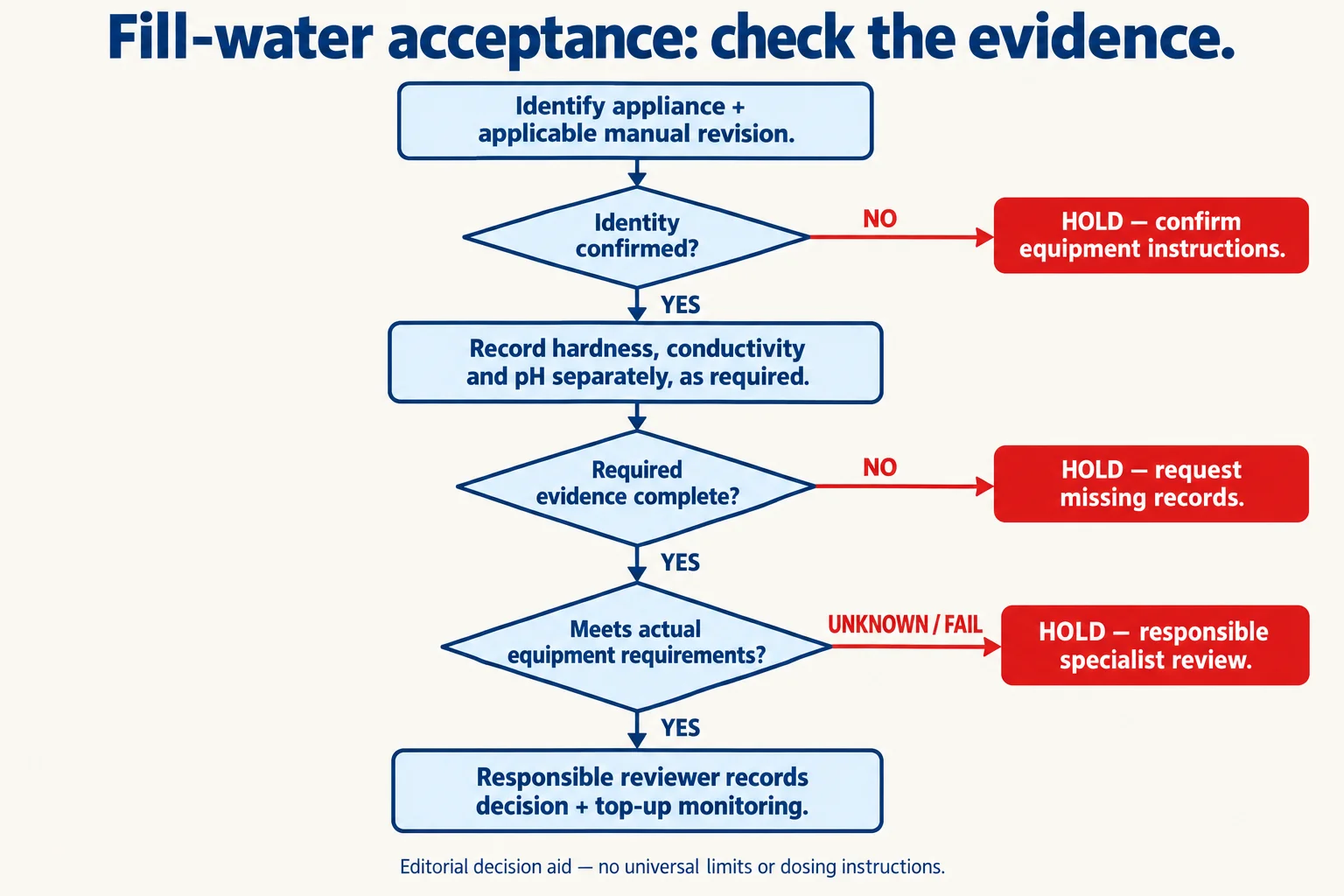
- Identify actual appliance and applicable manual revision
- Record hardness, conductivity and pH separately as required
- Are all required records complete? Missing → HOLD
- Do results meet the actual equipment requirements? Unknown/fail → HOLD and specialist review
- Complete → responsible reviewer records decision and top-up monitoring
Keep the water record separate and current at handover
Attach the accepted water-quality record to the project handover file, with the exact source document and any written clarification. Keep it distinct from the hydraulic sequence in the manifold commissioning guide. A completed balancing or flushing entry cannot answer whether the water meets a chemical requirement.
The named Viessmann technical guide calls for regular checks of appearance, hardness, conductivity and pH, and documentation of top-up quantity and properties. A later addition changes what the original sample represents. Record the addition’s date, source, quantity and treatment information, then follow the applicable monitoring instructions. Do not use the original fill certificate as permanent proof of unchanged circulating-water quality.
For the hardware schedule, the WARMHAUS brass-manifold range provides category context. Keep the exact manifold, pipe, seals and connected equipment in the application review. A category page does not approve the proposed fill water or establish chemical compatibility.

Send the component schedule with the open items
Use the WARMHAUS contact page for a pipe or manifold enquiry. Include country, component schedule, sizes, duty, quantities and required delivery date; ask whether the exact configuration and documentation can be offered. Keep water-treatment acceptance with the responsible equipment reviewer.
Conclusion
Put a named requirement beside each required result before signing. Where a certificate supplies hardness but leaves conductivity or the appliance revision unknown, issue a HOLD with those missing items listed. At handover, retain the resolved record and assign responsibility for top-up entries and the equipment’s required monitoring.
Frequently asked questions
Does softened water count as demineralised water?
No. Softening exchanges hardness-forming ions; it does not establish removal of dissolved salts. A hardness result cannot replace conductivity evidence.
Must every hydronic system use fully demineralised water?
The cited equipment example does not support that rule. Match the actual equipment, materials and applicable instructions before selecting treatment.
Can a clear-looking sample prove acceptance?
No. Appearance does not supply the separate hardness, conductivity or pH results required by the applicable instructions.
Does the worked record approve a Vitodens installation?
No. It demonstrates a HOLD decision when evidence is missing. The actual appliance configuration, instructions and required results remain necessary.
By Justin. Compiled from the cited public manufacturer documents, reviewed for this draft on 31 October 2026. No field measurements or product compatibility approval are claimed.