Heating Inhibitor Test Strip Passed: What Has Actually Been Checked?
A passed inhibitor strip supports only the test performed with that strip, its matching colour chart and its stated reading window. It does not establish pH, corrosion levels, water clarity or compatibility of an unidentified treatment. Before accepting the result, identify the test and treatment, verify that the sample was read correctly, and separate the completed check from the checks still outstanding.
That distinction matters at a service handover. “Inhibitor test passed” is a useful record. “System water approved” is a much wider conclusion, and the first statement does not supply all the evidence needed for the second.
Check that the colour result is valid
Start with the test container and instructions, rather than the appearance of the water. You need the product identity, its matching colour chart and the applicable instructions. A loose strip without those items leaves you unable to connect its colour to a defined result. A photograph can preserve an observation; it cannot reconstruct the missing reference chart.
A real public question illustrates the problem. In a BuildHub discussion about Fernox strip reliability, the questioner described a small repacked quantity arriving without instructions or a colour chart. Little colour was visible during the stated reading window, while a darker colour developed later. That account establishes a testing question, not a laboratory finding about why the strips behaved that way. It cannot prove expiry, contamination or the condition of that heating system.
For the Fernox Express Inhibitor Test identified as code 63630, the published instructions call for a representative system-water sample, a one-second dip and comparison with the colour chart within 10 seconds. They also direct the user to drain water for several seconds before taking the sample. Those are instructions for that named test, not a universal protocol for every brand of test strip.
If someone shows you a later photograph, ask whether it records the colour within the required window. A dark colour after that window does not retrospectively establish an in-window pass. Equally, you should not turn the delayed colour into a diagnosis of a defective strip. Repeat the check using an identified test with its correct chart and current instructions; obtain the manufacturer’s advice if its behaviour remains unclear.
The same logic applies to sampling. A strip measures the sample presented to it. If the sample is not representative of the circulating system water, a neatly photographed result still leaves a sampling question unresolved. Record the sample point and circumstances so the next person can judge what the result represents.
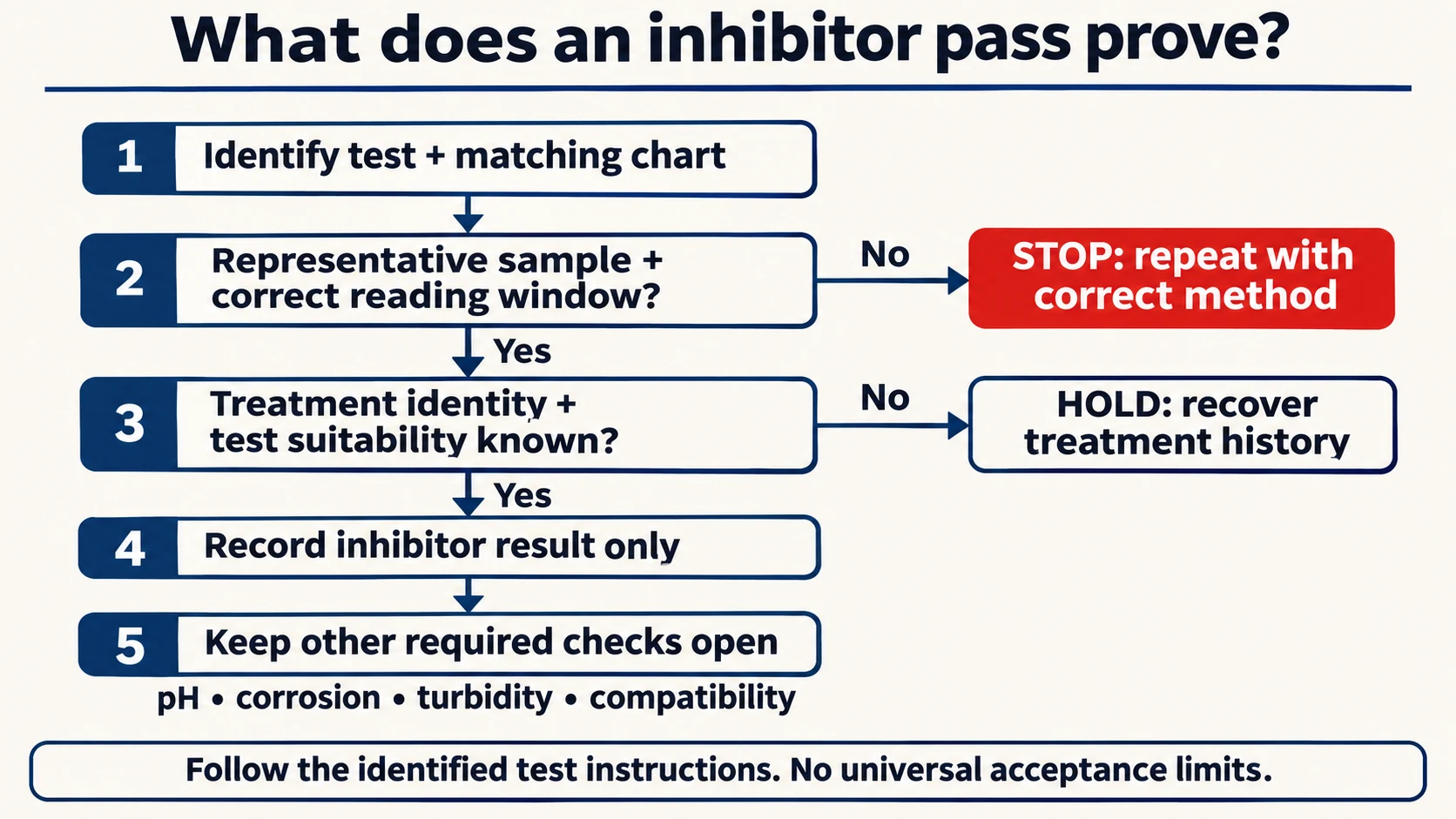
- Identify the test and its matching colour chart.
- Confirm a representative sample and the correct reading window; otherwise repeat with the correct method.
- Confirm treatment identity and test suitability; otherwise hold acceptance and recover treatment history.
- Record only the inhibitor result supported by the identified method.
- Keep other required pH, corrosion, turbidity and compatibility checks open until their evidence exists.
Separate inhibitor concentration from water condition
Once the reading is valid, determine what the test is designed to detect. Fernox describes its Express Inhibitor Test as checking its Protectors and other molybdate-based inhibitors. That scope matters: the words “inhibitor test” do not make a strip a universal assay for all treatment chemistries. Identify the treatment and use the checking method its manufacturer specifies.
There is also a difference between a compatible test and a complete assessment. Fernox’s Instant System Test combines inhibitor testing with separate corrosion/pH strips and a turbidity tube. The manufacturer explains that these components address different parameters. Their separate existence gives the reviewer a practical reason to resist treating one result as evidence for everything else.
| Recorded evidence | Supported conclusion | Still not established |
|---|---|---|
| Valid inhibitor-strip result, identified compatible treatment | The inhibitor check has the reported result under that test’s instructions | pH, corrosion indicators, suspended solids or mixed-product compatibility |
| Separate corrosion and pH test | The parameters measured by that named test | The inhibitor concentration without its own appropriate test |
| Turbidity-tube result | The suspended-solids observation measured by that method | The identity or concentration of the treatment chemical |
Source: Fernox Express Inhibitor Test and Instant System Test product instructions. This table interprets the scope of those methods; it sets no universal water-quality acceptance limits.
Keep the unanswered questions distinct. An unknown pH is not a failed inhibitor test. A passed inhibitor test is not a passed pH test. When you separate those statements, the record tells the next reviewer which assessment to obtain rather than inviting an unnecessary repeat of a check already completed.
Read three sample records without overclaiming
The following are illustrative record reviews, not measurements or customer cases. They show how the conclusion changes when one piece of evidence changes.
Record A: no chart, delayed colour
The file contains a loose strip, no product container and a photograph taken after the required reading window. The result is not interpretable as a pass or fail for an identified test. The useful decision is to replace the incomplete test record with a properly identified check. Adding inhibitor would not resolve the missing chart, product identity or timing.
Record B: valid pass, other parameters absent
The treatment is identified, the chosen test is appropriate for it, and the sample and timing follow the test instructions. The recorded result is a pass. Accept that inhibitor check within its documented scope. If the handover also requires pH, corrosion or turbidity evidence, leave those requirements open until the relevant results exist. Do not label the whole water assessment complete merely because its first item passed.
Record C: a clear pass, unclear treatment history
The strip was read correctly, but the record does not identify the inhibitor or later additions. There is now evidence about that test response, while the treatment history remains unresolved. The strip cannot reconstruct which products were added or establish that they can be mixed. Recover the treatment record and the applicable manufacturer guidance before using the result to justify another chemical addition.
This third case differs from an invalid reading. Repeating the same test can confirm repeatability, but does not necessarily identify the treatment. The missing input is the actual product history, because that determines whether the method and any replenishment instruction apply. Once that history is established, assess the named product against its own checking and dosing instructions. For the separate cross-brand decision, see mixing heating inhibitor brands during a top-up.
Record the limit before approving the handover
A useful handover record connects the observation to the method. Include the test product and treatment identity, the matching chart or container reference, the sample point, the reading timing, the recorded result and any unresolved conditions. Retain the image where the method calls for it. Avoid writing simply “water good” beside a photograph: a later reviewer cannot tell which property was checked.
For illustrative Record B, a defensible entry would read: “Identified treatment checked with its applicable inhibitor method; result recorded as pass. Separate pH, corrosion and turbidity results not supplied in this record.” This wording neither discards a useful test nor converts missing results into failures. It makes the remaining acceptance decision visible.
Determine which other results are actually required from the applicable equipment, commissioning or maintenance documentation. The cited product pages do not provide a universal acceptance specification for every boiler, heat pump, manifold or combination of metals. A device requirement belongs to the actual device and instructions. Likewise, do not carry a fill-water certificate forward as if it were automatically a complete current-system assessment. The softened versus demineralised fill-water guide explains why different water parameters require separate evidence.
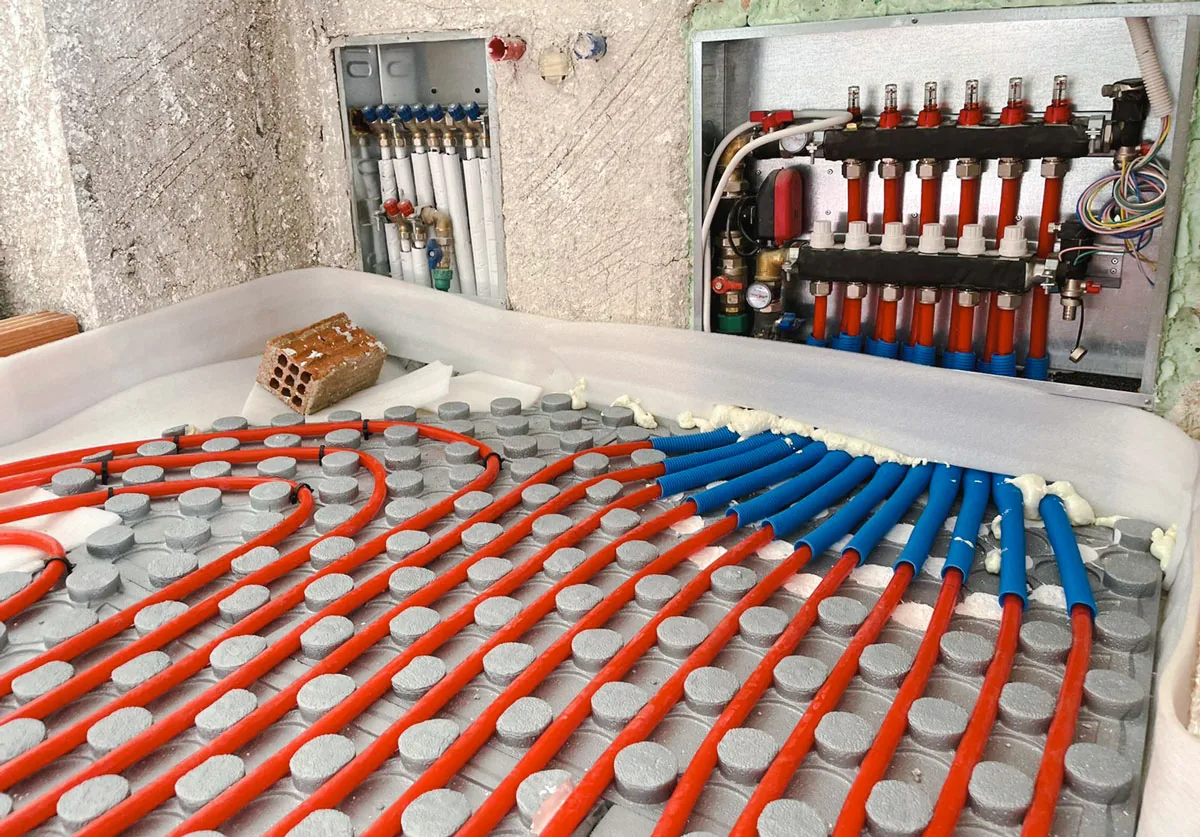
If a system component is being specified alongside this review, the component specification is a separate procurement decision. The WARMHAUS underfloor-heating manifold page is a starting point for that enquiry; this article does not confirm a particular chemical’s compatibility with a WARMHAUS model. Provide the project country, exact component and proposed treatment so availability and documentation can first be checked.
Conclusion
Accept a pass for the check it actually represents. First establish a valid method and reading; then match the result to the treatment and the parameter measured. Keep other water-quality checks and chemical-compatibility questions open when their evidence is missing. A narrowly written result is more useful at handover than a broad approval that the test never supplied.
Frequently asked questions
Can a colour that develops later count as the result?
Use the reading window stated for the identified test. A later colour cannot replace a missing in-window observation. It also cannot, by itself, diagnose expiry or contamination.
Does a pass mean no other water tests are needed?
No. Check which parameters the actual handover or maintenance requirements call for. Fernox’s combined system kit uses separate methods for inhibitor concentration, corrosion/pH and turbidity.
Can the strip identify which inhibitor is in the system?
The cited Express test checks its stated inhibitor scope; its result is not a treatment-history record. Establish the product identity before applying its checking or replenishment instructions.