A distributor rarely loses a PPR order on the pipe. He loses it on the one fitting that is not on the shelf — the single 32 × 25 reducing tee that sends the installer somewhere else. This guide sets out the complete PPR pipe fittings taxonomy: ten functional groups, how each order code is actually written, the thread standards (G/BSPP, R/BSPT, NPT) that decide whether a transition part seals, and the diameter and PN variables that multiply ten groups into a real stock list.
Two things make PPR fittings different from anything in metal or PVC. First, a PPR fitting is the same random-copolymer polypropylene as the pipe, so it does not sit on the pipe with glue or a seal — it fuses into it by hot-melt welding into one continuous wall. Second, that fusion is dimensioned as a system: the socket bore is cut to the pipe outside diameter, so a fitting from one production standard and a pipe from another can weld badly even when both are nominally 25 mm. Everything below assumes one matched PPR system.
I. How PPR Fittings Are Classified — Three Axes, Not One
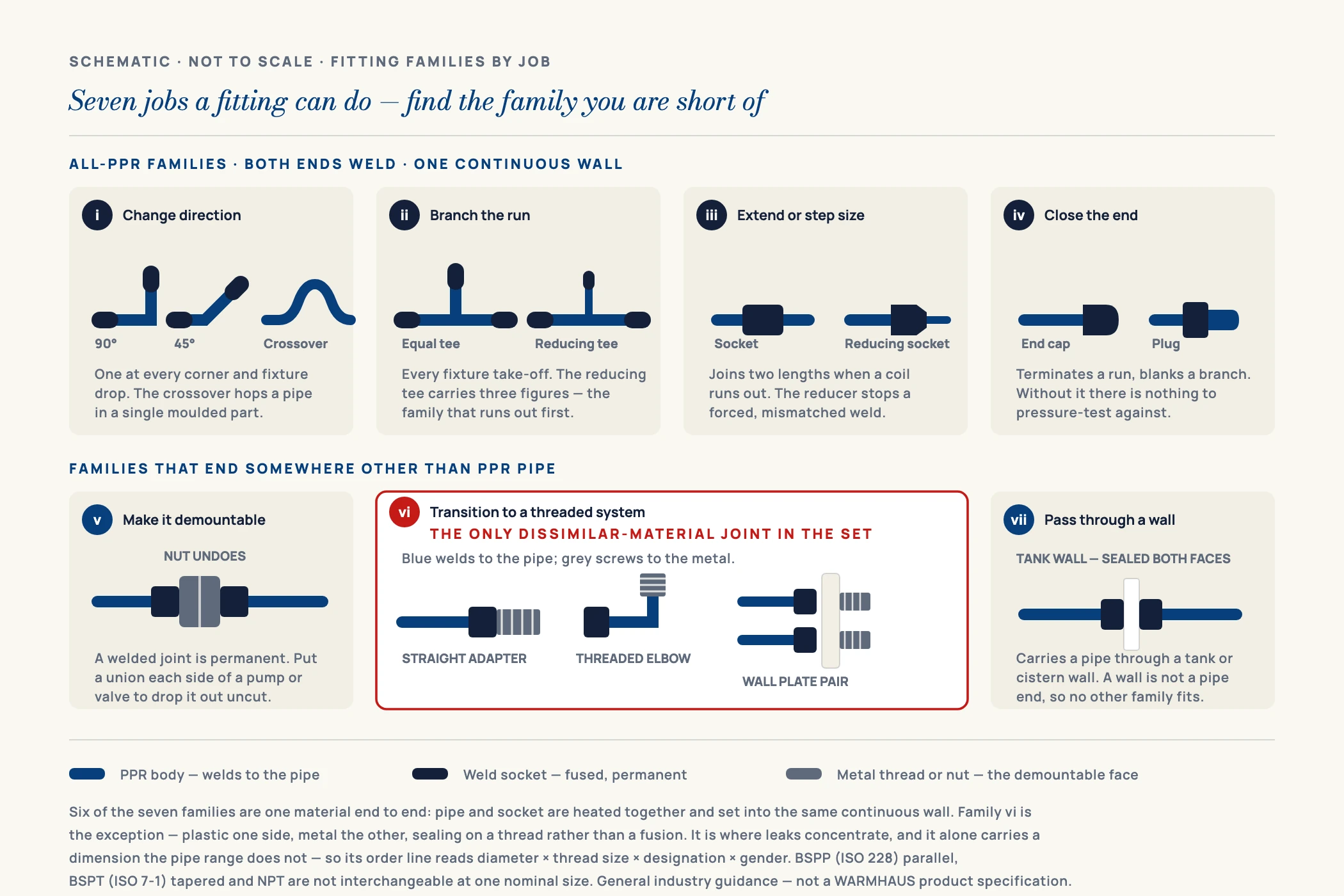
Catalogue confusion comes from collapsing three independent variables into one list. Function is what the part does to the run — change direction, branch, join, step a diameter, transition to metal, allow demounting, terminate, or support. That is the ten-group taxonomy below, and the axis installers speak in.
Connection type is the second axis. Nearly all PPR fittings have socket-fusion (weld) ends: a female socket receiving the pipe. The exceptions meet metal — threaded adapters, union halves and flange adapters — carrying a thread or bolt face on one side and a weld socket on the other. Two weld ends make a pure PPR part; one weld end and one thread makes a transition part, and transition parts are where system failures concentrate.
Geometry is the third: equal or reducing, 90° or 45°, male or female thread, and the diameter. This axis multiplies ten groups into hundreds of order codes — across a six-diameter residential range the reducing-tee group alone accounts for around fifteen legitimate combinations before a single thread size is added.
Ten functions, two connection types, and a diameter matrix — that is the whole PPR fitting catalogue, and why the reducing tee is always the part that runs out first.
II. PPR Pipe Fittings Types — Group, Code Shape and Stock Multiplier
Every PPR catalogue lists these ten groups. What a catalogue does not tell you is how many order codes each group turns into, and that is the number that decides whether your fitting box is complete. The third column below gives the shape of the order code — the figures that must appear on a purchase-order line for the part to be unambiguous — and the fourth gives what multiplies it. Read the table as a stocking model, not a product list.
Take a range of six diameters (20, 25, 32, 40, 50, 63 mm) as the working example throughout — the residential and light-commercial spread most distributors start with.
| № | Fitting group | How the order code is written | What multiplies it into codes | Codes over a 6-diameter range |
|---|---|---|---|---|
| I. | Elbows | Ø × angle (e.g. 25 × 90°); reducing: Ø1 × Ø2 × angle | Two angles (90°, 45°) × diameter; reducing versions add adjacent pairs | ~12 equal + a short reducing list |
| II. | Tees | Three figures: run × branch × run (32 × 20 × 32) | Every branch diameter below the main is a separate code | 6 equal + ~15 reducing — the biggest single group |
| III. | Sockets / couplings | Ø (equal); Ø1 × Ø2 (reducing) | One code per diameter, plus one per diameter pair you actually step | 6 equal + ~5 adjacent-pair reducers |
| IV. | Threaded adapters | Ø × thread size × thread standard × gender (25 × 3/4″ BSPP male) | Diameter × thread size × male/female × straight/elbow/tee body | Largest code count of all — see section V |
| V. | Unions | Ø, plus half type (weld/weld or weld/thread) | Diameter × whether the far half is welded or threaded | ~6–12 |
| VI. | Crossover / bridge bends | Ø only | Diameter alone; rarely made above mid-range diameters | ~3–4 (small diameters only) |
| VII. | Crosses | Ø, or run × branch × run × branch | Diameter; reducing crosses exist but are a specials line | ~4–6; not stocked deep |
| VIII. | Flange adapters | Ø × flange drilling standard and PN of the flange (not the pipe) | Ordered against the mating equipment, not the pipe range | Order to project, not to stock |
| IX. | End caps / plugs | Ø | Diameter alone — the simplest code in the catalogue | 6 |
| X. | Pipe clips / saddles | Ø × single/double × fixing type | Diameter × clip style; not a welded part | ~6–12 |
Group definitions, code conventions and the indicative code counts above reflect general industry practice for PPR systems, not a WARMHAUS-specific specification. Code structure and range depth differ by manufacturer — always confirm against the technical datasheet and catalogue of the pipe and fittings you are using. WARMHAUS fitting groups are listed on the PPR fittings page.
Two conclusions fall straight out of the right-hand column. Reducing tees dominate the code count — the group is defined by three figures instead of one, so it generates more line items than elbows and sockets combined, which is exactly why it is the group that runs out. And threaded adapters are not one group but a matrix, because they carry a dimension the pipe range knows nothing about: the thread. That is section V.
III. Reading the Groups: What Each Part Is Really For
I. Elbows and bends
The 90° elbow is the highest-volume fitting in almost every residential order — every fixture drop and corner uses one. The 45° version matters more than its volume suggests: two 45° bends across a shallow offset impose less pressure loss than two 90° turns, which is why specifiers on long runs call them out. Reducing elbows save a socket and a pipe stub at every fixture.
II. Tees and reducing tees
Equal tees branch a line at the same diameter; reducing tees drop a smaller fixture branch off a main, which is the normal case in a real building. This group also has the worst stock-out record, because the code is defined by three dimensions: a 32 × 20 × 32 tee and a 32 × 25 × 32 tee look nearly identical on a shelf. Bin them by full three-figure code, not by nominal main size.
III. Sockets and reducing sockets
The plain socket joins two pipe lengths — used when a coil runs out mid-wall, and constantly in repair work. The reducing socket steps a main down one or two diameters. Without it, installers force a smaller pipe into a larger socket and rely on molten material to fill the gap — precisely the joint that fails a pressure test.
IV. Threaded adapters — the transition part that decides the system
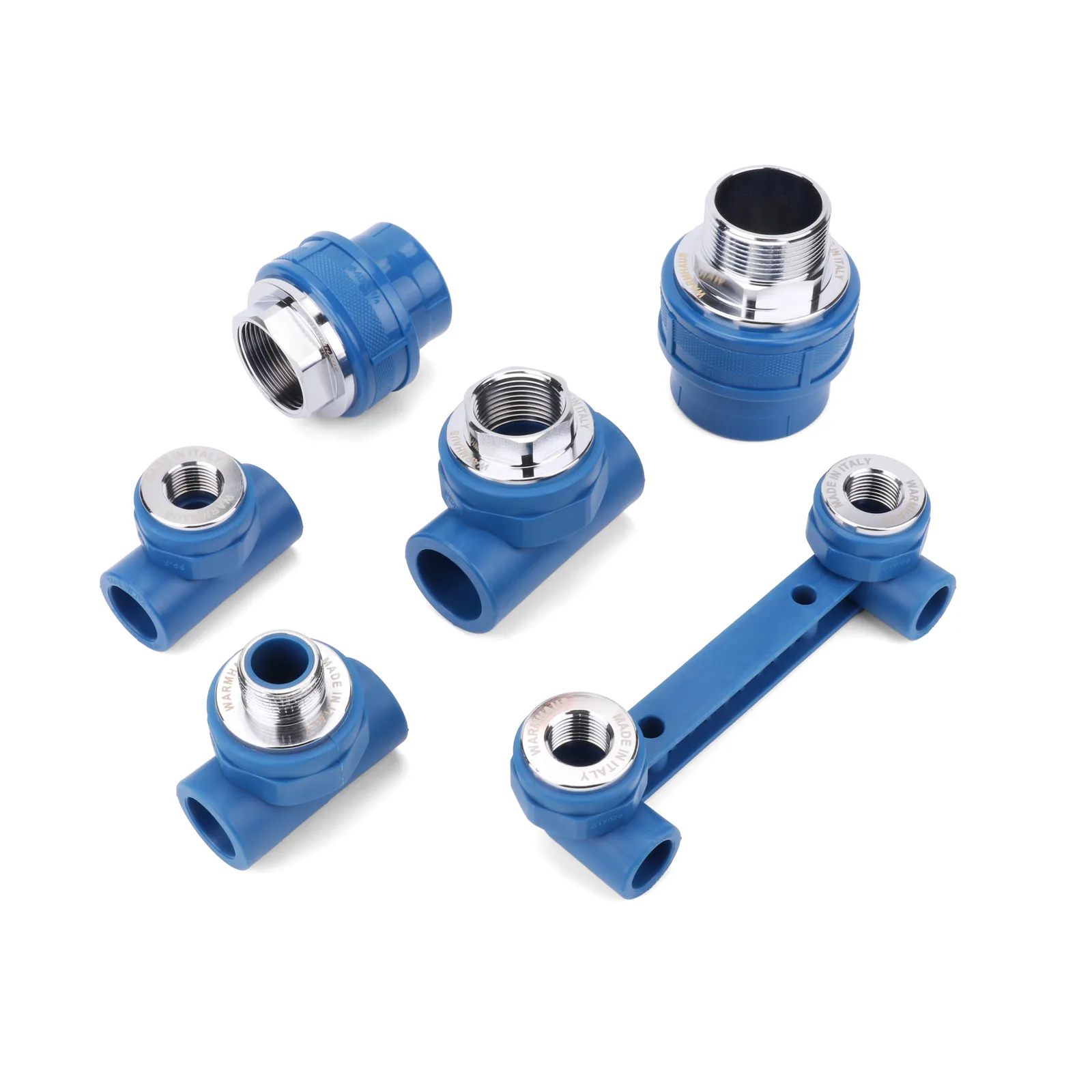
Everywhere the PPR line meets metal — a brass ball valve, a water meter, a tap tail, a heating manifold — you need a threaded adapter: weld socket on the PPR side, thread on the metal side. The decisive detail is whether that thread is a brass insert or cut directly into the plastic. A plastic thread creeps under load and loses its seal after a few service cycles; a metal insert holds a metal-to-metal thread and survives being opened again, which is why brass-insert adapters are the general specification for any interface that will be serviced. Male and female versions exist as straight adapters, elbows and tees. Because the insert sits in a plastic body, both the torque limit and the sealing method belong to the thread — the subject of the next section.
V. Unions
A welded PPR joint is permanent — its virtue and its limitation. The three-piece union restores a demountable point: two halves welded into the line and a nut that can be undone to drop a pump, filter or section of pipe out for service without cutting. Specifiers put unions either side of any serviceable device.
VI–X. Crossovers, crosses, flanges, caps and clips
The crossover (bridge) bend lets one pipe hop over another in a shared chase with a single moulded part rather than four elbows and three welds — fewer joints, fewer leak candidates. Crosses concentrate multiple branches at one node, useful under vanity units and in tight risers. Flange adapters appear only on larger mains, where the line bolts to a pump, a tank nozzle or a large valve; they are ordered against the equipment's bolt pattern, not the pipe alone. End caps terminate a run and close a branch for pressure testing. Pipe clips are not a joint, but they belong in the fitting order: PPR expands measurably with temperature, and a run clamped at the wrong interval will bow visibly on the wall.
IV. PPR Fitting Sizes — How the Diameter Matrix Works
PPR fittings are ordered by the outside diameter of the pipe they weld onto, not by a nominal bore as in threaded metal work: a 25 mm elbow receives 25 mm OD pipe. That convention removes most of the confusion importers hit cross-referencing a PPR catalogue against a steel or copper one, where DN and inch sizes describe the bore.
Second, the fitting must belong to the same PN class family as the pipe. Plain (unreinforced) PP-R pipe is commonly offered in PN10, PN16 and PN20, cold supply typically served by the lower classes and continuous hot water by PN20. PN25 is normally a fibre-reinforced or composite construction, not the same plain material at a heavier wall — so a quotation offering PN25 in plain PP-R deserves a question. Wall thickness changes with the class while the outside diameter stays fixed; because the fitting welds onto the outside surface, it will physically accept several PN classes, but the assembly should be specified as one system. The class-by-class geometry is set out in our guide to PPR pressure ratings and PN classes, and PN values are nominal at a 20 °C reference — hot water and long design life are handled by derating, not by the printed class. Size and PN detail for the WARMHAUS range sits on the PPR pipe page. Treat these class ranges as general industry guidance and confirm them against the datasheet of the pipe and fittings you are using.
Thread standards — the dimension the pipe range does not contain
Threaded adapters carry a second dimension independent of the pipe diameter, and it is not just a size in inches — it is a standard. Two threads can both be called “1/2 inch” and not seal against each other. This is the detail most first orders get wrong, so it is worth the codes in full.
| Designation | Family | Form | Where the seal is made | Typical use |
|---|---|---|---|---|
| G (e.g. G½) | ISO 228 / BSPP | Parallel | Not on the thread — on a washer, O-ring or flat face at the shoulder | The common European plumbing interface: valves, meters, manifold outlets, hose and tap connections |
| R (e.g. R½) | ISO 7 / BSPT | Tapered male | On the flanks of the thread itself, with sealant or PTFE tape | Male ends screwing into tapered or parallel female ports where a jointing compound is used |
| Rp (e.g. Rp½) | ISO 7 | Parallel female | Designed to receive an R tapered male and seal on the thread | The female counterpart most often found on plastic-body and brass fittings |
| Rc | ISO 7 | Tapered female | On the thread flanks against an R male | Tapered-to-tapered assemblies |
| NPT / NPTF | ANSI/ASME B1.20.1 | Tapered, 60° flank angle | On the thread flanks | North-American-specified work; not interchangeable with BSP, which uses a 55° flank angle |
Thread designations and their sealing principles are general industry guidance drawn from the published standards named above, not a WARMHAUS specification. Confirm the designation stamped or stated on both the adapter and the mating component before assembly, and follow the fitting manufacturer’s datasheet for tightening and jointing method.
Three practical consequences. First, BSP and NPT are different threads — the flank angle differs (55° against 60°) and the pitches diverge at most sizes, so a joint made between the two families may start and then leak or split the socket. Second, a parallel male into a parallel female needs a gasket: wrapping PTFE tape round a G thread and expecting it to seal like a tapered one is a common site error, and on a plastic body the extra turns are what cracks it. Third, an order line must therefore read diameter × thread size × designation × gender — “25 × ¾″ BSPP female”, not “25 mm female adapter”. Our guide to brass insert fittings for PPR covers the metal side of the same joint.
The practical result is a stock matrix rather than a list. For each diameter you sell pipe in: elbow, tee, socket and end cap. For each adjacent diameter pair: reducing socket and reducing tee. For each fixture and appliance interface: male and female adapters in the relevant thread sizes and designations your market actually uses. For each serviceable device: a pair of unions. That is why buying pipe and fittings from separate suppliers so often leaves a gap — never in the elbows, always in the reducing and transition parts nobody counted.
V. Ordering Mistakes That Cost a Distributor Real Money
The recurring errors in first PPR fitting orders. All show up as either dead stock or an urgent top-up shipment.
Ordering fittings and pipe from different production standards
Socket bores are dimensioned to a pipe outside diameter, so mixing sources means tolerance drift at every weld — inconsistent joints rather than obvious failures. Fix: order pipe and fittings as one matched system.
Under-ordering reducing tees and reducing sockets
Buyers count elbows and tees by eye and treat reducers as an afterthought — but real buildings step down at almost every branch. Fix: order reducing parts for every adjacent diameter pair, not only the most common one.
Specifying threaded adapters without the thread standard
The pipe diameter alone does not define the part, and neither does "½ inch" — BSPP (G), BSPT (R) and NPT are three different threads at the same nominal size. An order line reading "25 mm male adapter" will be clarified, or guessed. Fix: write every adapter code as diameter × thread size × designation × gender.
Accepting plastic-threaded adapters at the metal interface
A thread cut into polypropylene creeps under torque and loses its seal — the failure appears at the valve, not at the weld. Fix: specify a brass-insert thread on every adapter you stock for a serviceable interface, and state the brass grade in the enquiry.
Forgetting unions, end caps and clips entirely
Without end caps the installer cannot pressure-test; without unions he cuts the line to service a pump. Fix: add caps, unions and clips as a fixed percentage of the fitting count.
Ignoring the PN class of the fitting
A fitting that welds onto the outside diameter accepts several wall thicknesses, so a class mismatch is invisible on the shelf and only argued about at inspection. Fix: specify the class family alongside the diameter.
Fittings that arrive with no marking and no paper trail
On tendered and inspected work, an unmarked fitting from an unnamed source stalls the handover — the inspector cannot tie the part in the wall to anything. Fix: require the fittings to carry a manufacturer identification and material marking, and establish at enquiry stage which documents actually exist for that line — a management-system certificate, a declaration of conformity, an independent test report on stated samples — and which entity is named on each. They prove different things, and only a test report speaks to the part itself.
VI. Fittings, Welding and the Rest of the System
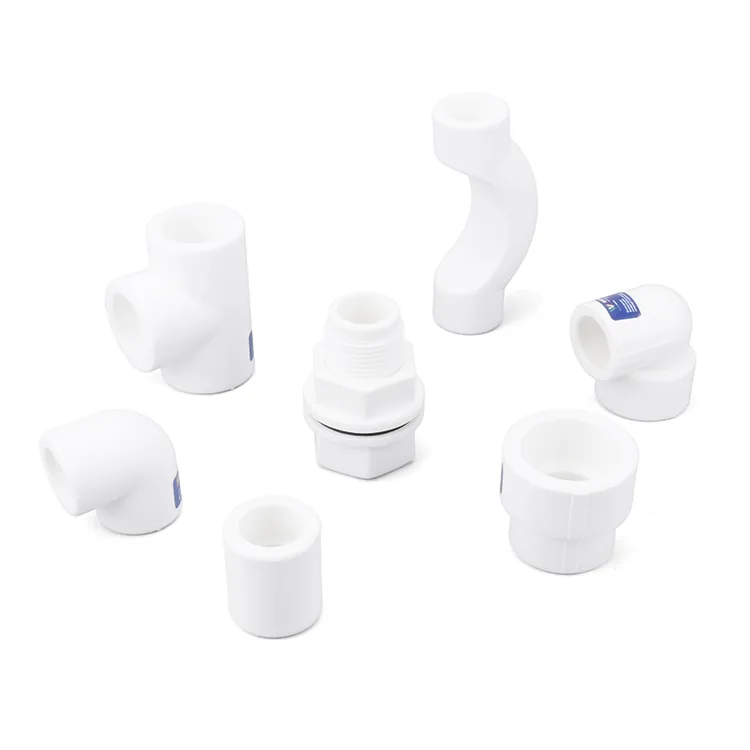
Every group above is installed by the same process — socket fusion. Pipe and fitting are heated together on matched dies, then pushed straight together, and the softened layers set into one homogeneous wall. So fitting choice and welding method are not separate decisions: the socket depth sets the insertion depth you mark on the pipe, and the fitting wall thickness influences how long the joint needs to cool. The parameters per diameter are in our step-by-step PPR welding guide — general industry guidance, always to be confirmed against the datasheets of the pipe, fittings and machine you are actually using.
A PPR fitting has no gasket, no adhesive and no mechanical seal, so nothing in the joint ages differently from the pipe itself. The trade-off is that the joint is permanent — which is why the union group exists. The same logic runs into valves: a PPR ball valve welds into the line as a fitting does, while a brass ball valve arrives through a threaded adapter. Two stock decisions, both in the same product range.
VII. Stock the Whole Fitting Set From One Source
Nearly every problem in this guide reduces to one thing: the fitting set arrived from more places than the pipe did. WARMHAUS manufactures both. We are a manufacturer of PPR, PEX and brass piping systems, not a trading company — the extrusion, injection-moulding and machining lines are our own, which is why socket dimensions and pipe tolerances are held to one internal standard rather than averaged across suppliers. The full PPR fittings range covers all ten groups in the table above, including brass-insert threaded adapters, moulded from the same PP-R material as the pipe. Our pipe is produced to DIN 8077 / DIN 8078 — the dimensional and general quality standards for PP-R pipe — and GB/T 18742.2-2017, and the fittings are dimensioned to weld onto that pipe, which is the compatibility that matters at the socket. Raw material comes from Hyosung, Borealis and LG.
Two practical points matter more than any specification. There is no MOQ, so the reducing tees and adapters you are unsure about need not be bought a pallet at a time — you can build the matrix at the size your market actually consumes, including the thread designations your market uses rather than the ones a catalogue defaults to. And the standard lead time is 45 days against planned production slots, long enough that the missing-part problem has to be solved at the order stage. Manufacturing since 1993, ISO 9001 / ISO 14001 / ISO 45001 certified, EU CE marked, SGS tested, Russian PT certified. Certificate documents: available on request.
Tell us the diameters you sell and the thread sizes your market uses, and we will build the fitting matrix against your pipe list. Request the PPR fittings type & size list and distributor terms