The most expensive misunderstanding in PPR specification is reading PN20 as “this pipe holds 20 bar”. It does not — not in a hot water riser, and not for decades. PN is a nominal pressure class defined at 20 °C, and the pressure a pipe can actually carry drops sharply as the water gets hotter. A pipe comfortably rated at 20 bar cold may be down to a fraction of that at 70 °C over a long design life. That is why hot water and heating circuits call for a heavier class, and why the cheapest PN10 on an offer sheet is not a like-for-like substitute for the PN20 in the specification.
This guide is for the people who make that call on paper: importers comparing quotations, sourcing agents writing a purchase specification, consultants signing off a riser schedule. It covers the relationship between PN, SDR and wall thickness, a class-by-class table, temperature derating, and the specification errors that turn a cheap container into a warranty problem. All figures are general industry guidance — always confirm against the datasheet of the pipe you are buying.
I. What PN Actually Means on a PPR Pipe
PN means nominal pressure, expressed in bar. A PN20 pipe is dimensioned so that, carrying water at a reference condition of 20 °C over a nominal 50-year design life, it sustains roughly 20 bar of internal pressure. Both halves of that sentence matter: the rating is tied to a reference temperature and to a design lifetime. Change either and the permissible working pressure changes with it.
There is a third variable that quotation tables routinely leave implicit, and a specifier should ask about it: the material grade. The wall thickness needed to reach a given class is calculated from a design stress, and that design stress derives from the resin’s long-term strength — its MRS, or minimum required strength, established by long-term hydrostatic regression testing. Different polypropylene grades do not share one MRS. A raised-temperature grade such as PP-RCT retains more strength at elevated temperature than a conventional PP-R, so at the same SDR the two do not necessarily land on the same pressure class, and at the same class they do not necessarily need the same wall. The PN↔SDR pairs in the table below are therefore conventional pairings for ordinary PP-R, not a material-independent law of geometry. Where a supplier offers a raised-temperature grade, ask for its material designation and its own pressure-temperature table rather than assuming the mapping carries over.
This is where PPR behaves differently from metal. Copper and steel lose very little strength between 20 °C and 70 °C, so plumbers trained on metal reasonably treat a pressure rating as a fixed property of the pipe. Polypropylene is a thermoplastic: its long-term strength is time- and temperature-dependent. Held at 70 °C, the stress it carries for decades is far lower than cold. The PN number is therefore a reference figure, not a site rating.
PN is not a promise about your building. It is a rating at 20 °C that you then derate for the temperature you actually run.
The practical consequence: you cannot compare a PN class against a system operating pressure without first accounting for temperature. A cold main at 6 bar and a hot circuit at 6 bar are not the same duty, though the gauge reads the same.
II. PN, SDR and Wall Thickness — the Same Fact Three Ways
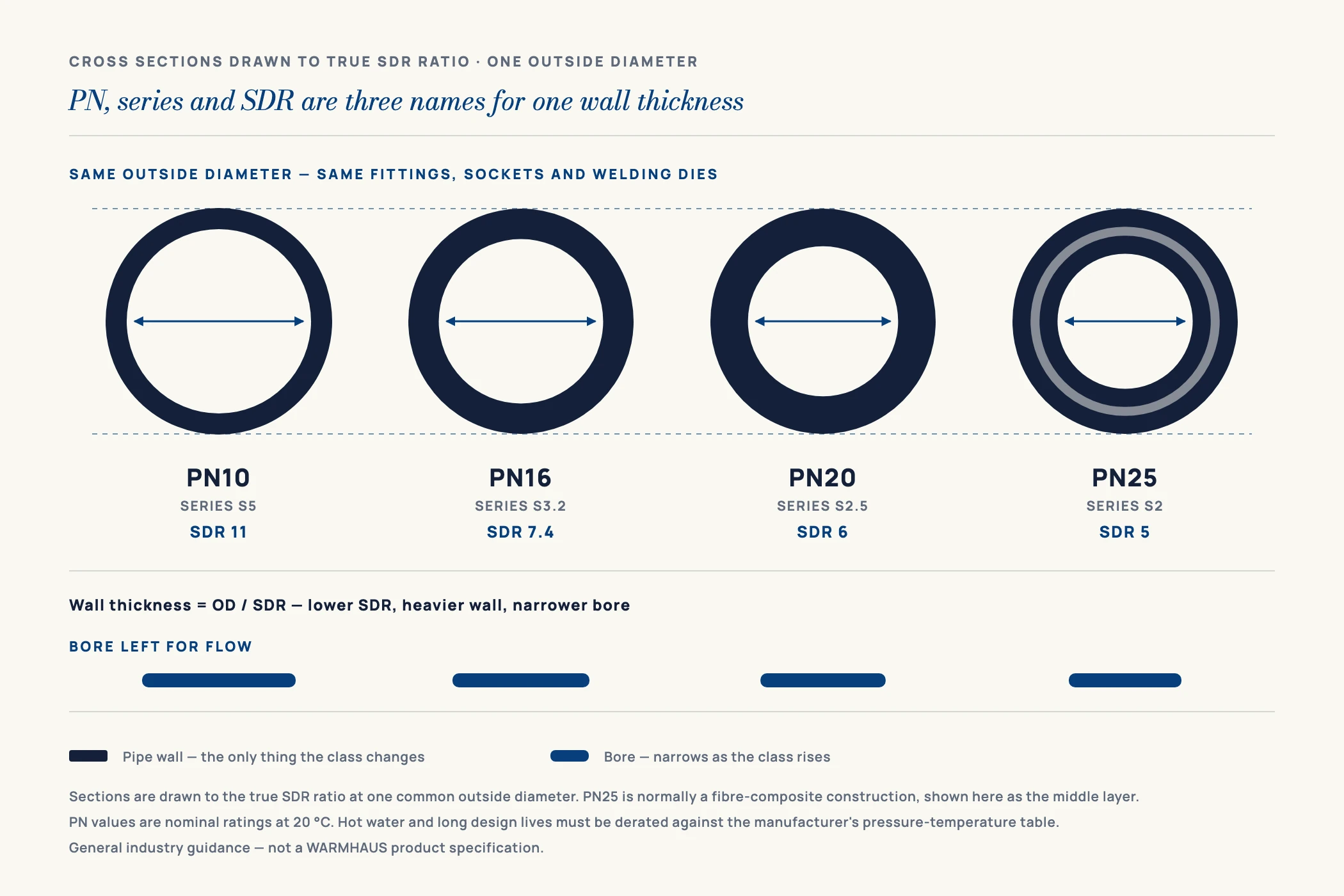
Here is the part that makes PPR specification click. Within one material grade, a higher PN class at a given outside diameter is simply a thicker wall. Hold the resin constant and the pipe just gets heavier as the class rises. Outside diameter stays constant so fittings, sockets and welding dies remain interchangeable, and the extra wall grows inward, which means a higher PN class also has a smaller bore. Change the resin grade as well, as noted above, and the arithmetic behind the class shifts with it — which is why “PN20” and “SDR 6” are only interchangeable shorthand as long as everyone is talking about the same material.
Engineers express that as SDR — Standard Dimension Ratio — outside diameter divided by wall thickness. A low SDR means a thick wall relative to diameter, so a low SDR corresponds to a high PN class: SDR 6 is a heavy wall, SDR 11 a light one. The related S (pipe series) in ISO-based standards derives from the same geometry. All three labels describe one physical thing: how thick the wall is relative to the diameter. Dimensional requirements are set out in DIN 8077 (dimensions) and DIN 8078 (general quality requirements), the standards WARMHAUS produces its PPR pipe range to, alongside GB/T 18742.2-2017.
Two operational points follow, and both cost money when missed. First, the bore shrinks as the class rises: a 25 mm PN25 pipe carries meaningfully less flow than a 25 mm PN10, so specifying a heavy class without revisiting the hydraulic sizing can starve the far end of a run. Second, weight per metre rises with the class, changing the freight and landed cost of a container.
III. PPR Pressure Class Table: PN10, PN16, PN20, PN25
The table below sets out the four common PPR classes side by side — the corresponding pipe series and SDR, the relative wall thickness, and the service each is normally specified for. Use it when reading a quotation or writing a purchase order. This page is the reference for PN and SDR values across this site; other guides link here rather than restating them.
| PN class | Series (S) | SDR (approx.) | Wall (relative) | Nominal rating basis | Typical service |
|---|---|---|---|---|---|
| PN10 | S5 | SDR 11 | Thinnest | ~10 bar at 20 °C | Cold water distribution only; drains and low-pressure cold lines |
| PN16 | S3.2 | SDR 7.4 | Medium | ~16 bar at 20 °C | Cold water at higher mains pressure; intermittent warm service |
| PN20 | S2.5 | SDR 6 | Heavy | ~20 bar at 20 °C | The general-purpose hot and cold sanitary class; most common specification |
| PN25 | S2 | SDR 5 (fibre-composite construction) | Heaviest | ~25 bar at 20 °C | Hot water risers, heating circuits, higher-temperature duty |
Note the step from PN20 to PN25 carefully, because it is the single most common error in PPR class tables. SDR 6 is the PN20 geometry, not the PN25 one. PN25 sits a step thicker again at approximately SDR 5. If a datasheet or a supplier’s table gives PN20 and PN25 the same SDR, it is claiming the two classes share a wall thickness at the same diameter, which they do not — and that is a good reason to query the rest of the document.
Values are general industry guidance, not a WARMHAUS-specific specification. SDR figures, wall thicknesses and permissible working pressures vary with the standard applied, the diameter and the material grade. Always confirm against the printed datasheet of the pipe you are buying before you specify or pressure-test.
Two entries deserve a note. PN10 is a cold water class — it appears on quotations because it is the cheapest thing that can legitimately be called PPR, and it is a common substitution when a buyer specifies only “PPR pipe, 25 mm” without a class. PN25 is usually not a thicker homogeneous pipe but a multilayer construction with a glass-fibre reinforced middle layer. Be precise about what that layer does and why the class number rises: the reinforcement raises the stiffness and hoop strength of the composite wall, and it is that added load-bearing capacity which allows the higher pressure class to be reached at a sensible wall thickness. Reduced thermal expansion is a second benefit of the same layer, not the reason the class is awarded. Both properties happen to be wanted in the same place — hot risers and heating circuits, where pressure duty and movement are design problems together — which is why the two get conflated so often. The full PPR system must be specified as a matched set: a heavy-class pipe welded into a lighter fitting is only as good as its weakest component.
IV. Temperature Derating: Why PN20 Is Not 20 Bar in a Hot Riser
This is the section to read twice. The permissible working pressure of a PPR pipe falls as the operating temperature rises and as the required service life gets longer. Manufacturers publish this as a derating table — service temperature down one axis, design life across the other, permissible pressure in the cells. The underlying data comes from long-term hydrostatic testing, and it is why PPR is classified by application class rather than by a single pressure number. The pattern is consistent across the industry:
Cold water, around 20 °C
The pipe operates close to its nominal reference condition, so the PN number is broadly usable as a working figure with the normal safety margin. This is the only case where “PN20 means 20 bar” is approximately true.
Domestic hot water, 60–70 °C
Permissible long-term pressure drops substantially below the nominal class — which is why PN20 is the normal minimum for sanitary hot water, and why PN10 has no place on a hot line.
Heating circuits and continuous high temperature
Derating is steepest here, and thermal expansion becomes a design constraint in its own right. Fibre-reinforced PN25 is the usual answer, with proper allowance for movement.
Design life is the hidden axis
The same pipe at the same temperature carries a higher permissible pressure for 10 years than for 50. A quotation citing a pressure figure without the temperature and design life behind it is not comparable to anything.
Peaks matter as well as averages
Malfunction temperatures, thermal shock from a failed mixing valve and water hammer all load the pipe above steady state. The margin in the class absorbs these — it is not there to be spent in advance.
The public standards that formalise this are worth naming in a specification: ISO 15874 covers polypropylene piping systems for hot and cold water, EN ISO 21003 covers multilayer systems, and ISO 10508 defines the application classes linking a service condition to required pipe performance.
That last one is the standard to quote by name on a purchase specification, because it turns “hot water” into something testable. ISO 10508 sets out application classes, each a defined service profile of temperatures and durations rather than a single number, and a pipe is declared for a class together with a design pressure. The classes in general use are these:
| Class | Intended application | Typical design basis |
|---|---|---|
| Class 1 | Hot water supply, lower-temperature service | Around 60 °C operating |
| Class 2 | Hot water supply, higher-temperature service | Around 70 °C operating |
| Class 4 | Underfloor heating and low-temperature radiators | Lower operating temperature, long duration |
| Class 5 | Higher-temperature radiator heating | The most demanding of the heating classes |
| Cold | Cold water service at ~20 °C | Quoted alongside a class where the pipe serves both |
Application classes are summarised here as general industry guidance to show what to ask for; each class in the standard is a full service profile combining operating, maximum and malfunction temperatures with the hours spent at each over a nominal 50-year design life. Class 3 relates to low-temperature space heating. Take the governing definitions, the design temperatures and the design pressure from the current text of the standard and from the pipe’s own declaration — not from a summary table.
The practical use is this: a declaration reads as a class plus a design pressure, for example a pipe declared for Class 2 at a stated bar rating. Underfloor heating work is normally Class 4, which is why a pipe declared only for cold service is not a substitute in a heating circuit however generous its PN number looks. Asking a supplier which application class a pipe is declared for — and at what design pressure — is a far sharper question than asking whether it is “suitable for hot water”. These standards are cited as general industry references, so you know what to ask a supplier for — not as certifications WARMHAUS holds. Our own third-party position is set out on the certifications page: ISO 9001, ISO 14001 and ISO 45001 management system certification, EU CE marking, SGS testing and Russian PT market approval. Certificate documents are available on request.
V. Choosing a Class: A Practical Method
Specifying a PN class is a four-step decision, and it goes in this order. Any other order is how buyers over-pay on cold lines and under-specify hot ones.
I. Start from the service temperature, not the pressure
Identify what the circuit carries — cold distribution, domestic hot water, or a heating circuit — and its continuous operating temperature and malfunction peak. Temperature sets the class floor; pressure only refines it. A cold line at 8 bar is a lighter duty than a 70 °C line at 4 bar.
II. Establish the real system pressure, including transients
Take the mains or pump pressure at the worst point in the system, not the average, and account for pump head, static head in a tall building, and water hammer. In high-rise work the lower floors of a riser sit at a very different pressure from the top — a legitimate reason to change class by zone.
III. Check the derating table for the required design life
With temperature, pressure and design life in hand, read the derating table for the pipe you are actually buying and confirm the permissible working pressure exceeds your system pressure with margin. This is the step most commonly skipped — skipping it is what makes PN selection feel like guesswork.
IV. Re-check the hydraulics after you have chosen
Because a heavier class narrows the bore, confirm the flow velocity and pressure drop still work at the specified diameter. If they do not, step the diameter up rather than dropping the class down. Then verify that fittings and valves in the same system are rated for the same duty as the pipe.
VI. Six Specification Errors That Cost Money
These are the recurring mistakes in PPR purchase specifications — the ones that surface as a rejected batch or a failed pressure test months after the container has landed.
Ordering “PPR pipe” without naming a class
An order specifying only diameter and quantity invites the lightest legitimate class. Fix: write diameter, PN class and governing standard on every line of the purchase order.
Reading the PN number as the site working pressure
The nominal class applies at 20 °C. Fix: derate for the actual service temperature and design life before comparing it with the system pressure.
Comparing quotations on price per metre alone
A lower class is a lighter pipe, so it always looks cheaper per metre. Fix: compare like classes, and use weight per metre to check the wall thickness is what was ordered.
Mixing classes across a single circuit
A circuit performs to its weakest component, and a light fitting welded into heavy pipe is exactly that. Fix: specify pipe, fittings and valves as one matched system.
Ignoring bore loss on heavy classes
Upgrading class without revisiting the hydraulics reduces flow at the far end of long runs. Fix: re-run the velocity and pressure-drop check after any class change.
Forgetting thermal expansion on hot lines
PPR moves with temperature, and pressure class alone does not solve it. Fix: use fibre-reinforced pipe on hot circuits, with expansion loops and correct bracket spacing.
One more point for buyers rather than engineers. Class substitution is difficult to detect by eye, because outside diameter is identical across classes by design — a PN10 and a PN20 of the same size look alike in a photograph and in a crate. What differs is wall thickness, bore and weight, so the practical incoming check is to measure the wall with a calliper and weigh a known length, then compare both against the datasheet. If you are qualifying a new source, our guide on how to vet a PPR pipe manufacturer covers what else to verify before the first order, and PPR pipe specifications goes deeper on dimensions.
VII. Getting the Right Class from One Source
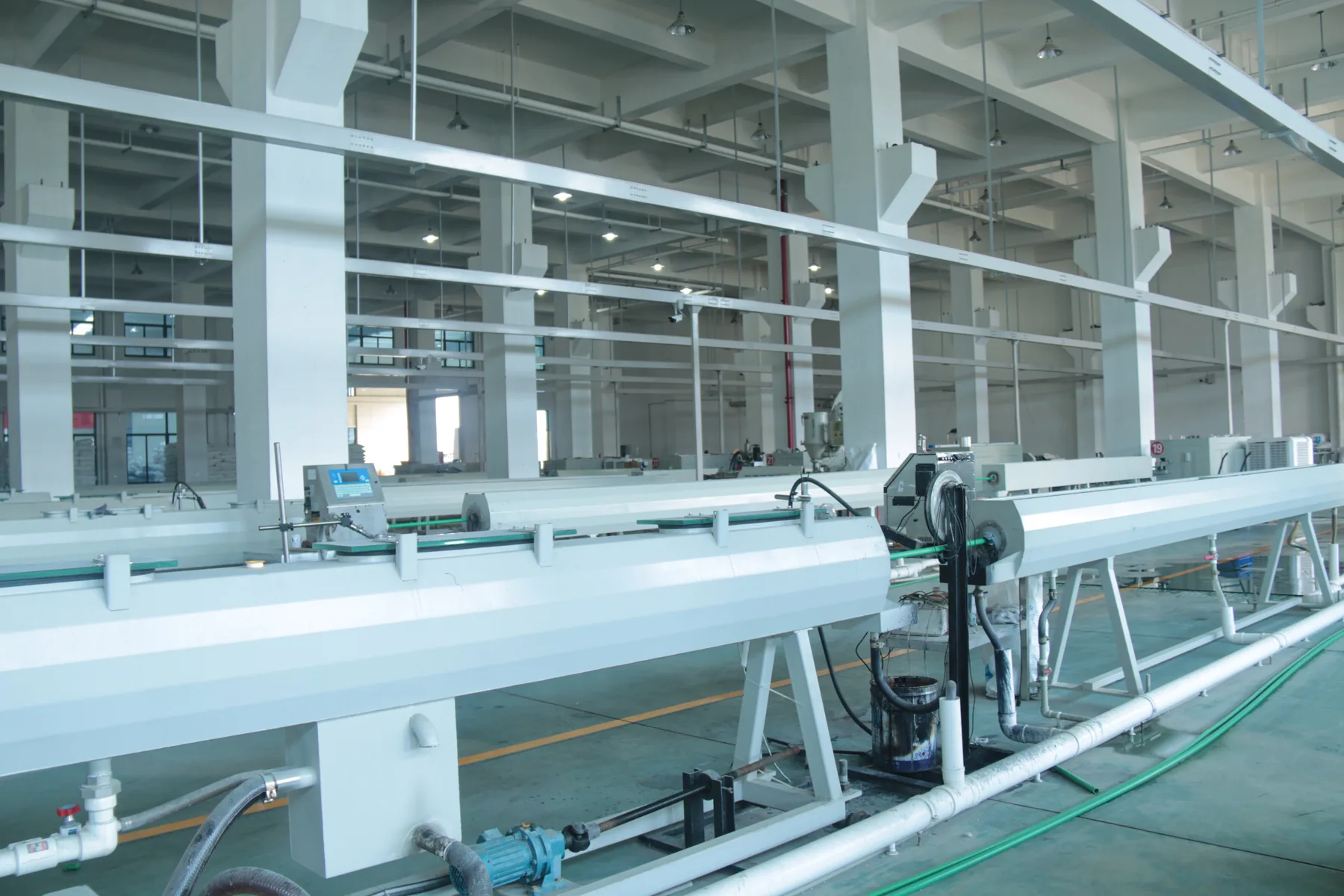
Pressure class is ultimately a manufacturing question. A PN class is a wall thickness held on an extrusion line, run after run — and consistency of that wall separates a pipe that meets its class from one that merely carries the marking. WARMHAUS is a manufacturer of PPR, PEX and brass piping systems, not a trading company. The extrusion, injection-moulding and machining lines are our own, which is why wall thickness and socket dimensions are held to a single internal standard rather than averaged across outside suppliers. We produce to DIN 8077 / DIN 8078 and GB/T 18742.2-2017, from raw material supplied by Hyosung, Borealis and LG.
For an importer, the useful part is that pipe, fittings and valves for a given duty come from one source and are specified as a set — so a mixed container does not require three supplier accounts and three sets of paperwork. Manufacturing since 1993, ISO 9001 / ISO 14001 / ISO 45001 certified, EU CE marked and SGS tested, with no MOQ and a standard lead time of 45 days. Tell us the diameters, classes and service conditions in your market: Request PPR pipe specifications and the PN class range . Pricing, certificate documents and full technical datasheets — available on request.