Sorting five quotations on unit price and asking the cheapest for a sample reliably picks the supplier who removed the most cost from the product — because nothing in that process measures what was removed. Evaluating well means scoring the supplier before you score the sample: who actually makes the part, what the material really is, whether tolerances hold across a run rather than in one hand-finished piece, and what happens when a batch goes wrong twelve months from now. Fifteen points below, each tied to a document rather than a claim.
The technical figures quoted are general industry guidance, not a WARMHAUS-specific specification, and tolerance bands and material grades differ between standards and product families. Always confirm the numbers against the technical datasheet of the fittings you are actually buying before writing them into a purchase order.
I. The 15-Point Scorecard
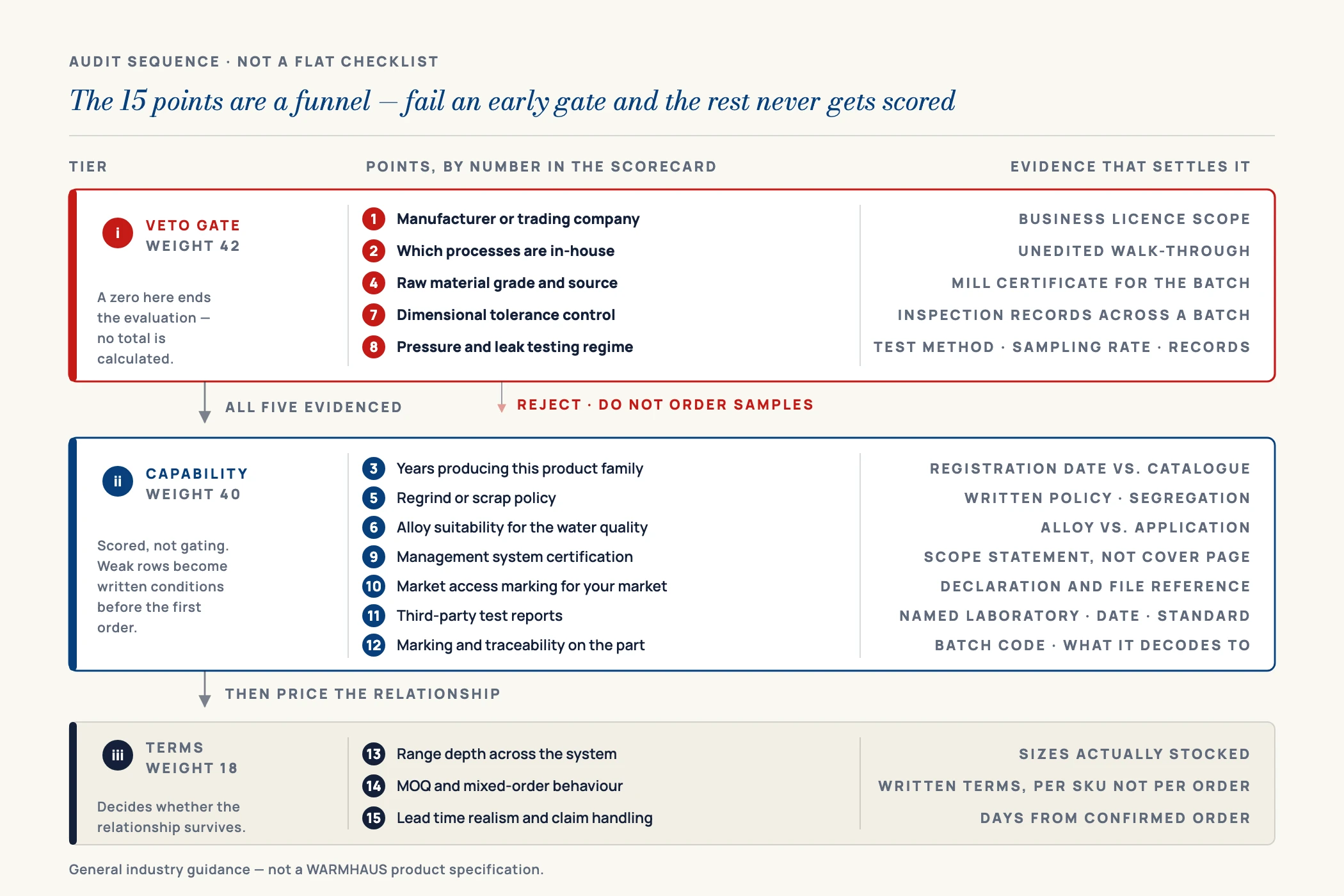
Score each point 0–3: 0 = no evidence or refused, 1 = claimed only, 2 = documented, 3 = documented and independently verifiable. Multiply each score by the row’s weight and add the results. Weights total 100, so the maximum weighted score is 300 (100 × 3). Weights reflect how expensive the point is to get wrong after the container has landed.
Five rows are marked critical in the table — points 1, 2, 4, 7 and 8. A zero on any critical row stops the evaluation regardless of the total: those are failures a discount cannot compensate for, and a supplier who scores well elsewhere while refusing to evidence the material grade is exactly the profile this audit exists to catch. Read the totals as follows.
| Weighted score | Band | What to do |
|---|---|---|
| 240–300 | Proceed | Order samples against your written specification |
| 180–239 | Proceed with conditions | Close the gaps in writing before the first order; re-score |
| 120–179 | Hold | Viable only with inspection at your cost on every shipment |
| Below 120, or any critical zero | Reject | Do not proceed to samples |
Worked example. A supplier answers well on identity and commercial terms but is thin on evidence. Say they score 3 on points 1 and 2 (own moulding and machining, shown on an unedited walk-through), 2 on point 4 (names the alloy but sends no mill certificate), 2 on points 7 and 8 (test methods described, records shown for one batch), 3 on points 14 and 15 (written MOQ and lead-time terms), and 1 on everything else — a claim with no document behind it. Add it up in four groups. The two 3-scores on identity give 9×3 + 8×3 = 51. The three 2-scores on material grade and testing give 9×2 + 8×2 + 8×2 = 50. The two 3-scores on commercial terms give 6×3 + 6×3 = 36. The remaining eight rows all score 1, and their weights (4 + 6 + 6 + 6 + 7 + 6 + 5 + 6) total 46. Sum: 51 + 50 + 36 + 46 = 183 out of 300.
No critical zero, so this supplier is not rejected — but 183 sits just inside Proceed with conditions, four points above Hold. The reading is concrete rather than a grade: the factory is probably real and the terms are probably honest, but nothing about the material or the testing has been independently evidenced. So the condition writes itself — the mill certificate and the batch inspection records arrive before the first order and you re-score those three rows, or every shipment gets inspected at your cost. Note also how close the band boundary is: a single 2 dropping to 1 on a heavy row moves this supplier into Hold, which is why the scores are worth recording rather than eyeballing.
| # | Audit point | Group | Weight | What proves it |
|---|---|---|---|---|
| 1 | Manufacturer or trading company · critical | Identity | 9 | Business licence scope · plant video walk-through |
| 2 | Which processes are in-house · critical | Identity | 8 | Named lines: moulding, machining, assembly |
| 3 | Years producing this product family | Identity | 4 | Registration date vs. product catalogue history |
| 4 | Raw material grade and source · critical | Material | 9 | Resin or brass alloy designation · mill certificate |
| 5 | Regrind or scrap policy | Material | 6 | Written policy · incoming material segregation |
| 6 | Alloy suitability for the water quality | Material | 6 | Alloy designation vs. application |
| 7 | Dimensional tolerance control · critical | Quality | 8 | Inspection records across a batch, not one part |
| 8 | Pressure and leak testing regime · critical | Quality | 8 | Test method, sampling rate, retained records |
| 9 | Management system certification | Quality | 6 | ISO 9001 certificate · scope statement |
| 10 | Market access marking for your market | Compliance | 7 | CE declaration · destination-market documents |
| 11 | Third-party test reports | Compliance | 6 | Report from a recognised laboratory |
| 12 | Marking and traceability on the part | Compliance | 5 | Batch code on part or bag · what it decodes to |
| 13 | Range depth across the system | Commercial | 6 | Full catalogue with sizes actually stocked |
| 14 | MOQ and mixed-order behaviour | Commercial | 6 | Written terms, per SKU not per order |
| 15 | Lead time realism and claim handling | Commercial | 6 | Stated days from confirmed order · written policy |
| Total | 100 | Maximum weighted score 300 |
Weights and scoring bands are a general sourcing framework, not a WARMHAUS-specific specification or an industry standard. Adjust the weights to your own market’s failure history — an importer supplying projects with contractual liability should weight compliance higher than one supplying retail counters.
II. Identity — Who Actually Makes the Part (Points 1–3)
A trading company can supply excellent fittings and a factory can supply poor ones, but the two relationships fail differently — and you need to know which you are in before the first problem, not during it.
I. Manufacturer or trading company
The question is not answered by “we are a factory” in an email. Ask which processes happen under their roof and which are bought in. Most fittings suppliers are a mix, and a straight answer — we mould PPR fittings here, we buy in the brass inserts — beats a blanket claim of total integration. The consequence is control: when a dimension drifts, an integrated manufacturer changes a tool and a process parameter, while a trading company forwards your complaint to a factory it does not own.
II. Which processes are in-house
Get the production lines by name: injection moulding for PPR fittings, bar machining and forging for brass, thread cutting, assembly, packing. Then check the list against a video walk-through — from raw material intake to the packing bench in one continuous take rather than an edited film. Cuts between shots are where borrowed footage lives.
III. Years producing this product family
Company age is weak evidence on its own — what matters is how long they have made this product. A supplier who added brass fittings to a PPR catalogue eighteen months ago is running a young process on a material with different failure modes. Cross-check the registration date against the catalogue. Our own answer is that manufacturing began in 1993 on our own plant.
III. Material — What the Fitting Is Actually Made Of (Points 4–6)
Material is where cost gets removed quietly — invisible in a photograph and usually invisible in a single sample.
Dimensional faults are found by the installer. Material faults are found by the end user, two years later, through the ceiling.
IV. Raw material grade and source
Ask for the specific designation, not the category. “PPR” is a category; a named resin grade from a named producer is a specification. For brass, alloy family shows up in machinability, pressure behaviour and response to aggressive water. A supplier who names the grade and produces a mill certificate for the batch is running a real incoming-material process; one who answers “high quality raw material” either does not know or will not say. Our own brass fittings are produced from 57-3 and CW617 brass, with resin from Hyosung, Borealis and LG. Applying point VI to ourselves, since it would be inconsistent not to: both of those are leaded free-machining brasses, and neither is a dezincification-resistant grade. That is the normal specification for general water fittings and valve bodies, but it is not the right answer everywhere — where the water is soft, acidic or high in chloride, or where a fitting is buried or embedded in screed, ask us (or any supplier) whether a DR or low-lead option exists for that item and specify it explicitly. Potable-water lead limits are set by your destination market, not by the alloy name, so check the grade against that market’s rules before ordering. The alloy comparison is set out in full in CW617N vs HPb57-3 brass.
V. Regrind and scrap policy
Reprocessed material is not automatically a defect — controlled in-house regrind of clean, identified sprue is normal practice, managed by a written limit. What you are auditing is whether that limit exists and whether incoming and reclaimed material are physically segregated on the floor. Uncontrolled regrind changes melt behaviour batch to batch, and the symptom months later is inconsistency: fittings from one carton weld cleanly and fittings from another do not, with no visible difference between them.
VI. Alloy suitability for your water
This point is scored against your market, not the supplier’s catalogue. Water chemistry varies between the regions we supply, and an alloy that performs indefinitely in one network can suffer in another. State the application and water conditions in the enquiry and see whether the supplier engages or simply confirms whatever you asked for. One who asks a follow-up question about your water is worth more than one who says yes to everything.
IV. Quality Control — Whether It Holds Across a Run (Points 7–9)
Any supplier can produce one good fitting. The audit question is whether the four hundredth matches the first, and the only evidence for that is records — not a sample.
Dimensional tolerance control
Ask how often dimensions are checked during a run, on what instruments, and to see inspection records from a recent batch of the fitting you intend to buy. You want a spread of readings against a defined tolerance band — not one certificate showing a single perfect measurement. On threaded parts ask about thread gauging: threads that are individually acceptable but drift across a batch cause assembly complaints nobody can reproduce in the office.
Pressure and leak testing regime
Establish three things: the test method, the sampling rate, and whether results are retained and retrievable by batch. A supplier who tests every part, one who tests a defined sample per batch, and one who tests when a customer asks are three different risk profiles. Ask what happens to a batch that fails — quarantine, rework, or quiet re-inspection until it passes. Test parameters and retained reports: available on request.
Management system certification and its scope
ISO 9001 certifies a quality management system, not a product — a distinction suppliers blur constantly. Read the scope statement: it names the sites and activities covered, and a scope covering trading rather than manufacture tells you what the cover page does not. Verify the certificate is current and issued to the entity you are contracting with. WARMHAUS holds ISO 9001, ISO 14001 and ISO 45001; our quality control process sets out where inspection sits in the production flow.
V. Compliance and Commercial Terms (Points 10–15)
Buyers most often defer these six until after the price is agreed, which is backwards. Compliance failures stop a container at the border; commercial terms decide whether the relationship survives its first genuine problem.
X. Market access marking and destination documents
Establish what your destination market requires before asking what the supplier holds, then compare the lists yourself. EU CE marking is a manufacturer’s declaration of conformity backed by a technical file, so ask for the declaration and file reference rather than a logo on a brochure. Other markets run their own regimes — Russian PT approval is a separate route with separate documents. A supplier who ships to your destination regularly produces the right paperwork without a long conversation.
XI. Third-party test reports
In-house and third-party test data are different evidence and should be scored separately. Ask which recognised laboratory performed the test, on which product, on what date, against which standard. A report on a 20 mm fitting does not cover a 63 mm one, and a report from four years ago does not cover a mould since replaced. WARMHAUS products are SGS tested — SGS being a Swiss inspection and testing group. By our own criterion that sentence is a 1, not a 3: it names the laboratory and nothing else. The four answers only exist per report, which is why the honest form of this claim is to send the reports for the items you are quoting rather than to print a summary here — available on request, and you should read the product, date and standard on each one exactly as you would from any other supplier. A supplier whose website answers all four in general terms is describing something that cannot be true in general.
XII. Marking and traceability on the part
Ask what is stamped on the fitting and on the bag, and what a batch code decodes to at the factory. Traceability matters at exactly one moment, but absolutely then: when a distributor reports a problem with stock bought fourteen months ago and you need to know which run it came from and what else shipped from it. A supplier who cannot trace a code back to a production date cannot contain a problem — only replace whatever the complaining customer still holds.
XIII. Range depth across the system
An impressive catalogue with a thin stocked range creates a specific problem: the odd sizes and low-runner elbows hold up projects, and are exactly what a narrow supplier will quote long or quietly substitute. Ask which sizes they run regularly versus which merely appear in the catalogue. For a distributor, depth across one system — PPR fittings, valves, brass fittings and manifold components from one source — removes the work of reconciling three suppliers’ readings of the same nominal dimension.
XIV. MOQ and how mixed orders are handled
Read minimum order quantity as per SKU, not per order, because that is where it bites. A 500-piece MOQ per item forces a distributor to buy years of stock in a slow-moving size just to carry a complete range. WARMHAUS operates with no MOQ, which is what makes a mixed first container possible without committing to volumes the market has not yet proved.
XV. Lead time realism and claim handling
Score the honesty of the lead time, not its length. A supplier who quotes an implausibly short time to win the order will be late, and lateness against a promise costs more than a longer honest schedule. Ask for days from confirmed order, and what happens when a batch is rejected on arrival: who inspects, who pays freight, on what timescale. Get it in writing while you still have leverage. Our standard lead time is 45 days from confirmed order, planned into production slots.
VI. How to Run the Audit Without Travelling
Most buyers score this remotely the first time, which works if the sequence is right. Send the fifteen points as a written enquiry rather than a phone call — written answers are comparable and commit the supplier to something. Then request the documents named in the scorecard’s right-hand column all at once rather than in a trickle, noting how long each supplier takes and what arrives incomplete. Then run the unedited walk-through. Only then order samples, against a specification you wrote, so the sample tests conformity rather than arriving as a gift.
Keep the scores, with the date and the weighted total out of 300 written on them. When a problem appears eighteen months later, the scorecard tells you whether you accepted a known weakness or were genuinely surprised — and that determines whether you fix the supplier or replace them. The broader sequence is in our guide to vetting a pipe manufacturer; the certification questions are unpacked in ISO and CE certifications explained.
VII. Where WARMHAUS Sits on This Scorecard
It would be strange to publish an audit and dodge it, so: WARMHAUS is a manufacturer of PPR, PEX and brass piping systems — not a trading company. The extrusion, injection-moulding and machining lines are our own, across three plants totalling 100,000 m² of building area, with over 500 staff including 50+ technical and R&D personnel. Manufacturing since 1993. Total monthly capacity across the three plants is 2,000 tonnes, of which 600 tonnes is the pipe, fittings and brass ball valve programme described on this site — the balance is other production run on the same lines and is not what we quote to piping distributors. We state the split rather than the headline figure because point 2 of this scorecard asks you to check exactly that: a supplier quoting total tonnage is answering a different question from the one you asked, and the number worth comparing is capacity in your product family.
On the compliance rows: ISO 9001, ISO 14001 and ISO 45001 certified, EU CE marked, SGS tested, with Russian PT approval for that market. Certificate documents and copies are available on request against the items you are quoting. On the commercial rows: no MOQ, and a standard lead time of 45 days from confirmed order — planned into production slots rather than promised loosely. Terms and territory arrangements are on our distributor page. Request the certificate set, test reports and a quotation against your fittings list — send the sizes and destination market and we will answer the fifteen points in writing.