A 40 ft container loaded only with PPR pipe usually ships at a fraction of its permitted weight. The box fills, the scale barely moves, and you have paid ocean freight to move air. That is why experienced importers stop buying by product family and start buying by load: put light, bulky pipe and dense, heavy brass in the same container and the same freight cost carries far more saleable stock. The catch is that a mixed load is a planning exercise, not a shopping list. Get them wrong and you have crushed coils at the bottom of the stack, two suppliers blaming each other, and a customs officer holding a packing list that does not match the box.
This guide is for the importer or distributor who already sells more than one product family — typically a plumbing pipe supplier serving both hot-and-cold water work and underfloor heating. Figures throughout are general industry guidance for planning purposes; confirm every weight, dimension and carton count against the packing list and datasheets issued for your specific order before you book.
I. Why a Single-Product Container Wastes Money
Ocean freight is priced per container, not per kilogram. Whatever a box weighs on the day, you pay broadly the same to move it — which means the economics of importing are governed by one ratio: how much value you fit inside a fixed volume with a fixed weight ceiling.
Plumbing products sit at opposite ends of that ratio. Rigid PPR pipe travels in bundles of straight lengths — 4 m is the most common commercial length, though suppliers cut to other lengths and you should confirm what your order is packed in — and a bundle of pipe is mostly enclosed air; it fills a container long before it approaches any payload limit. PEX in coils is denser than straight pipe but still bulky. Brass is the opposite — ball valves, manifolds and insert fittings are small, extremely dense, and a modest number of pallets will consume a large share of the permitted payload while occupying very little floor. Fittings and controls sit in between, shipped in cartons that stack cleanly.
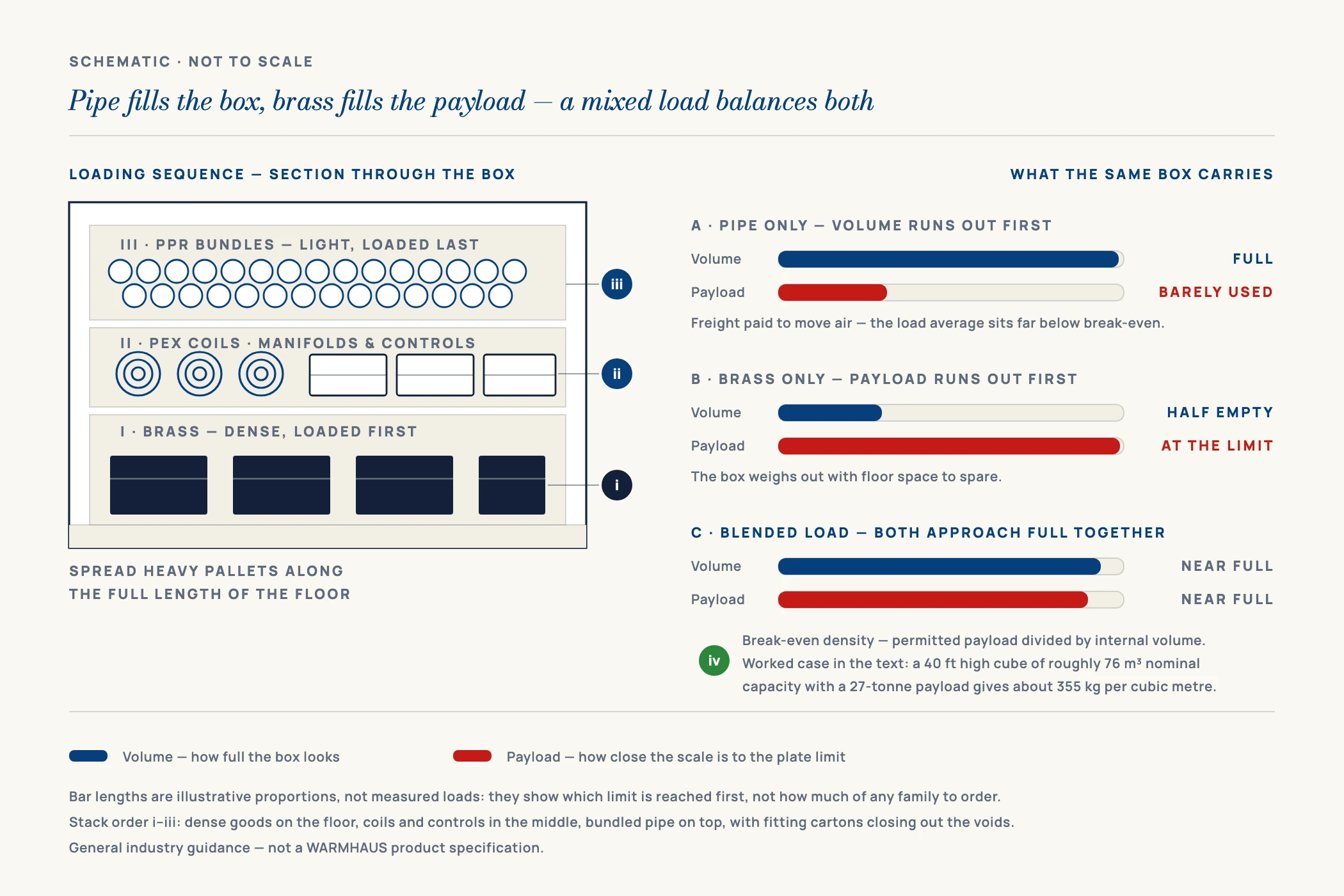
A pipe-only container hits the ceiling on volume. A brass-only container hits it on weight. Neither uses what you paid for.
The way to make that concrete is the break-even density of the box you have booked: divide the payload you are allowed to load by the internal volume you can actually fill. A standard 40 ft dry container offers roughly 67 m³ of internal capacity, and a 40 ft high cube roughly 76 m³; a 20 ft dry box is around 33 m³. Maximum payload — tare subtracted from gross rating — is stamped on the door of the individual unit and is commonly in the region of 26–28 tonnes for a 20 ft and 26–29 tonnes for a 40 ft, but it varies by unit and by the operator's own limit, so read the plate rather than a table.
Work one case through. Take a 40 ft high cube with 76 m³ nominal capacity and a 27-tonne payload. The break-even is 27,000 kg ÷ 76 m³ ≈ 355 kg per cubic metre. Any load averaging below that density fills the box before it reaches the weight limit — you are volume-constrained, and every extra kilogram is free. Any load averaging above it hits the weight limit with space to spare — you are weight-constrained, and every extra cubic metre is free. Bundled plastic pipe sits far below the line; palletised brass sits far above it. The planning goal is to blend the families so the load average lands near that break-even figure, because that is the point at which neither the space nor the payload you paid for is going to waste. In practice you will not fill 76 m³ — stowage loss around bundles, pallets and voids means usable volume is meaningfully lower, so treat the number as a ceiling and the break-even density as a target to steer towards, not a figure to hit exactly.
Container capacities and payloads above are general industry guidance for planning only. Internal volume varies with container type, and permitted payload varies by individual unit and operator — always read the plate on the door of the container you are given, and confirm the calculation with your freight forwarder before booking.
Combine the families and each covers the other’s weakness. Brass and other dense goods go in first as a low, heavy base; pipe and coils fill the volume above. The container reaches its volumetric limit and a sensible share of its payload at roughly the same moment, which is the definition of an efficient load. The effect compounds: better utilisation lowers landed cost per unit, which lets you hold a wider range at the same working capital.
II. What Actually Goes in a Mixed Plumbing Load
Five families cover most mixed containers in this trade, and each behaves differently once it is inside a steel box.
PPR pipe ships in bundles of straight lengths and is the volume driver of any load — it decides how full the container looks. PPR fittings are moulded, light and carton-packed, and they are the classic void filler: sockets, elbows, tees and reducers go into the gaps that pipe bundles inevitably leave. PEX pipe arrives in coils, which nest and stack but must not be crushed or deformed in transit. Brass — ball valves, manifolds, insert fittings — is the weight, and it belongs at the bottom. Underfloor heating components and controls, including manifolds, actuators and thermostats, are mostly carton goods that stack well and are the easiest items to use as a levelling layer.
Thinking in these five families rather than in SKUs is what makes a mixed load planable. You are deciding how much of the box goes to volume goods and how much to weight goods, then filling in the detail. Working through our full plumbing product range, build the load in that order — decide the pipe volume first, because it is the constraint, then add brass to bring the weight up, then use fittings and controls to close out the voids.
III. Mixed-Load Planning Table
The table below is a planning aid, not a packing list. It groups the five families by the two properties that matter when you are building a load — how dense they are and where they belong in the stack — so you can sketch a container before you have quantities. Read it as: what does this family do to my load, and what will go wrong if I place it badly.
| Product family | Packing form | Density class | Role in the load | Stack position | Main handling risk |
|---|---|---|---|---|---|
| PPR pipe | Bundled straight lengths | Very low | Volume driver — sets how full the box is | Upper layers, laid full length | Ovality and bowing under point loads |
| PPR fittings | Cartons on pallets | Low to medium | Void filler between bundles | Mid layers and gap-filling | Carton crush if loaded under brass |
| PEX pipe | Coils, often boxed | Low to medium | Volume, with better nesting than straights | Mid to upper layers | Coil deformation and kinking |
| Brass valves & fittings | Cartons on pallets | High | Weight ballast — brings payload up | Floor, evenly spread front to back | Point loading and concentrated weight |
| Manifolds & controls | Cartons, some part-assembled | Medium | Levelling layer between families | Mid layers, protected on all sides | Impact damage to fragile assemblies |
Density classes and stacking roles are general industry guidance for planning a mixed plumbing load, not a WARMHAUS-specific specification. Actual carton weights, pallet dimensions, bundle counts and permitted stacking heights vary by item and by order — always confirm against the packing list and product datasheets issued for your shipment, and against the payload limit stated on the container itself.
Two constraints sit outside the table and override it. The first is the container payload limit, which is printed on the door of the unit you are actually given and is not a number you should assume from a general reference. The second is road and axle weight regulation in the destination country. A container can be within its own payload rating and still exceed what the local haulier is permitted to move on a given chassis, in which case the box has to be stripped and split before it leaves the terminal — an avoidable cost that lands on the importer. Limits differ by country, and by vehicle configuration within a country, so this is a question for your freight forwarder in the destination market rather than a number to look up. Ask both questions before you finalise quantities rather than after.
IV. Loading Sequence — Heavy Low, Light High, Voids Last
Loading order is not a warehouse detail. It is the difference between a container that arrives intact and one that arrives with deformed coils and split cartons, and it follows three rules that apply to almost any mixed plumbing load.
Heavy low. Brass pallets go on the floor, spread evenly along the length of the container rather than concentrated at one end. Weight bunched at the door end or the nose end shifts the centre of gravity and creates handling problems for the haulier long after the box has left the factory. Even distribution is a safety matter, not a neatness preference.
Light high. Pipe bundles and coils go above the dense layers, laid so the load bears on the bundle as a whole rather than on isolated points. Thermoplastic pipe under a sustained point load will take a set, and a bundle that has been crushed against a pallet corner for five weeks at sea does not straighten out on the quay. This is also why coils should not carry pallets on top of them.
Voids last. Fitting cartons and control cartons close out the gaps between pipe bundles and against the walls. This is not only about fitting more in — a load that cannot shift does not chafe. Large empty voids give the cargo room to slide and topple when the ship rolls, and each impact is taken by whatever is next to the gap. Filling voids, or blocking and bracing them where they cannot be filled, is the cheapest damage prevention available to you, and a wide fittings range is what makes filling them practical. Where a void cannot be closed with saleable goods, dunnage and airbags do the same job — your forwarder can advise on what the route requires.
One further point specific to mixed loads: separate the families visually. Use clear pallet labelling, and where possible keep each family in a contiguous block. A container that is unloaded into a sorting yard with three product types intermixed carton by carton generates receiving errors that will show up as stock discrepancies weeks later, when they are much harder to trace.
V. Documentation — Where Mixed Loads Actually Get Stuck
The physical load is the easy part. The reason many first mixed containers go badly is paperwork, because a mixed load multiplies the number of things that can fail to match.
Start from the principle that a customs officer compares documents to each other before comparing them to the goods. Every product family in the box needs to appear consistently on the commercial invoice, the packing list and the bill of lading, with the same descriptions and the same quantities. A brass ball valve line that appears on the packing list but was merged into a general “fittings” line on the invoice is enough to hold a container.
Three specifics matter more in a mixed load than in a single-product one. Tariff classification differs by family — plastic pipe, plastic fittings and brass articles do not share a heading, and each has its own duty treatment in most tariff schedules. Classification is your customs broker’s call in your own jurisdiction, not something to accept from a supplier’s template. Certification files need to cover every family in the box, not just the headline product; a shipment cleared on the strength of a PPR file will still be questioned about its brass and its controls. And marking and labelling requirements can differ between plastic and metal products in the same market, which is easy to miss when one supplier ships everything.
One supplier does not remove the documentation work. It removes the version conflicts.
This is the practical argument for consolidating a mixed load with a single manufacturer rather than assembling it from three. When PPR, PEX and brass come from three companies, you are reconciling three invoices, three packing lists and three certification files into one shipment, and any inconsistency between them becomes your problem at the border. From one source, the documents are generated together. WARMHAUS holds ISO 9001, ISO 14001 and ISO 45001 management-system certification, carries EU CE marking and Swiss SGS third-party testing, and holds Russian PT approval for that market. Certificates and certificate documents are available on request. For a deeper walk through what each of these marks does and does not cover, see our guide to ISO and CE certifications for piping, and for the regional import mechanics, importing pipes into the Gulf and North Africa.
VI. Six Mistakes That Ruin a Mixed Container
These are the failures that recur, in rough order of how expensive they are when they happen.
Planning by volume and forgetting the payload limit
Brass is dense enough that a load which looks half empty can already be at its weight ceiling. Fix: track cumulative weight and cumulative volume in parallel as you build the order, and confirm the payload limit of the actual container against destination-country road weight rules.
Brass pallets loaded on top of pipe or coils
The single most damaging loading error, and entirely avoidable. Concentrated weight on thermoplastic pipe produces permanent deformation that only appears at installation. Fix: dense goods on the floor, without exception, and no pallets stacked on coils.
Weight concentrated at one end of the container
Uneven fore-and-aft distribution creates a handling and road-safety problem, and in some jurisdictions an axle-weight violation on a legally loaded box. Fix: spread heavy pallets along the full length rather than blocking them together at the door.
Descriptions that differ between invoice, packing list and B/L
A mixed load has more lines and therefore more opportunities to diverge. Inconsistency between documents is a far more common cause of delay than anything about the goods. Fix: reconcile all three documents line by line before the vessel sails, not after arrival.
Certification covering only the headline product
A file that covers PPR but not the brass or the controls in the same box leaves you answering questions at the worst possible moment. Fix: request the certification file for every family in the load at the order stage, and check the scope of each document rather than the title.
Ordering three families to three separate lead times
The container ships when the slowest item is ready. Three suppliers means three production schedules and no single party accountable for the consolidation date. Fix: place the families on one production plan, or accept and schedule around the longest lead time deliberately.
VII. Getting the Range Right Before You Get the Load Right
There is a commercial question underneath the logistics one, and it is worth answering first: what should actually be in the box? A mixed container is only an advantage if the mix matches what your market buys. Loading brass to hit a payload figure, when your customers buy almost no brass, converts a freight saving into dead stock — which is more expensive than the freight you saved.
Size a first mixed load by working backwards from the systems your customers install rather than forwards from the container. If your business is hot-and-cold water in apartment blocks, the load is mostly PPR pipe and fittings with a brass component for valves and a modest controls element. Moving into underfloor heating shifts the balance towards PEX coils and manifolds, and the brass line grows because manifolds are brass. A second mixed container is usually better proportioned than the first, simply because it is sized on sell-through data instead of estimates. That argues for starting deliberately small on unfamiliar families — which is where no MOQ changes the calculation, because you can include a trial quantity in an existing load rather than committing to a full minimum order to find out whether it sells.
Whether you are buying to resell under our brand or under your own also affects load planning, since labelling and packaging decisions have to be made before production rather than at the port — our comparison of private-label and OEM options covers what changes in the schedule, and our private label versus distribution guide works through which model suits which stage of a distribution business.
VIII. One Manufacturer, PPR, PEX and Brass, One Container
Everything above is easier when the load comes from one place. WARMHAUS is a manufacturer of PPR, PEX and brass piping systems — not a trading company. The extrusion, injection-moulding and machining lines are our own, across three plants totalling 100,000 m² of building area, with over 500 staff including more than 50 technical and R&D personnel, and a total monthly capacity of 2,000 tonnes. Because PPR pipe, PPR fittings, PEX pipe, brass valves and manifolds, underfloor heating components and controls are all produced in-house, a mixed container is one order, one production plan, one packing list and one certification file — instead of three suppliers, three schedules and three sets of documents that have to be reconciled before they reach a customs officer.
Two things matter specifically for buyers building a first mixed load. There is no MOQ, so you can add a trial quantity of an unfamiliar family to a container built around the products you already sell, and find out how it moves before you commit inventory to it. And the standard lead time is 45 days, planned as production slots — one schedule for the whole load rather than three that have to be aligned. Raw material comes from Hyosung, Borealis and LG, and we name our resin suppliers because a buyer is entitled to check. Manufacturing since 1993, ISO 9001 / ISO 14001 / ISO 45001 certified, EU CE marked and SGS tested, supplying distributors and importers across the Middle East, North Africa, Southern Europe and Latin America.
If you are weighing up whether to bring three families into one container, the practical next step is a load sketch against real quantities. Tell us your market, the families you already sell and the ones you are testing, and we will put the range, packing data and terms together. Request a mixed-container quotation and packing data — or read the terms and support on our distributor partnership page first.