An ISO 9001 certificate does not tell you the pipe is good. It tells you the factory has written down how it intends to make the pipe, and that an auditor checked whether it follows what it wrote. That is useful to know — it is just not what most buyers think they are getting when they ask for “ISO certification”. The three standards sent to you by almost any serious pipe fittings manufacturer — ISO 9001, ISO 14001 and ISO 45001 — certify management systems, not products. Knowing what each covers changes the questions you ask, and the questions are where the real due diligence happens.
This guide is written for the person who has to sign off on a supplier: the importer building a first container, the sourcing agent shortlisting three factories, the specifier defending a choice to a client. If you also need the basics of CE marking and third-party testing, our guide to ISO and CE certifications explained covers that side.
I. Systems Certificates vs Product Approvals — The Distinction That Matters Most
Almost every certification misunderstanding in piping procurement comes down to one confusion between two categories of document that answer different questions.
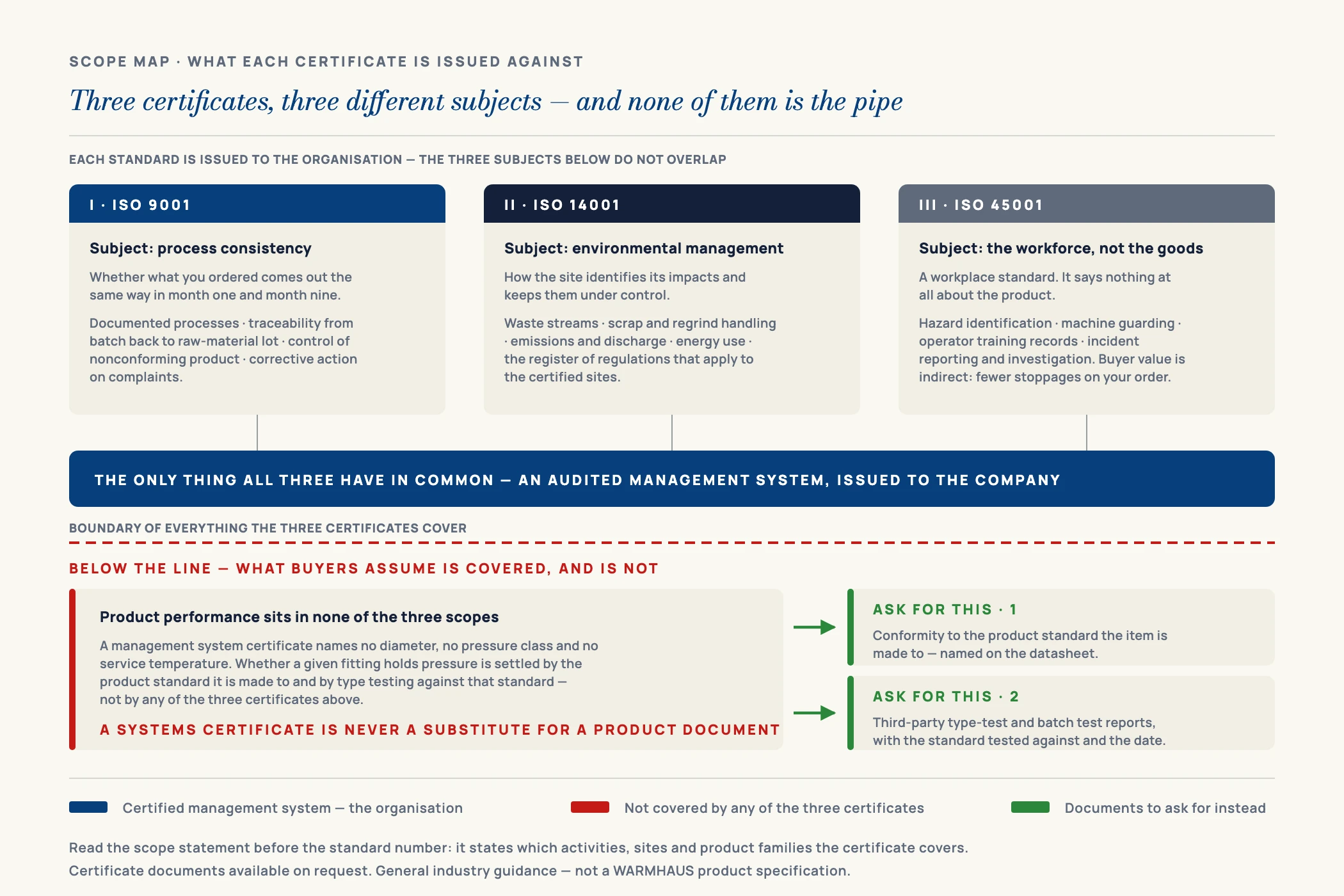
A management system certificate — ISO 9001, ISO 14001, ISO 45001 — is issued to an organisation. It says this company operates a documented system for managing quality, environment or occupational health and safety, and an accredited certification body audited it against the standard. It does not name a pipe, a diameter or a pressure class, and it cannot tell you whether a particular PN20 fitting will hold pressure at 70 °C.
A product approval or test report is issued against a product or product family: this item, made to this specification, was tested and met these requirements. That is the document that tells you something about the pipe in the box.
A system certificate tells you how the factory is run. A product test report tells you what came out of it. Ask for both, and never let one stand in for the other.
The system certificate is your evidence that results are repeatable — that the batch you approve in month one resembles the batch you receive in month nine. The product report is evidence that the item meets a technical requirement today. A supplier who sends the first when you asked for the second is either careless or hoping you will not notice. What a factory does with these systems day to day sits on our quality control page.
II. The Three Standards Compared
The table sets out what each standard covers, what an auditor looks at, and — most usefully — what evidence you can ask a supplier to produce under each one. The last two columns are where a certificate stops being a logo and starts being a question.
| Standard | What it certifies | Typical audit focus | What a buyer can ask for | What it does not prove |
|---|---|---|---|---|
| ISO 9001:2015 | Quality management system of the organisation | Process control, document control, traceability, handling of nonconforming product, corrective action, customer complaints | Scope statement, batch traceability method, complaint and corrective-action procedure, inspection records for your order | That any specific pipe or fitting meets a product standard |
| ISO 14001:2015 | Environmental management system of the organisation | Waste streams, scrap and regrind handling, emissions and discharge controls, energy use, legal compliance register | Policy on regrind and reprocessed material, waste handling procedure, scope of the certified sites | That the product is recyclable, low-carbon, or free of any given substance |
| ISO 45001:2018 | Occupational health & safety management system | Hazard identification, machine guarding, worker training records, incident reporting and investigation | Site-level safety procedures, training records for line operators, incident review process | Anything at all about the product — this is a workplace standard |
| Product test report (third-party) | A specific product or product family | Testing to the referenced product standard: dimensions, pressure, thermal behaviour | The report itself, the standard tested against, sampling basis, issue date | That production after the test date is identical |
| Market-access marking | Legal placing on a given market | Conformity assessment route required by that market’s rules | The declaration and the standards referenced in it | Superiority over another compliant product |
Scope descriptions and audit focus are general industry guidance, not a WARMHAUS-specific specification. Requirements, audit emphasis and accepted evidence vary by certification body, market and product family. Always confirm against the actual certificate, the referenced standard and the technical datasheet of the pipe and fittings you are buying.
III. ISO 9001 — What It Actually Buys You
ISO 9001 matters most to a pipe buyer because it governs consistency. The standard is built around one demand: define your processes, control them, measure them, and act when they drift. For a pipe plant that translates into three checkable things.
Traceability. A quality system worth the certificate can connect a length of pipe back to a production batch, and that batch back to the raw material lot it was extruded from. This is what makes a complaint resolvable. Without traceability a failed batch is an argument; with it, it is an investigation with a defined boundary.
Control of nonconforming product. Every factory produces some material that fails inspection. The question is what happens to it — whether it is identified, segregated and dispositioned, or whether it quietly rejoins good stock at the end of a busy shift. Ask how nonconforming product is marked and where it goes.
Corrective action. When a customer complains, does the system record it, find a root cause, change something and verify the change worked? You are not auditing the factory; you are checking the mechanism exists and that someone can describe it without hesitating. The wider set of checks a buyer should run is in our guide to vetting a PPR pipe manufacturer.
IV. ISO 14001 and ISO 45001 — Why a Buyer Should Care
These two are routinely dismissed as compliance decoration. That is a mistake, for reasons more commercial than technical.
ISO 14001 certifies an environmental management system: how a site identifies its environmental impacts, controls waste and emissions, and tracks the regulations that apply to it. For a plastics plant the interesting part is material handling and scrap. Every extrusion line generates start-up scrap and off-spec production, and what happens to that material — how regrind is segregated, controlled, and whether it is permitted back into pressure pipe at all — is a quality question wearing an environmental badge. Ask about the regrind policy specifically; it is far more revealing than asking whether a factory is “ISO certified”.
The second reason is procurement-side. Public tenders and larger contractors increasingly ask suppliers to demonstrate environmental management through their own supply chain, so a supplier’s ISO 14001 scope can become part of your submission.
ISO 45001 certifies occupational health and safety management. It says nothing about the product — writing “ISO 45001 product certification” in a tender is a category error an experienced specifier will notice. What it indicates is a plant where machine guarding, training and incident investigation are managed rather than improvised. The buyer’s argument for caring is continuity: lost time on the line becomes a schedule problem on your order.
V. How to Read a Certificate Properly — Five Fields
Most buyers check that the standard number is right and move on. There are five fields worth reading, and four of them are not the standard number.
The scope statement
The most important line on the document and the one most often skipped. It states which activities and products the certification covers — whether it covers manufacture or only trading, and which product families are included. A certificate whose scope reads “sales and distribution” belongs to a trading company, not a factory. If the scope does not mention manufacturing of what you are buying, it does not cover what you think it covers.
The named legal entity and the sites
Certificates are issued to a specific legal entity and often list site addresses. Check that the entity on the certificate is the one that will issue your invoice and sign your contract. Group structures are legitimate, but a certificate belonging to an affiliate is not evidence about the plant that will run your order. Where a company operates more than one plant, ask which sites are in scope.
Validity dates and the certification cycle
Management system certificates run on a multi-year cycle with surveillance audits in between and recertification at the end. Check the expiry date, and if the document is close to it, ask whether recertification is underway. An expired certificate on a company profile is a housekeeping failure at best; combined with vague answers it is a signal.
The certification body and its accreditation
A certificate’s value depends on who issued it and whether that body is itself accredited; the document normally carries the body’s name and an accreditation mark. Where a body maintains a public register, a certificate number can be checked against it. Not every mark or declaration has a public register behind it, so verify what is actually verifiable rather than assuming.
The standard edition
ISO 9001:2015, ISO 14001:2015 and ISO 45001:2018 are the current editions. A certificate quoting a superseded edition means the transition was not completed — a small detail, but the kind that tells you how the supplier’s documentation is maintained overall.Certificate copies and numbers: available on request.
VI. The Questions to Ask Before You Order
Certificates start a conversation rather than ending one. These questions separate a supplier who runs a system from one who merely owns a document, and all of them are normal for a buyer placing a repeat order.
On scope: Does your ISO 9001 scope cover manufacturing of the product families I am buying, and which sites are inside it? On traceability: If I report a batch problem six months from now, what do you need from me and how far back can you trace? On inspection: What is checked at raw-material intake, in-process and before packing, and can records for my order be provided?
On material: Which raw material grades and suppliers do you use, and what is your policy on reprocessed material in pressure pipe? On product evidence: Which product standard is this item made to, and what third-party test evidence exists? On change: If you change a material grade or a tool, will I be told before the order ships?
Write the answers down. A year later they should still be the same — and if a supplier’s story about its own quality system changes between orders, that tells you more than any certificate. For buyers building a first shipment, our guide to importing pipes into the Gulf and North Africa covers the practical side.
VII. Where the Certificates Stop and the Documentation Starts
A complete supplier file is not one certificate but a small stack, each item answering a different question a customs officer, a consultant or an angry site manager might ask.
The management system certificates show the organisation is run to a defined system. The market-access documentation allows the goods to be legally placed on your market. Third-party test reports are the technical evidence for the product. Product datasheets give the dimensions, pressure classes and service conditions your installers work from. And your own commercial documents — packing lists, batch numbers, inspection records — make the first four usable when something goes wrong.
Missing pieces are not automatically a red flag; a manufacturer may not hold every approval a market recognises, and honest suppliers say so. The red flag is a supplier who claims approvals it does not hold, or lets a systems certificate be mistaken for a product approval without correcting you. That unprompted correction is one of the better signals in a first conversation.
VIII. What WARMHAUS Holds, Stated Plainly
Because this article is about reading certificates honestly, here is our own position stated the way we would want a supplier to state theirs. WARMHAUS is a manufacturer of PPR, PEX and brass piping systems — not a trading company. Extrusion, injection-moulding and brass machining lines are our own, across three plants totalling 100,000 m², manufacturing since 1993 with over 500 staff and 50+ technical and R&D personnel.
We hold ISO 9001:2015, ISO 14001:2015 and ISO 45001:2018 management system certification. On the product and market-access side we are EU CE marked, SGS tested, and hold Russian PT documentation. That is the complete list — we do not claim approvals we do not hold, and if a market you sell into requires one outside it, we would rather tell you than let you find out at a border.
Products are manufactured to DIN 8077 / DIN 8078 and GB/T 18742.2-2017, with raw materials from Hyosung, Borealis and LG. For a distributor the practical arguments are: four product lines from one certified source, so a mixed container does not need four supplier accounts and four sets of paperwork; no MOQ, so you can test a range before committing volume; and a standard lead time of 45 days from confirmed order, planned into production slots rather than promised loosely. See how the lines are set up on our factory page. Request our certificate copies, scope statements and product documentation — tell us which market you are importing into and we will send the documents it actually asks for. Certificate documents and detailed test documentation: available on request.