A PPR import into Saudi Arabia fails in one of three places, and price is almost never one of them. It fails at the port, because the conformity paperwork was assembled after shipment instead of before. It fails on site, because a pipe class chosen for a temperate service temperature went into an unshaded roof void whose air temperature on a summer afternoon is far above the 20 °C a nominal pressure class assumes. Or it fails on the second order, because the first container was mixed badly and half the pallet is still in the warehouse a year later. This guide works through all three, with the specification and document tables to hand a supplier before you commit.
It is written for the importer, the distributor building a first PPR line, and the sourcing agent quoting a contractor, and assumes you know what PN20 means. What follows is general industry guidance — regulatory requirements are set by the Saudi authorities and change, so confirm current rules with your customs broker or conformity-assessment body, and confirm all technical figures against the datasheet of the pipe you are offered.
I. Why Saudi Arabia Is a PPR Market in the First Place
PPR dominates hot-and-cold water plumbing across the Gulf for practical reasons. It does not corrode, which matters where feed water is desalinated and aggressive to metal. It is welded rather than jointed, so a correct system has no threaded connections to weep behind a wall. It is lighter per metre than copper and jointed by socket fusion rather than brazing, which is why contractors and specifiers commonly cite handling and labour when they compare the two — the actual cost balance depends on local metal prices and labour rates and should be worked out project by project, not assumed. And it tolerates the chlorinated, high-temperature domestic hot water a Saudi villa or hotel produces most of the year.
Against that, the region imposes a stress European datasheets rarely model: sustained high ambient temperature. A cold-water line in an unshaded duct in Riyadh in July is not operating at the 20 °C a nominal pressure class assumes — it is warm enough that long-term hydrostatic strength is materially lower than the printed number suggests. That fact drives most of the decisions below. The wider regional picture is in our countries we supply overview.
A pressure class is a promise made at a reference temperature. Change the temperature and you have changed the promise.
II. Ambient Temperature and Pressure Class — Read Before You Specify
Polypropylene loses strength as it warms. This is not a defect; it is how the material is characterised. The standards describing PPR — ISO 15874, DIN 8077 and DIN 8078 for dimensions and quality requirements, and the service-condition classes of ISO 10508 — express performance as a relationship between temperature, pressure and time, not a single number. A PN rating is nominal at a reference condition, typically water at 20 °C over a long design life. Run the pipe hotter and the pressure it holds for that life drops.
For a Saudi project this makes the European habit of putting PN10 or PN12.5 on cold-water branches risky. Where a cold line runs through a roof space, an unconditioned riser or a shallow trench, the working temperature is not the water temperature at the meter — it is whatever the surrounding structure heats the pipe to by afternoon. Many Gulf specifiers standardise the whole building on a heavier class, which buys margin and simplifies site logistics at once. The table below shows the direction of the effect, not design values.
| Service condition | Typical location | Effect on allowable working pressure | Common specification response |
|---|---|---|---|
| Cold water, conditioned interior | Shaded shafts, internal walls | Close to the nominal PN rating | Lower PN class may be acceptable |
| Cold water, unconditioned | Roof voids, external risers, car parks | Reduced — pipe sits well above the 20 °C reference | Step up a PN class; insulate or shade |
| Domestic hot water, continuous | Distribution to fixtures | Substantially reduced versus nominal | PN20 typical; check design life at design temperature |
| Hot water with recirculation | Hotels, hospitals, staff accommodation | Lowest — continuous elevated temperature | PN20, or fibre-reinforced multilayer where the designer calls for it |
| Heating circuits | Chiller returns, plant rooms | Governed by design temperature and cycling | Confirm class against the project design brief |
Values above are general industry guidance, not a WARMHAUS-specific specification. Allowable working pressure at a given temperature must be taken from the design tables in the applicable standard and the datasheet of the pipe and fittings you are using. Where a mechanical designer has issued a project specification, that governs.
Two reference points make that table usable on a purchase order. The first is the class-to-wall relationship: PN is set by wall thickness at a fixed outside diameter, expressed as SDR, and the full PN-to-SDR correspondence is tabulated once in our guide to PPR pressure ratings and PN classes — use that table rather than a second one here. The second is ISO 10508, which is what actually decides the duty, because it classifies systems by service condition rather than by a single temperature. Its classes are Class 1 (hot water supply, 60 °C design temperature), Class 2 (hot water supply, 70 °C), Class 4 (low-temperature underfloor heating and low-temperature radiators) and Class 5 (higher-temperature radiator heating); Class 3 covers low-temperature underfloor heating in some editions. Each class is defined as a sequence of temperature-and-duration steps over a nominal 50-year design life, plus a malfunction temperature, and each is paired with a design pressure. Specify the class, not just the PN number — a supplier who is quoting to Class 2 and one quoting to Class 1 are not offering the same pipe. These are general industry references; the class definitions and their design pressures must be read from the current edition of the standard and confirmed against the pipe datasheet.
Two further points for any supplier. UV exposure: PPR left uncovered on a site compound through a Gulf summer degrades at the surface — ask how pipe is bundled and wrapped, and store it shaded on arrival. Thermal movement: long straight runs in hot buildings need expansion loops or offsets designed in rather than clamped rigid. Neither is strictly a purchasing decision, but both are things a distributor gets blamed for.
III. Which Scheme Applies — Saudi Arabia and Its Neighbours by Name
Most import guidance stops at "the documents matter". The useful version names the systems, because a distributor selling into more than one Gulf state is dealing with several at once, and they are not interchangeable.
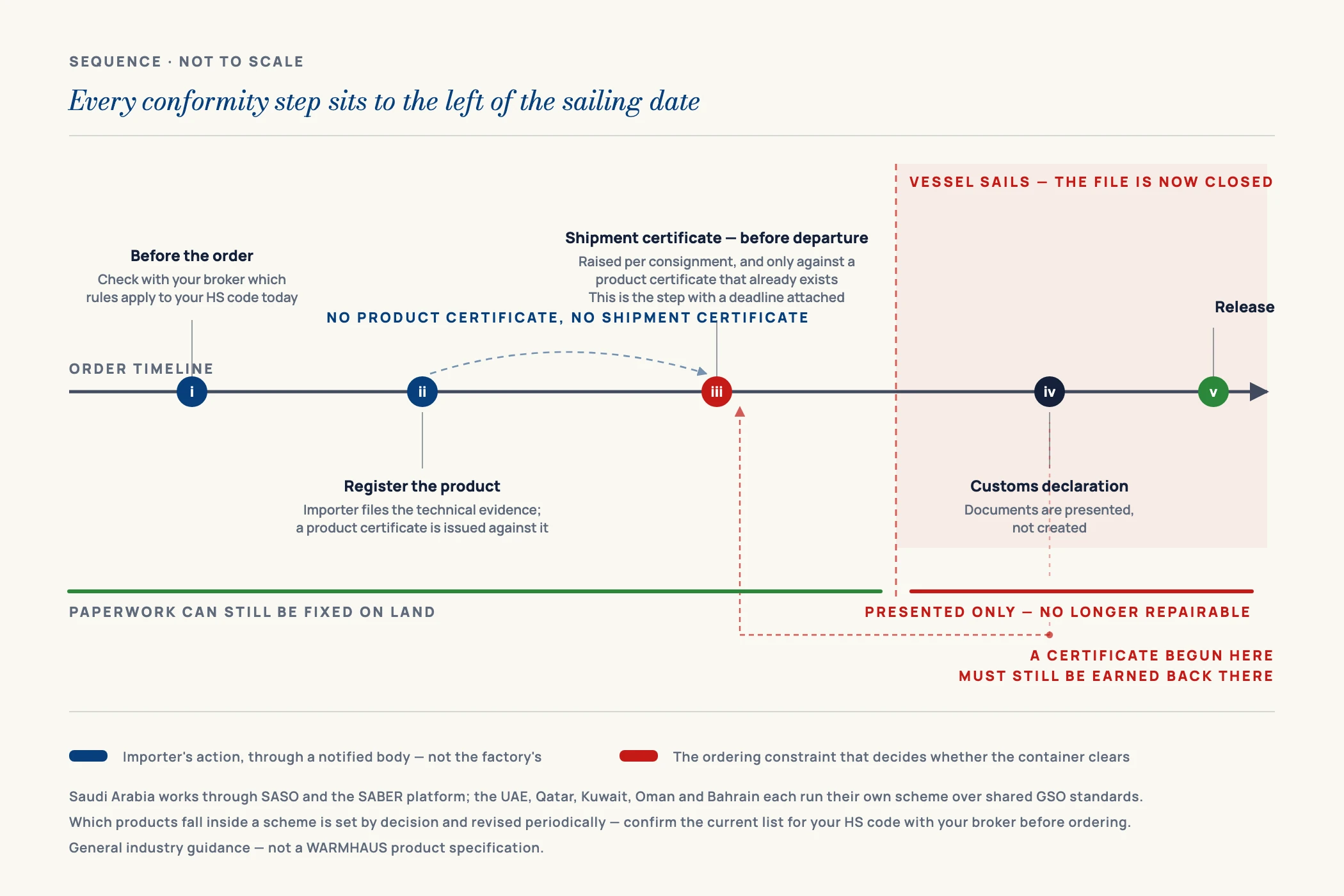
In Saudi Arabia the standards body is SASO (the Saudi Standards, Metrology and Quality Organization), and the operating platform is SABER — an online system through which the importer registers the product and obtains, first, a Product Certificate of Conformity (PCoC) for the product itself, then a Shipment Certificate of Conformity (SCoC) for each consignment before clearance. The PCoC is issued by a conformity-assessment body notified for the relevant technical regulation; the SCoC references it. SABER replaced the older SASO CoC route for products brought inside its scope. Note the sequence — the product certificate has to exist before the shipment certificate can be raised against it, which is precisely why a certificate started after the vessel sails causes demurrage.
The neighbouring markets run their own systems on similar principles with different names. The table sets out who does what.
| Market | Authority / standards body | Conformity scheme | What the importer typically obtains |
|---|---|---|---|
| Saudi Arabia | SASO | SABER platform | Product CoC (PCoC), then a Shipment CoC (SCoC) per consignment |
| United Arab Emirates | MoIAT (formerly ESMA) | ECAS, and EQM for the quality mark | Certificate of conformity under ECAS for regulated products |
| Qatar | Ministry of Commerce and Industry (QGOSM standards function) | National conformity requirements, largely built on GSO standards | Conformity documentation as required for the HS code |
| Kuwait | PAI (Public Authority for Industry) | KUCAS | Technical Evaluation Report and a shipment CoC |
| Oman | MoCIIP / DGSM | National scheme on GSO standards | Conformity documentation, product registration where required |
| Bahrain | Ministry of Industry and Commerce | National scheme on GSO standards | Conformity documentation as required for the HS code |
| GCC-wide layer | GSO (GCC Standardization Organization) | Regional standards and the GCC conformity marking regime | Underlying regional standards the national schemes reference |
Scheme names and responsible bodies are given as general orientation, not legal or customs advice, and are not a statement of which route applies to any particular consignment. Scopes, platform names and responsible authorities are revised periodically and differ by HS code. Confirm the current position with your customs broker and the appointed conformity-assessment body before ordering.
Two structural points follow. First, GSO sits underneath most of these: the national schemes generally reference regional GSO standards, so a technical file assembled to satisfy one Gulf market is usually a large part of what the next one needs. Second, every one of these schemes is registered by the importer, not by the factory. The manufacturer supplies test reports, datasheets and management-system certificates; the certificate itself is issued to the importer or the consignment through a notified body. A supplier claiming to "hold SABER" has misunderstood the scheme — or is hoping you have.
IV. The Document File — What Travels With the Container
Whichever route applies, the mechanics are the importer's responsibility and the details change, so the rule is simple: establish the current requirement for your HS code with your customs broker and appointed conformity-assessment body before you place the order, not after the vessel sails. What the factory owes you is the underlying evidence file — complete and consistent, so whichever route applies can be completed without chasing documents across time zones.
The table below is the file a competent PPR supplier should be able to assemble. It separates what the factory issues from what a third party issues and what you generate locally — a distinction that trips up first-time importers.
| Document | Issued by | What it evidences | When you need it |
|---|---|---|---|
| Commercial invoice & packing list | Supplier | Value, HS codes, quantities, gross/net weights, carton marks | Before shipment; must match the B/L exactly |
| Bill of lading | Carrier / forwarder | Title and shipment terms | On loading |
| Certificate of origin | Chamber of commerce | Origin as declared for tariff purposes | Before arrival; often needs legalisation |
| ISO 9001 / 14001 / 45001 certificates | Certification body | Quality, environmental and OH&S management systems at the factory | Supplier qualification and most tenders |
| EU CE marking documentation | Manufacturer declaration | Conformity with applicable EU requirements for market access | Where the buyer or tender asks for it |
| Third-party test reports (SGS) | Independent laboratory | Testing of submitted product samples | Technical evaluation; supports conformity files |
| Product technical datasheets | Manufacturer | Dimensions, PN class, resin type, marking format | Specification stage, before the PO |
| Conformity certificate for import | Designated conformity body | Regulatory clearance for the consignment | Registered before customs clearance |
| Arabic labelling / marking artwork | Buyer and supplier jointly | Labelling as required for the local market | Agreed before production starts |
General orientation to the documents commonly involved in importing plumbing products — not legal or customs advice, and not a claim about which route applies to any consignment. Requirements vary by HS code and change; confirm the current position with your customs broker and the relevant Saudi authorities. WARMHAUS holds ISO 9001, ISO 14001 and ISO 45001 certification, is EU CE marked and has SGS third-party testing; certificate documents available on request.
One habit saves more trouble than any other: ask for the document set at RFQ stage, not shipping stage. A manufacturer that sends scanned certificates and datasheets the same week has files that exist; a supplier promising them "when the order is confirmed" is often assembling them from someone else's factory. To evaluate ours against your tender checklist, request the PPR technical and certification pack .

V. Building the First Container — Range, Ratios and Money
The commercial mistake specific to PPR is buying pipe like a commodity and fittings like an afterthought. Pipe fills a container quickly and looks like the whole order on a spreadsheet; fittings are what sell it, because a plumber who cannot find a 32 mm reducing tee takes the job elsewhere. Some structure for a first order, as rules of thumb rather than a formula:
Fix the diameter band before the quantities
For domestic and light commercial plumbing the working range is typically 20–63 mm, with 20 mm and 25 mm carrying most of the volume. Decide whether you are serving larger risers too, before spreading budget across sizes nobody asks for.
Weight the fitting range to the small diameters
Sockets, elbows, tees, reducers and threaded transition fittings in 20 mm and 25 mm empty first. Order exotic sizes in token quantities until you have your own sell-through data.
Do not skip the transition fittings
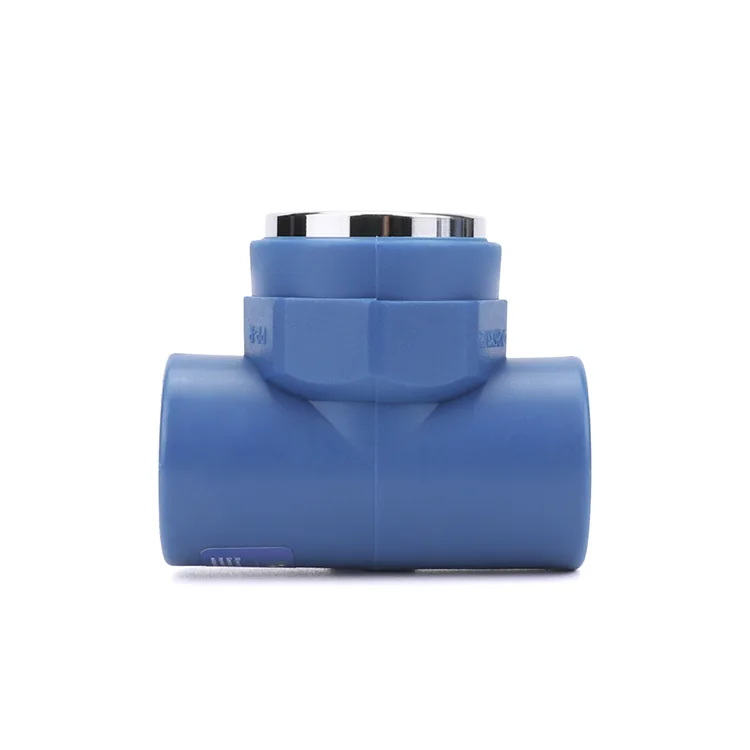
Every PPR system meets metal somewhere — meter, heater, mixer. Brass-insert transition fittings are where thin brass or a poorly moulded insert causes leaks that look like pipe failures. Ask what brass grade the insert is machined from.
Buy valves and tools with the first order
Ball valves, stop valves and hot-melt welding machines with dies for your diameter band should ship with the pipe. Installers who cannot get a matching machine locally choose a different system.
Plan the calendar backwards from site
Standard lead time is 45 days from confirmed order, before sea transit and clearance. Count backwards from the date the contractor needs material on site — a first order belongs a season early, not a month early.
Agree marking and packing in writing
Batch marking, carton labelling, bundle counts and pallet configuration affect how quickly a consignment clears and how easily a warehouse picks it. Settle it before production — it cannot be fixed after extrusion.
On minimum quantities: WARMHAUS operates with no MOQ, which matters more on a first Saudi order than it looks. The trial container can be built around what your market actually asks for — a wide fitting range in modest quantities plus the pipe volumes you are confident of — instead of padded to hit a per-item minimum. Territory terms are on our distributor programme page.
VI. Vetting the Supplier From a Distance
You will probably qualify the first supplier without visiting. Four questions do most of the work, and all four fit in one message.
Who makes the resin? Long-term PPR performance rests on virgin PP-R random copolymer. Regrind and filler blends extrude and weld acceptably on day one, then fail early under sustained hot water. A manufacturer names its resin suppliers without hesitation; WARMHAUS works with Hyosung, Borealis and LG, and we name them because a buyer is entitled to check. Which lines are yours? Extrusion, injection moulding and brass machining are three separate capital investments; a company owning all three answers to you rather than forwarding your complaint onward. What standards is the pipe produced to? Ours: DIN 8077 / DIN 8078 and GB/T 18742.2-2017. What certification file exists today? Not what could be obtained — what is in the drawer now.
Then verify the answers against wall thickness on arrival. A vernier caliper and the dimensional table in DIN 8077 tell you in under a minute whether pipe printed PN20 has the wall it should. It is the commonest substitution in the category, invisible in a photograph, trivially detectable if you check. Comparable due diligence for neighbouring markets is in our guide to importing pipes into the Gulf and North Africa, and the fusion-jointing method that decides whether any of this holds pressure on site is in the PPR welding guide.
VII. Working With WARMHAUS on a Saudi Programme
Most of what makes a Saudi PPR import go smoothly is unglamorous: one supplier for pipe, fittings, valves and welding tools, so socket tolerances match and one certification file covers the consignment instead of four. WARMHAUS is a manufacturer of PPR, PEX and brass piping systems, not a trading company — the extrusion, injection-moulding and machining lines are our own, across three plants totalling 100,000 m² of building area, over 500 staff and a total monthly output of 2,000 tonnes. Manufacturing since 1993. ISO 9001, ISO 14001 and ISO 45001 certified, EU CE marked, SGS tested; certificate copies available on request.
That means three things here. Your PPR system — pipe, fittings, valves and hot-melt tooling — comes from one production source with matched dimensions, so installers are not fighting tolerance drift between brands. No MOQ lets you build a realistic first container instead of a padded one. And the certification file supporting your conformity submission comes from the company that made the goods, which is what decides how long the container sits at the port. Standard lead time is 45 days from confirmed order. Send us the diameters, pressure classes and volumes your projects call for, and we will come back with specifications, the certification file and distributor terms.