Almost no plumbing import into Egypt fails on the product. It fails on the file. A container of perfectly good PPR pipe sitting at a port while somebody chases a missing conformity document costs more in demurrage and lost site time than the margin on the goods inside it — and the fix was a fifteen-minute conversation with the manufacturer before production started. The importer’s real job is not finding a cheap pipe. It is making sure that the pipe, the marking printed on it, the certificate that describes it and the invoice that declares it all say the same thing, and that they all exist before the vessel sails.
This guide is for importers, sourcing agents and distributors building a plumbing programme for the Egyptian market: the document file, the marking questions that get missed, how to choose a range for how Egyptian contractors actually build, and the commercial mechanics that decide whether the second order happens. Section II names the four Egyptian bodies involved and says which one owns which question, so that “confirm with the authority” becomes three specific enquiries rather than a shrug. That said: Egypt’s import regulations, registration requirements and duty schedules are set by those authorities and change by decree, and whether a given regime catches your goods depends on the HS classification. Confirm the current position with a licensed Egyptian customs broker before you commit to an order. Nothing below replaces that check. For the wider regional picture see our guide to importing pipes into the Gulf and North Africa, and the markets we already ship to on our countries we supply page.
I. The Import Requirement Table
Send this table to any supplier you shortlist and ask them to confirm the right-hand column in writing. A manufacturer that owns its production lines answers within a day. A trading desk buying from three factories will hedge, delay, or answer only in general terms — itself the most useful signal in the whole sourcing process.
| What the file needs | Who issues it | What the importer must verify | When it must exist |
|---|---|---|---|
| Commercial invoice | Supplier | Description, HS code and quantities match the packing list exactly | Before shipment |
| Packing list | Supplier | Carton counts, net and gross weights, marks per pallet | Before shipment |
| Certificate of origin | Chamber of commerce | Issued for the actual manufacturing entity, not a trading agent | Before shipment |
| Bill of lading | Carrier / forwarder | Consignee and notify party agreed with your bank in advance | At loading |
| Quality management certificate | Certification body | ISO 9001 in the manufacturer’s own name, validity date current | Before order |
| EU CE marking documentation | Manufacturer (declaration) | Declaration of conformity covering the exact product range ordered | Before order |
| Third-party test reports | Independent laboratory | Reports name the product, dimensions and standard tested against | Before order |
| Product marking specimen | Manufacturer | Printed pipe legend agreed and signed off before extrusion | Before production |
| Carton and label artwork | Manufacturer | Language, brand, barcode and unit counts as your market needs | Before production |
| Container loading photos | Manufacturer | Stow pattern, dunnage, seal number readable in the image | At loading |
| Insurance certificate | Insurer | Cover matches the Incoterm you agreed, not the one you assumed | Before shipment |
| Importer registration record | Egyptian authorities | Your own registration current for the product categories imported | Before order |
| Exporter/factory registration record | Egyptian authorities | That your supplier is registered where the regime requires it — this is checked on the manufacturer, not on you | Before order |
This table is general industry guidance for planning a plumbing import, not a legal statement of Egyptian customs requirements and not a WARMHAUS-specific specification. Documentation requirements, registration rules and tariff treatment are set by the Egyptian authorities and change; confirm the current list with your licensed customs broker and against the datasheet and certificate file of the products you are actually ordering.
II. Who Administers What — the Egyptian Bodies by Name
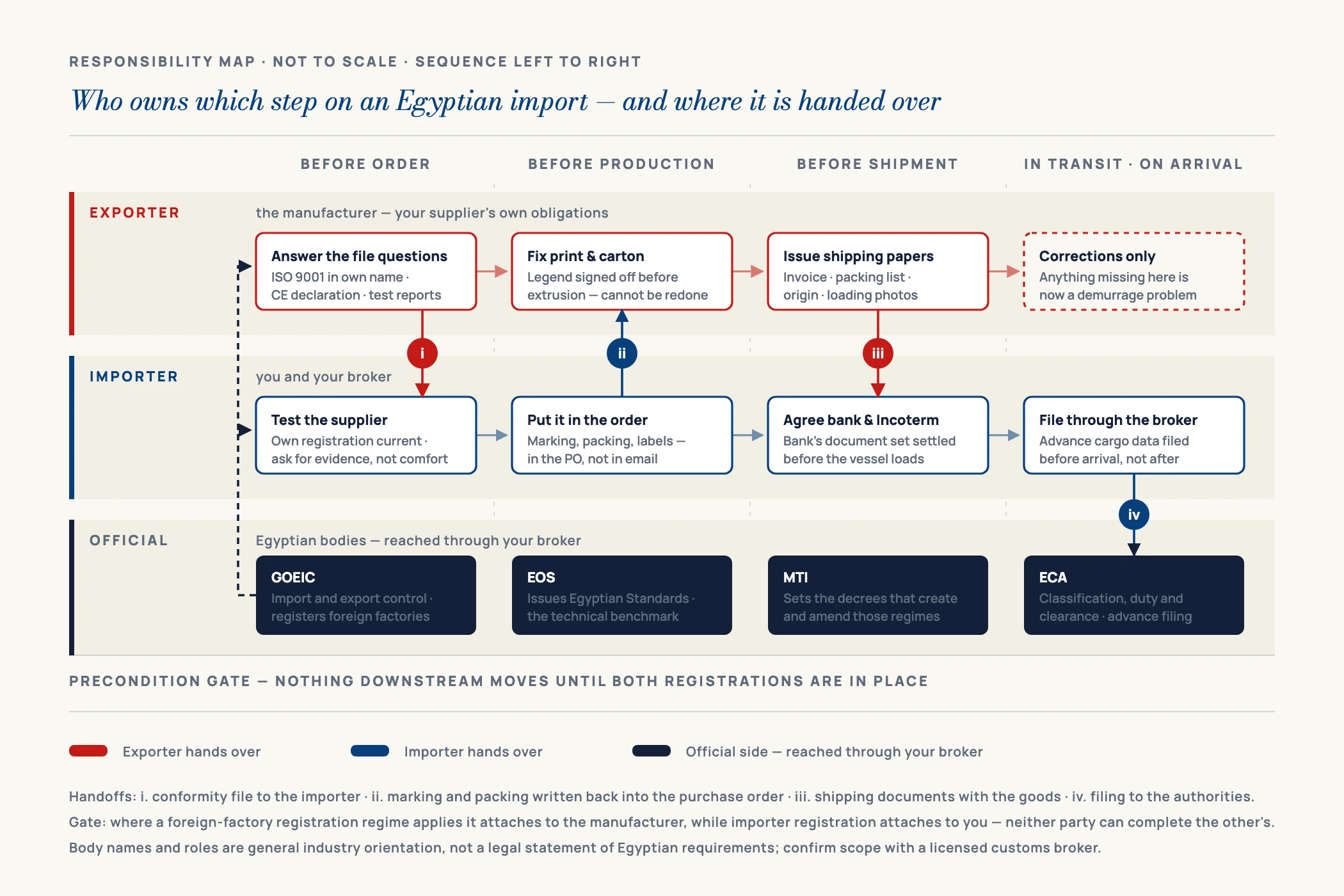
“Confirm with the Egyptian authority” is useless advice unless you know which authority. Four organisations come up repeatedly on a plumbing consignment, and they do different jobs. Knowing which one owns which question is what turns a broker conversation from a fishing expedition into three specific enquiries.
| Body | Commonly written as | What it owns | The question to put to it (via your broker) |
|---|---|---|---|
| General Organisation for Export and Import Control | GOEIC | Import and export control; inspection of consignments; the registration of foreign factories permitted to export specified goods to Egypt | Is my product category inside the registration regime, and is my supplier’s factory registered under it? |
| Egyptian Organisation for Standardization and Quality | EOS | Issues Egyptian Standards (ES). Where a mandatory ES exists for a product, that is the technical benchmark a consignment is judged against | Which ES number applies to this pipe or fitting, and is it mandatory or voluntary? |
| Egyptian Customs Authority | ECA | Tariff classification, duty and clearance; operates the electronic advance-cargo-information system through which shipment data is filed before arrival | What is the correct HS classification, and what must be filed before the vessel sails? |
| Ministry of Trade and Industry | MTI | Sets the decrees that create and amend the registration and inspection regimes above | Has the rule that applied to my last shipment changed? |
Body names and responsibilities above are general industry orientation given so that you can direct a question to the right place. They are not a legal statement of Egyptian import requirements, and scopes, decrees and electronic platforms change. Whether any regime applies to your consignment depends on the HS classification and the product category. Establish the current position with a licensed Egyptian customs broker before you commit to an order.
Two features of this system deserve planning attention rather than a footnote. First, where a foreign-factory registration regime applies, it attaches to the manufacturer and not to you — which means it is a supplier-selection criterion you have to test before the first order rather than a form you file afterwards. Ask the question early: a manufacturer that already ships into Egypt will answer it immediately. Second, advance cargo information is filed before arrival, not on arrival, so the document set has to be complete while the goods are still moving. Both of these push the same way: the paperwork conversation belongs in the first week of the enquiry, not the last week before loading.
III. Marking and Labelling — Decided Before Extrusion, Not After
The single most expensive mistake in a first container is discovering at the port that the print legend on the pipe does not match what the paperwork declares. Print is applied during extrusion. It cannot be changed once the pipe is made, and nobody is going to re-print forty pallets of PPR because a brand name was spelled differently on the invoice.
Agree the full legend in writing before production is scheduled. For a PPR pipe that normally means: brand name, material designation, nominal outside diameter and wall thickness, the pressure class, the standard the dimensions follow, and a production identifier such as a batch or date code. Ask for a photograph of the printed legend on the first metres off the line and approve it before the run continues.
Print is applied during extrusion. Everything you want written on the pipe has to be agreed before the machine starts, not after the container is sealed.
The same discipline applies to cartons. Decide who the carton speaks to — the customs officer, the storeman, or the plumber at the counter — and specify unit count, size, pressure class, brand, barcode and any language requirement accordingly. If you are building your own brand rather than reselling the manufacturer’s, the trade-offs are set out in our comparison of private label versus distribution. Private label changes the artwork lead time, so it belongs in the first conversation and not the third.
IV. Choosing the Range for the Way Your Buyers Actually Build
The most expensive stocking error is buying a catalogue spread instead of a demand curve — slow-moving large diameters tying up capital while the fast sizes go out of stock. The fix is not a rule of thumb from a guide; it is a description of the buildings your customers work on, which only you can supply. What follows is the reasoning to apply to it, not a claim about what Egyptian sites contain — verify the pattern with your own contractor customers before you convert it into an order.
Where plumbing is chased into walls and screeds rather than run in accessible service voids, three consequences follow, and they hold wherever that construction pattern dominates. The demand curve sits heavily in the small branch diameters that feed fixtures, with risers and mains a much smaller share by piece count even though they carry far more weight — which is why a stock plan weighted by tonnage misreads the market. Fittings outnumber pipe by a large factor in piece terms: elbows, tees, sockets, reducers and the brass-insert transitions that connect the plastic network to taps, mixers and meters. And because buried pipe cannot be reached without breaking finishes, the cost of a joint failure is the demolition, not the fitting — so weld quality and bore consistency matter to a contractor far more than a small unit price difference, and that is the argument you sell on.
Test the assumption before you act on it. Ask three of your target contractors what diameters they buy most, whether hot water is distributed buried or in voids, and what proportion of their basket is fittings. If the answers match the pattern above, weight the order accordingly. If they do not, weight it to what they told you — a real answer from three customers beats any general market description, including this one.
Pressure class deserves a deliberate decision rather than a default. Higher PN classes carry thicker walls for a given outside diameter, reducing the bore and therefore the flow, but giving more margin for sustained hot-water service. Hot-water and buried circuits are conventionally specified at a heavier class than cold-water branches. The relationship between class, wall thickness and service temperature is set out in our guide to PPR pipe specifications and on the PPR pipe range. Treat those as general industry guidance and confirm the class against the datasheet of the pipe you are buying and the design conditions of the project.
Fix the diameter band before you discuss price
Decide which outside diameters your market genuinely turns over, and quote only those. A quotation spread across a catalogue you will not stock is not comparable to anything, and it invites a supplier to win on the sizes you never order.
Weight the fittings to the small end
Piece counts on elbows, tees and sockets in the branch sizes dominate site consumption. Order them in the ratio the site consumes them, not in a flat spread across the fitting list, or you will be air-freighting elbows within three months.
Do not leave out the brass transitions
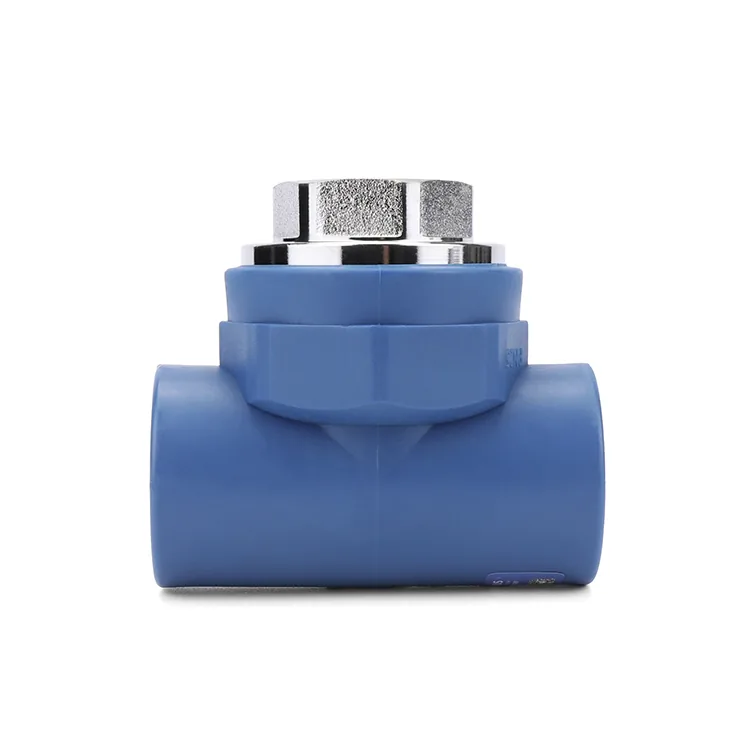
Every plastic network terminates in a threaded metal connection. Male and female threaded adaptors, wall-plate elbows and union sets are where a system meets the tap, and running out of them stops a job as effectively as running out of pipe. Our brass fittings range and the PPR fittings line are made to the same internal standard.
Ship the tools with the first container
A PPR system is only as good as its welds, and welds depend on a machine that holds temperature. Sending welding machines and dies with the goods, rather than expecting the market to supply them, protects the reputation of the brand you are about to build. The technique itself is covered in our PPR welding guide.
Plan the calendar backwards from the site date
Work back from when material is needed on site: sea transit, port clearance, inland movement, and standard production lead time of 45 days from confirmed order. Add contingency for the approvals in your own file. Nobody has ever regretted starting a container four weeks earlier than they thought necessary.
Put the marking and packing in the purchase order
Not in an email thread, not in a call. Print legend, carton artwork, unit counts, pallet pattern and labelling all belong in the order document, because that is the version that gets read on the production floor.Product specifications, certificates and test documentation: available on request.

V. The Commercial Mechanics That Decide the Second Order
Importing into Egypt has a working-capital shape that new distributors underestimate. Funds are committed, the goods travel, clearance completes, and only then does stock start converting into sales. That gap between paying and collecting — not the unit price — is the real constraint on how fast a plumbing programme can grow, and the first two orders should be designed around it.
Three things follow. Agree the payment instrument with your bank before you agree it with the supplier, because the document set your bank requires is not always the one the supplier expected to produce, and a mismatch found after loading is expensive. Be precise about the Incoterm — who pays freight, who carries risk from which point, and who owes which documents all follow from it, and many disputes are simply two parties assuming different things about three letters. And size the first order for learning, not volume: a container that proves the documents, marking, packing and market reaction is worth more than a large one that ties up capital in an untested range.
This is where the absence of a minimum order quantity changes the arithmetic. A per-item MOQ forces a new importer to buy depth in items they cannot yet forecast. Without one, the first container can be a wide, shallow range in modest quantities, and the second can correct the ratios using real sales data instead of guesses. Territory and terms are covered on our distributor partnership page.
VI. Vetting the Supplier From a Distance
You will probably place the first order without visiting the plant. That is normal and manageable, provided you test what a trading desk cannot fake on a video call. Ask for the extrusion line running the exact diameter you ordered, on a date you nominate rather than from a file they already have. Ask who owns the injection-moulding tools. Ask for the raw material grades and their suppliers — a manufacturer knows the polymer and brass it buys. Ask for the ISO 9001 certificate in the manufacturer’s own registered name, and read the validity dates rather than the logo.
Two clarifications worth carrying into any certification conversation, because both are misrepresented often. ISO 9001 certifies a management system, not a product — it tells you there is a documented process and an auditor, which is useful, but it is not a product approval. EU CE marking is a manufacturer’s declaration of conformity supported by evidence, not a certificate issued by a public registry you can look up. What the various marks mean is set out in our explainer on ISO and CE certifications, and the full vetting sequence is in how to vet a PPR pipe manufacturer.
Add one Egypt-specific question to that list, because it can disqualify a supplier after you have already negotiated everything else: ask whether the factory is registered where the Egyptian foreign-factory registration regime requires it for your product category, and ask for evidence rather than reassurance. Where the regime applies, the registration attaches to the manufacturer — no amount of paperwork on your side substitutes for it. A supplier already shipping into Egypt answers immediately; one that has never done so may not know the question exists. Confirm the current scope with your broker, since the categories caught by the regime are set by decree and change.
One more test, and it is the cheapest. Send a technical question that requires a real answer — a wall thickness at a given class, a weld time for a specific diameter, the brass grade in a particular fitting. A factory technical office answers directly; an intermediary answers slowly, vaguely, or with a catalogue screenshot.
VII. Working With WARMHAUS on an Egyptian Programme
WARMHAUS is a manufacturer of PPR, PEX and brass piping systems — not a trading company. The extrusion, injection-moulding and machining lines are our own, which is what makes the print legend, the carton artwork and the fitting range negotiable in the first place: we are scheduling our own production, not relaying a request to somebody else’s factory. Manufacturing since 1993 across three plants totalling 100,000 m² of building area, with over 500 staff and a 50-strong technical team. Raw materials are sourced from Hyosung, Borealis and LG.
Certification: ISO 9001, ISO 14001 and ISO 45001 management systems, EU CE marking, SGS testing and Russian PT market approval — certificate documents and test documentation available on request. Production covers PPR pipe, fittings and valves, PEX pipe, brass fittings, ball valves, manifolds, underfloor heating components, controls and welding tools, which is what makes a mixed first container practical: one supplier account, one document file, one loading photo set instead of four of each.
No MOQ, which matters a great deal on a first Egyptian container where the right range is still a hypothesis. Standard lead time is 45 days from confirmed order, planned into production slots rather than promised loosely — build your calendar on that figure and add your own clearance contingency on top. Request the product range, certification file and container planning support for Egypt — send us the diameters and fitting types your market turns over and we will come back with a range proposal and a loading plan rather than a price list.