Heating Leak Sealer or Component Repair? Choose the Assessed Scope
An internal heating leak sealer belongs in a product-specific discussion after a competent professional has assessed the system and the leak. A confirmed small, inaccessible leak in the stated central-heating application may fit a named manufacturer’s scope. A visible accessible leaking component should follow its component-repair assessment. Unexplained pressure loss needs investigation before choosing a sealing product.
Those three situations can produce similar requests at a trade counter, yet lead to different decisions. The useful starting question is what has actually been established about the leak and the equipment. This guide helps component buyers, property maintenance coordinators and heating professionals separate the routes. It supplies no chemical dose, diagnostic procedure or WARMHAUS treatment approval.
Key Takeaways
- Establish the actual system and leak assessment before selecting a treatment route.
- A named internal sealer’s scope can cover small inaccessible heating leaks.
- Accessible leaking components retain their own repair assessment.
- Pressure loss alone does not establish that a sealer is applicable.
- Keep leak sealer and corrosion inhibitor as distinct treatment functions.
- Use the exact product and equipment instructions for any professional treatment decision.

Read the scope of the proposed product
Fernox describes its UK Leak Sealer F4, product code 56603, for small inaccessible leaks and weeps within central-heating systems. That gives the professional a defined application to consider. It leaves the actual system identification, leak assessment and equipment requirements to be checked for the job. The manufacturer’s description belongs to that named product and cannot establish the suitability of every bottle sold as a leak sealer. Fernox F4 product information.
The word “inaccessible” has a practical consequence for the purchasing decision. It describes a problem where the location or physical access makes an ordinary repair difficult. It should be supported by the assessment of the actual installation. A component hidden behind a removable panel and an unresolved leak somewhere in a building deserve different records even if both are initially described as concealed.
Application scope also includes the type of circuit. The Fernox page identifies a special consideration for single-feed indirect cylinders such as Primatic arrangements, where potable-water chemicals must be used. A person who cannot establish the system type has an applicability question to resolve before treatment is selected. A generic description of “wet heating” leaves that question unanswered.
A competent review therefore ties together the exact product reference, the identified system and the observed problem. It can conclude that a product falls within the stated application while leaving its use subject to the actual equipment requirements. It can also conclude that the available information is insufficient. Both outcomes are more precise than promising that an additive will solve any pressure-loss complaint.
Open Fernox manufacturer scope explainer
Choose the accessible-component route
A visible leak at an accessible valve, joint or other component gives the professional a specific item to assess. The immediate task is to establish the component’s condition and appropriate repair or replacement route. Keep that task visible when an internal-sealer proposal arrives alongside the component enquiry. Otherwise, a general chemical suggestion can displace a repair decision that the observed condition already makes possible.
This distinction is about choosing the work to assess. It provides no instruction to tighten a nut, dismantle a valve or operate unfamiliar equipment. A component can leak because of its condition, its connection or the surrounding installation. The person responsible for the repair needs to identify the actual item and relevant method before deciding how to restore it.
Suppose a maintenance coordinator has a professional report identifying an accessible leaking connection beside an emitter. The useful purchasing result is to identify the required component or connection specification for the repair. Buying an unspecified bottle would leave that confirmed repair question unresolved. If a professional proposes another route, the record should explain its applicability to the observed problem.
Accessibility can change during the work. Once a previously concealed component becomes accessible and its fault is identified, revisit the original treatment rationale. The decision should follow the updated evidence. A previous description of the leak as inaccessible is a historical observation, and should not automatically govern the next stage of the repair.
Keep unexplained pressure loss open
A falling pressure record describes a symptom. It does not by itself establish a small inaccessible leak that fits a sealer’s stated application. The responsible professional still needs to assess the system and determine the relevant cause. Preserve what the observer actually knows, including any visible water, service history and comparable observations, without converting an absence of visible leakage into a diagnosis.
This matters when the proposed purchase is driven by convenience. A product that can be introduced into circulating water appears easier than locating an uncertain fault. Ease of application cannot supply the missing assessment. Selecting the product first can narrow attention around one explanation while the actual pressure-loss mechanism remains unresolved.
WARMHAUS’s discussion of recurring radiator gas treats refill and pressure history as evidence for a professional investigation. That is an earlier diagnostic boundary. The decision here comes later, when the question is whether an established leak and identified circuit fit the proposed treatment. Retaining that sequence prevents the sealer discussion from becoming a substitute diagnosis.
If the information remains incomplete, the completed choice is to request professional assessment before making a chemical selection. State the missing condition precisely. “The loss mechanism is unconfirmed” gives the next person a clearer task than “the system may need treatment”. The record can progress as the assessment adds facts, without pretending the initial symptom established an application.
Separate sealing from inhibitor protection
Corrosion inhibitor and internal leak sealer address different treatment functions. A bottle proposed to seal a small leak does not answer whether corrosion protection is at the appropriate condition for the actual system. Equally, checking inhibitor condition does not determine whether a visible leaking component should be repaired. Keep the purpose of each proposed product explicit in the maintenance record.
Existing treatment information matters when any further chemical is considered. Record the identified product and credible service information for the professional reviewing the system. An unlabelled treatment history remains uncertain even when the water looks clear. WARMHAUS’s inhibitor top-up guide addresses the separate compatibility question rather than establishing permission to mix other treatments.
This scope comparison provides no dosing arithmetic or radiator-count shortcut. For an actual treatment proposal, reconcile the exact product label and current manufacturer instructions with the equipment requirements through the responsible professional.
Keeping the instruction reference attached to the proposal avoids asking the reader to resolve formulation details from a general guide. The outcome is an identified scope question and an instruction-version question. It leaves an actual dose to the source and assessment that can support it, preserving the distinction between understanding a product’s purpose and authorising its use.
Resolve four treatment-scope cases
The following cases are hypothetical. They illustrate how changing a known condition changes the appropriate next task. They describe no completed customer repair, product test or guaranteed outcome.
| Established situation | Completed route choice | Condition retained |
|---|---|---|
| Professional assessment identifies a small inaccessible leak in an identified heating circuit | Consider the exact internal product within its stated scope | Check actual equipment and product instructions |
| Accessible component is visibly leaking | Assess component repair or replacement | Identify the actual item and connection |
| Pressure falls, cause unresolved | Investigate before selecting sealer | Symptom supplies no leak-scope approval |
| Potable or unfamiliar circuit | Resolve application suitability first | Heating product wording cannot settle it |
In the first case, the small inaccessible heating leak is already an assessed finding. The professional can compare it with the named manufacturer’s application, check the actual equipment requirements and determine whether treatment is appropriate. That is a conditional route into a product-specific decision. It supplies no prediction that the sealer will cure the fault or remove the need for further work.
Change the same case so that opening an access point exposes the leaking component. The purchasing question moves toward the repair item and connection. The fact that a sealer was previously considered does not decide what should happen once the fault is accessible. Update the record with the new condition and let the competent repair assessment determine the next action.
In the third case, the owner has pressure observations but no established cause. Decline to select a sealer from that symptom alone. In the fourth, the circuit type or potable-water relationship is uncertain. Resolve that applicability question before using a central-heating product description. These are different stopping points with different missing inputs, which is why they should remain separate rows.
Keep a useful assessment record
A useful handover records the identified circuit and equipment, what the professional has established about the leak, whether the affected item is accessible, and the reference of any proposed product. Add the instruction version used in the review and the person responsible for the next assessment. The record should preserve observations separately from conclusions so that a later change can be understood.
Also record what remains open. The professional may have identified the circuit while still investigating the loss mechanism, or established a repair item while waiting for its exact connection details. A short statement of that remaining question prevents an availability enquiry from being mistaken for a completed repair plan. The next person can act on the specified gap rather than repeat the entire conversation.
A completed B2B buyer walkthrough
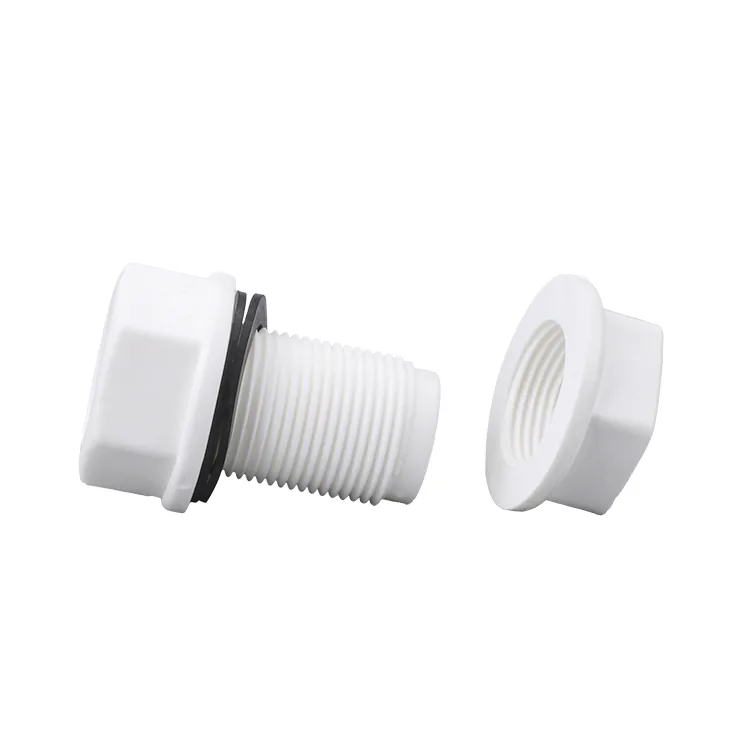
Consider an illustrative distributor preparing a component enquiry after receiving a heating contractor’s assessment. Every project input in this example is hypothetical. It is a purchasing demonstration, with no assertion that WARMHAUS stocks the component or has approved the installation. The contractor has identified an accessible leaking removable connection at a pump interface and instructed the buyer to obtain a replacement complete union assembly to the reviewed connection drawing. That assessment changes the buyer’s task from choosing a sealing additive to identifying an available matched replacement assembly.
The contractor’s hypothetical schedule identifies a 32 mm PP-R socket on the piping side and a G 1 male connection on the equipment side, with the mating arrangement defined on drawing H-17 revision B. Its stated service is a closed heating-water circuit with design information recorded as 50°C and 3 bar. Those figures describe the example’s supplied requirements. They establish no rating for a candidate product. The purchaser must retain the drawing and ask the potential supplier to identify the exact assembly and applicable service documentation against it.
The distributor can now issue a concrete conditional enquiry line. “Please check availability for 12 complete removable union assemblies to drawing H-17 revision B, 32 mm PP-R socket × G 1 male equipment connection, for the recorded heating-water service. Confirm the proposed product reference, complete supplied parts, dimensions, sealing arrangement and product-specific suitability documentation against the drawing and stated conditions. Delivery destination: Italy. Please identify any mismatch before quoting.” Twelve units and the destination are example purchasing inputs, not a minimum order or an available-stock claim.
This is an enquiry for a complete identified assembly against a specification. It is not an instruction to combine a loose nut, tailpiece and seal from different catalogues. The buyer has a line a supplier can assess, while the contractor retains responsibility for the actual connection and repair requirements. A response offering a same-diameter fitting without establishing the mating arrangement should leave that candidate unresolved. The pipe-side size alone does not fill the other fields on the reviewed drawing.
| Purchasing record | Completed example entry | Release effect |
|---|---|---|
| Assessed work | Replace accessible leaking complete union assembly | Prepare component enquiry |
| Requirement basis | Drawing H-17 revision B and stated service | Attach exact drawing and inputs |
| Candidate | Supplier to identify exact complete assembly | No SKU selected yet |
| Held inputs | Candidate dimensions, mating/seal arrangement and applicable documentation | Hold technical acceptance and purchase release |
| Commercial stage | Conditional availability and quotation request | No stock, price or delivery assumed |
The completed outcome has two different statuses. The component enquiry is ready to send because the requirement has been specified. Technical acceptance and the purchase order remain on hold because no supplier candidate has been matched to it. Keeping those statuses separate prevents a quote request from silently becoming an approval. If the supplier identifies a candidate with a different thread designation or incomplete assembly, return that specific discrepancy for review instead of deleting the requirement to make the quote fit.
Now change the evidence. Suppose the contractor’s revised report says the loss remains unlocated beneath an inaccessible floor and withdraws the pump-connection replacement instruction. Cancel the assumption behind the union line and hold that component purchase. The next task returns to the professional’s assessed leak and identified circuit, including whether a named internal product fits its stated scope and the equipment requirements. The buyer cannot keep ordering the union merely because the first worksheet was complete, or substitute a bottle in its place without a new treatment decision.
Change a different condition: the leak remains accessible, but the equipment connection designation is unreadable and drawing H-17 has not been confirmed. The correct purchasing output is a held enquiry line, with equipment-interface identification assigned to the responsible contractor. A supplier may be asked about the product family, but neither a proposed G connection nor a complete matching assembly has been established. This example shows exactly which missing input prevents an item-specific release while leaving the broader component discussion possible.
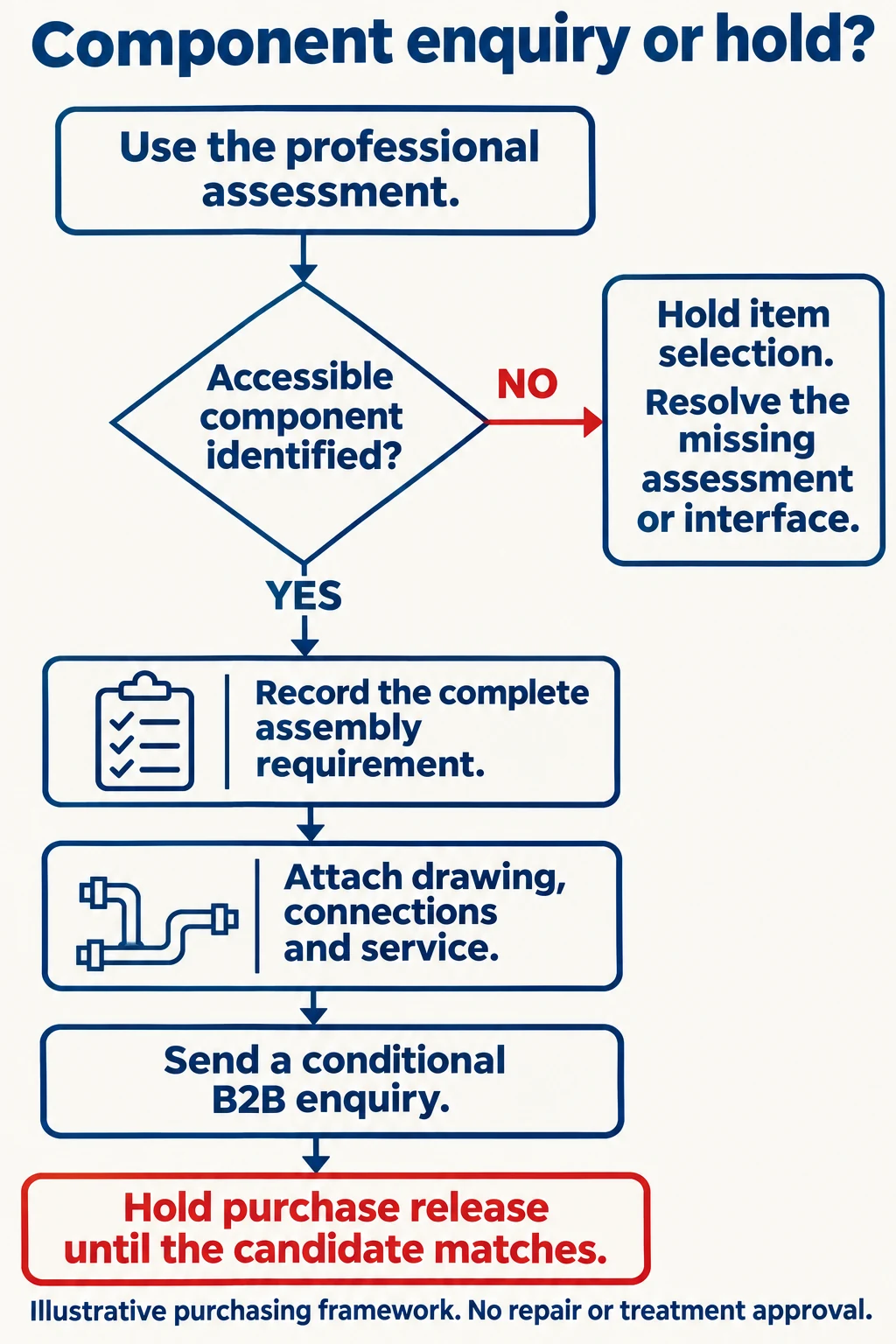
Component enquiry or hold?
Accessible component identified?
- Use the professional assessment.
- Record the complete assembly requirement.
- Attach drawing, connections and service.
- Send a conditional B2B enquiry.
- Hold purchase release until the candidate matches.
If no, hold item selection. Resolve the missing assessment or interface.
Illustrative purchasing framework. No repair or treatment approval.
Prepare a component enquiry
Once the assessment identifies a piping or heating component requirement, prepare its specification independently of the chemical discussion. Include the destination, intended service, product or drawing reference, dimensions, connection type and the document question that needs answering. A clear component enquiry helps establish whether a proposed item and its supporting information are available.
Submit a piping or heating component specification for an availability check. Availability and product-specific documentation require confirmation. This enquiry does not establish chemical supply, a treatment approval, laboratory analysis or a diagnostic or repair service.
Conclusion
Choose the next task from the established condition. Consider a named internal sealer within its stated scope for an assessed small inaccessible heating leak. Direct an accessible leaking component into its repair assessment. Keep unexplained loss and uncertain circuit applicability open until the responsible professional resolves them. Carry the actual product and equipment requirements through every route.
Frequently Asked Questions
Does pressure loss alone justify an internal leak sealer?
No. Establish the loss mechanism and application through professional assessment before selecting treatment.
Is leak sealer a replacement for inhibitor?
The treatment functions differ. Review the actual system protection and proposed products separately.
Does a sealer description approve its use with every boiler?
Use the exact manufacturer’s scope and actual equipment requirements. This guide supplies no blanket approval.
Can this guide calculate a dose?
No. Dosing belongs to the exact current product instructions and professional assessment.