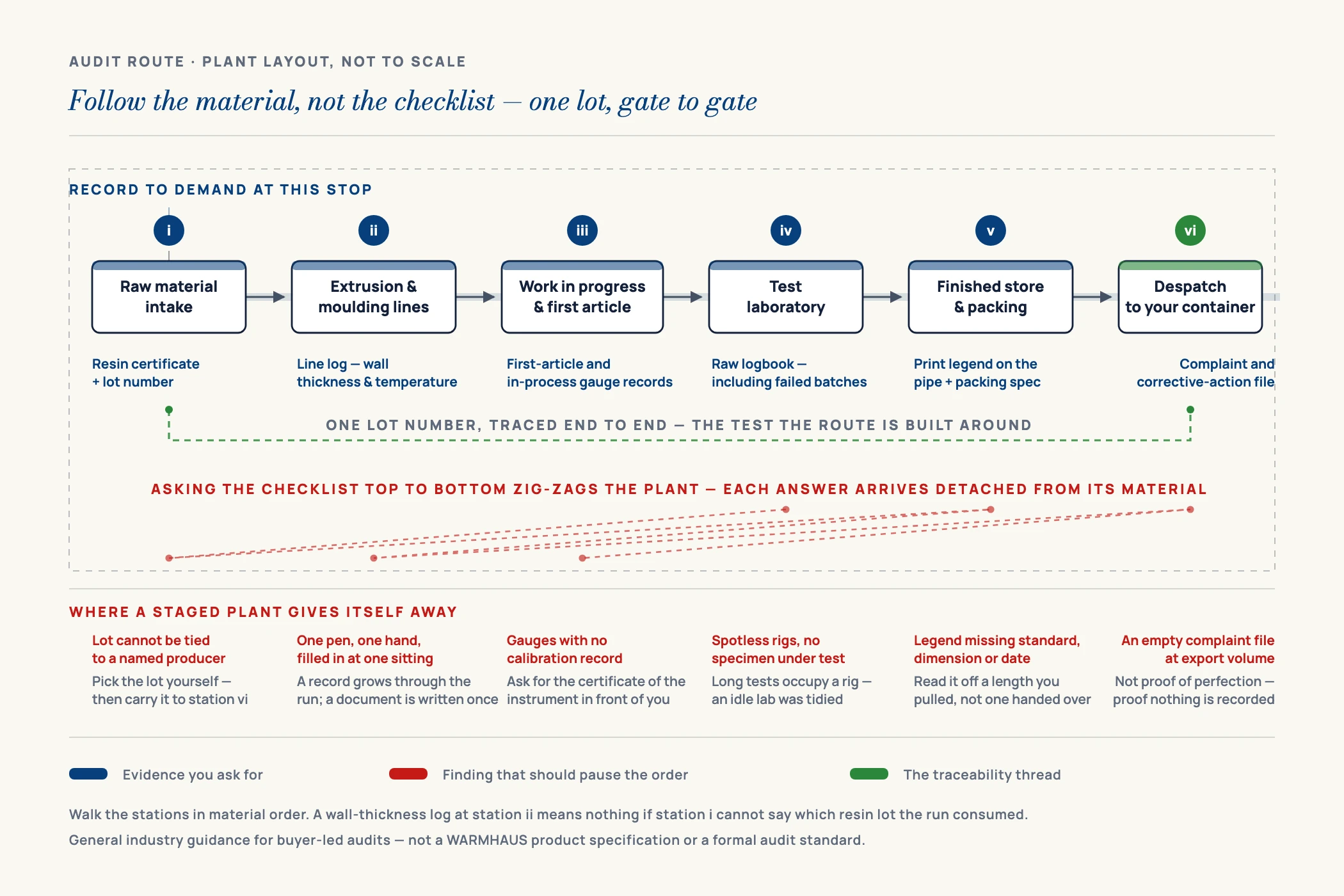
The single most useful thing you can do on a factory audit is refuse the tour. A prepared tour walks you past the newest extruder, into a clean meeting room, and out again with a folder of certificates — and it tells you almost nothing about whether the pipe you order in March will match the sample you approved in January. A real audit follows material, not corridors: you start where resin enters the site, finish where a carton is sealed, and at every stop ask the same question — show me the record for this, from a batch you did not know I would pick.
This checklist is for the person doing the walking — a sourcing agent, an importer’s technical buyer, or a third-party inspector working to your brief. Everything technical below is general industry guidance, not a WARMHAUS-specific specification; tolerances, test intervals and acceptance limits vary by product standard and by market, so always confirm against the datasheets and standards applicable to the pipe you are buying. If you have not yet built a shortlist, our guide to vetting a PPR pipe manufacturer covers the desk research that should happen before anyone books a flight.
I. The Six-Station Audit Checklist
Work the stations in this order. The sequence matters: there is no point examining a wall-thickness log at station four if nobody at station one can tell you which resin lot the pipe came from. Budget the time from the scope rather than a rule of thumb: a plant running several product lines — extrusion plus moulding plus brass machining — needs evidence collected at each of the six stations for each line, and a single working day is tight for that. Where the scope is broad, plan two days or narrow the scope to the product families you are actually buying, and say which in your report. A re-audit of a known supplier, revisiting open findings rather than the whole route, is correspondingly shorter.
| Station | What you are verifying | Evidence to demand on the spot | Finding that should stop the order |
|---|---|---|---|
| 1 · Raw material intake | Resin grade, traceability, storage conditions | Supplier delivery notes · resin certificates · lot numbering on silos or bags | No lot identity, or resin grade cannot be tied to a named producer |
| 2 · Extrusion hall | Line control, dimensional consistency, regrind policy | Line log sheets · calibration records · written regrind rule | Unlabelled regrind hoppers feeding a pressure-pipe line |
| 3 · Moulding & machining | Fitting and valve production, alloy identity, tooling condition | Alloy certificates for bar stock · mould maintenance log · gauge records | Fittings bought in and re-boxed while presented as own production |
| 4 · Test laboratory | Whether testing is routine or staged for visitors | Pressure-test rigs in use · raw logbooks · failed-batch records | A laboratory with no failures recorded in any period |
| 5 · Warehouse & packing | Stock rotation, marking, UV protection, carton integrity | Printed pipe marking · storage under cover · packing specification | Print legend missing standard, dimension or production date |
| 6 · Documentation room | Certificates, complaint handling, corrective actions | Management-system certificates · complaint file · corrective-action log | An empty complaint file at a plant shipping export volume |
Stations, evidence types and acceptance thresholds above are general industry guidance for buyer-led audits, not a WARMHAUS-specific specification or a formal audit standard. Requirements differ by product standard, destination market and the scope of your own quality agreement — always confirm against the datasheets and standards applicable to the products you are buying.
II. Station 1 — Raw Material Intake
Everything downstream inherits whatever happens here, which is why it is the first stop and the one most audits skip. You are looking for three things: identity, traceability and storage.
Identity means the plant can name the resin producer and the grade, not just the polymer family. “PPR” is a family; a pressure-pipe grade of random copolymer polypropylene from a named producer is a specification. Ask which grades run against which pressure classes. For PEX and PERT lines, ask the same about the base resin and the crosslinking route — a point our comparison of PPR against PEX, copper and PVC covers from the specification side.
Traceability means a lot number that survives the journey to the finished carton. Pick one silo or pallet of bagged resin, note the lot, and ask which production orders consumed it. If that cannot be done in minutes, then no recall, complaint investigation or failure analysis is genuinely possible — whatever the quality manual says.
Storage is the easiest to assess and the most often neglected. Resin should be under cover, off the floor, dry and rotated. Bags split open in a yard, or hoppers open to a dusty hall, introduce contamination that surfaces later as inclusions in the pipe wall — which the plant will attribute to something else.
Pick a lot number at random and follow it forward. A factory that can do this in minutes has a quality system; one that needs a week has a filing cabinet.
III. Station 2 — The Extrusion Hall
This is where you find out whether the plant actually extrudes. It sounds absurd to check, but “manufacturer” is not a protected term in the piping trade — it is used by businesses that extrude, by businesses that subcontract extrusion and print their own legend, and by pure re-packers, with nothing in a catalogue or a website to distinguish them. You cannot know which you are dealing with from documents, and the difference is visible in the hall in thirty seconds if you know what you are looking at. That is the whole reason this station exists.
I. Are the lines running, and running your product?
Count the lines, note how many are producing, and ask what is on each right now. Eight extruders with two running on audit day is normal in a low season; eight with none running, no maintenance activity and no material at the hoppers is a different signal. Ask for the current week’s production plan and compare it against what you can see. Then ask directly: which catalogue products are extruded on this site, and which are not? A straight answer is not a red flag — an evasive one is.
II. Line control and dimensional checks
Ask for the log sheet at the line, not a printout from the office. Operators typically record outside diameter and wall thickness at set intervals through a run. You want a log filled in progressively in different pens and hands, with occasional out-of-range entries and a note of what was done — a uniform log completed in one sitting is a document, not a record. Ask which gauges are used and to see the calibration record for the specific instrument in front of you.
III. The regrind question
Ask what happens to start-up scrap and off-cuts. There is a legitimate answer — controlled reuse of the factory’s own clean, identified material in non-pressure applications under a written rule — and an illegitimate one, which is unlabelled recycled material of unknown origin fed into pressure-pipe production to hold a price. Hoppers of mixed-colour granulate with no labelling beside a pressure-pipe line are worth stopping the audit over. Ask for the written regrind policy; if it is not in writing, there is no control.
IV. Station 3 — Moulding, Machining and the Fittings Question
Pipe is the easy part of a piping audit. Fittings and valves are where sourcing fragments, because plenty of pipe extruders buy their fittings and their brass in, then present a catalogue that implies one factory. That is not automatically disqualifying — but you need to know, because it changes who is accountable when a batch of sockets does not fuse properly.
For injection-moulded fittings, ask to see the moulding shop and the mould store. A plant that owns its tooling has a maintenance log, shot counts and refurbishment records; a plant that does not has none of it, and the conversation shifts quickly to a “partner factory”. At the press, gate marks, weld-line position and flash tell you whether tooling is maintained. Our breakdown of PPR pipe specifications covers the dimensional conventions these parts must hold to.
For brass fittings, valve bodies and manifolds, the questions are alloy and machining. Ask which alloy is used for which product family, ask for the certificate that came with the bar stock, and ask whether the alloy differs by destination, because some markets restrict certain compositions. Then look at the machining area: CNC lathes with in-process gauging and a visible first-article routine behave differently from a row of manual machines with no measurement at all. A go/no-go thread gauge on the bench with a use log is a good sign.
Whatever the answer, write it into your report as a clear split: made here, made by a named subcontractor under this plant’s quality system, or bought as a finished item. Buyers who skip this discover the boundary during a claim, which is the worst possible moment.

V. Station 4 — The Test Laboratory
Every plant will show you a laboratory. The audit skill is telling a working lab from a display one, and there are four reliable tells.
Are the rigs occupied right now?
Long-duration hydrostatic pressure testing occupies a rig for hours or days depending on the regime, so a working lab has specimens under test on an ordinary Tuesday, each tagged with batch, start time and conditions. Empty, spotless rigs in a plant claiming continuous production is the classic display-lab finding. Ask what is on test and which batch it came from, then ask to see that batch on the production floor.
Ask for the raw logbook, not the summary report
Summary reports are prepared for buyers. The logbook is where technicians record what actually happened, including tests aborted, repeated or failed. Open it at a random page from several months ago. Handwriting that changes with shifts, corrections initialled rather than erased, and occasional anomalies are evidence of a genuine record. A perfectly clean book is a rewritten one.
Ask to see a failure
The single most informative request in the whole audit. Every real production operation generates non-conforming batches; the question is what happens next. Ask to see a recent non-conformance: what failed, how it was detected, what was quarantined, what the corrective action was, and whether it was verified. A plant that can walk you through one failure end to end is far more credible than one claiming never to have had any.
Check what the lab can and cannot do in-house
No pipe factory tests everything itself, and subcontracting some tests to third-party laboratories is normal — what matters is that the plant knows which is which and can produce the external reports. Ask for the list of in-house tests, the subcontracted ones, and a recent third-party report.Test documentation and certificate references: available on request.
Pressure testing deserves particular attention, being the test most closely tied to field failures. Our quality control and pipe testing overview sets out the routine checks a piping plant runs and what each is meant to catch.
VI. Station 5 — Warehouse, Marking and Packing
The warehouse is where an audit stops being about production and starts being about what arrives in your container. Four checks, all quick.
Print legend. Pull a length of pipe at random and read what is printed on it. A complete legend generally carries the manufacturer or brand, the material, the dimension and pressure class, the standard the product is made to, and a production identifier such as date or shift. If a market you sell into requires additional marking, confirm the line can print it — this is a common cause of goods being rejected at destination rather than in the factory.
Storage conditions. Polypropylene and polyethylene pipe degrade under prolonged direct sunlight, so finished stock belongs under cover rather than in an open yard. Ask how long stock typically sits before shipment and whether it is rotated. Pipe that has clearly been outside for months is a quality problem you will inherit.
Bundling and carton integrity. Fittings loose in oversized cartons arrive scratched; thin single-wall cartons on a long sea route arrive crushed. Ask for the packing specification in writing, and whether it changes for sea freight versus road.
Loading practice. Watch a container being loaded if you can, or ask for photographs of a recent load. Mixed loads of pipe, fittings, valves and manifolds need a plan, and plants that do this well have one. For distributors consolidating several lines into one shipment, our note on importing pipes into the Gulf and North Africa covers the documentation running in parallel.
VII. Station 6 — Documents, Certificates and Complaints
The paperwork stop comes last on purpose. By now you have seen the plant, so you can read the documents against what you observed rather than the other way round.
Management-system certificates. Note the scope, the issuing body and the validity dates, and check the scope matches the site you are standing in and the products you are buying — a certificate issued for one plant does not automatically cover a second site down the road. ISO 9001 covers the quality management system, ISO 14001 the environmental management system, ISO 45001 occupational health and safety. None of the three certifies a product; they certify how the organisation is run, which is exactly what an audit assesses. Our explainer on what ISO, CE and SGS actually cover sets out the boundaries, and the longer version deals with the mistakes buyers make reading them.
Market access documentation. This is where audits most often go vague, so be specific about which scheme your destination actually runs. CE marking for the EU is a declaration of conformity supported by a technical file, not a certificate drawn from a public register — ask to see the declaration and the file behind it, and do not ask for a CE certificate number, because the scheme does not issue one. Saudi Arabia works through SASO requirements administered on the SABER platform, which issues a shipment-level certificate of conformity in addition to the product certificate. The UAE runs ECAS under ESMA (now within MoIAT), Qatar operates QGOSM, and the GSO standards sit across the GCC as the common technical reference the national schemes draw on. The Russian market uses the EAC / GOST R (PT) framework. Each is a separate application with its own validity, and none of them follows from holding any of the others. Ask which schemes the plant currently holds for the product families you are buying, in which market, and check the expiry dates.
Third-party test reports are a different category again. Where a plant holds reports from a body such as SGS, ask which products, dimensions and test methods each report covers, and treat a report on one dimension as evidence for that dimension only — a common overreach is a single favourable report presented as though it covered a catalogue. The documentation running alongside a shipment is covered in our guide to importing pipes into the Gulf and North Africa.
The complaint file. Ask to see it, then take one complaint from the last year and trace it: what was claimed, investigated, concluded, and what changed as a result. This is the closest thing to a preview of how the supplier behaves when something goes wrong on your order. An empty complaint file at a plant shipping export volume is not evidence of perfection — it is evidence that complaints are not recorded.
VIII. Auditing Without Travelling
Not every order justifies a flight, and first orders rarely do. A remote audit recovers a useful share of the value if you structure it rather than accepting a video call on the supplier’s terms.
Send the station list in advance and ask for a live walk-through, not an edited film. Name what you want to see rather than accepting the route offered: a specific line, the lot number on a particular silo, the logbook opened at a page you choose, the mould store. Ask the person holding the camera to zoom in on a print legend and read the batch code aloud, and request photographs with the current date visible in frame. Then commission a third-party inspector for pre-shipment inspection on the first two or three orders, working to your checklist rather than a generic one.
Whichever route you take, write the findings up the same day in a fixed format: station, evidence seen, evidence not provided, decision. Audits that become leverage are the ones with a written record; audits that become an impression are forgotten by the next quotation. If you are still deciding how deeply to engage, the choice between private label and straight distribution changes how much audit depth is worth funding.
IX. What an Audit of WARMHAUS Would Cover
WARMHAUS is a manufacturer of PPR, PEX and brass piping systems — not a trading company. Extrusion, injection-moulding and machining lines are our own, so stations two and three are a walk through our own halls rather than a conversation about partner factories. Manufacturing since 1993 across three plants totalling 100,000 m² of building area, over 500 staff, a technical team of 50-plus, and a total monthly capacity of 2,000 tonnes. Base resins come from Hyosung, Borealis and LG, and brass products are machined from 57-3 and CW617 alloy, so station one has named material sources behind it.
Production runs under ISO 9001, ISO 14001 and ISO 45001 certified management systems, with EU CE marking, SGS testing and Russian PT for that market. Pipe is produced to DIN 8077 and DIN 8078 and to GB/T 18742.2-2017. Certificate documents, scopes and test documentation are available on request, sent against your product list rather than published as a wall of logos. There is no MOQ — which matters when a first order is deliberately small because you intend to audit before you scale — and standard lead time is 45 days from confirmed order, planned into production slots. The factory overview and the distributor programme set out how supply is organised.
Run this checklist on us. Request an audit pack, certificate scopes and a live plant walk-through — send the product list and destination market you are evaluating, and we will arrange the walk against the six stations above rather than a prepared tour.