Dirty Heating Water, Clean Magnetic Filter: What the Mismatch Means
Dirty heating water and a nearly clean magnetic filter can coexist. The magnet shows what it captured under its operating conditions; the sample shows the appearance of water taken at a particular point. Neither observation alone identifies the contaminant or proves chemical protection. Compare the sample, circulation path and actual filter before deciding what further assessment is needed.
Key Takeaways
- Magnet deposits and sample appearance are different observations.
- Record sampling location and circulation conditions.
- Identify the actual filter and its instructions.
- Colour alone does not identify a contaminant.
- Clear water does not establish chemical protection.
Two observations that measure different things
The apparent contradiction starts when two different observations are treated as the same test. A magnet deposit is evidence of captured material. A brown or black sample is evidence about visual appearance. To connect them, you need to know whether representative circulating water passed through the relevant filter, what capture mechanism the model uses and when it was last serviced.
In particular, neither colour nor an almost-clean magnet establishes bacterial contamination, the source of corrosion or a reason to add a particular cleaner.

Why little on the magnet does not settle the water question
Fernox’s Powerflushing Filter II description explains magnetic extraction of black iron oxide and the role of contact time within that device. It demonstrates a capture mechanism. It does not say every dissolved substance or suspended contaminant is captured by every magnetic filter, and a powerflushing accessory is not evidence of the construction or performance of the unit fitted to your heating return.
That distinction gives a defensible interpretation of a clean magnet: little material was found there when inspected. It does not establish that all the system water is clean. The water may contain a different form of contamination, the sample may represent a different condition, or the assumed flow/capture arrangement may not have been established. These are questions to resolve rather than diagnoses to choose by colour. For device selection rather than water interpretation, the related separator-versus-strainer discussion addresses a different decision.
A field record that separates circulation, sampling and chemistry
Put the observations on one record. Note when and where the sample was taken, whether the system was circulating, whether recent work disturbed deposits, the known treatment or heat-transfer fluid, filter model, documented flow path and last service. A sample from a stagnant drain point and a magnet inspected after a recent cleaning do not represent an identical observation period.
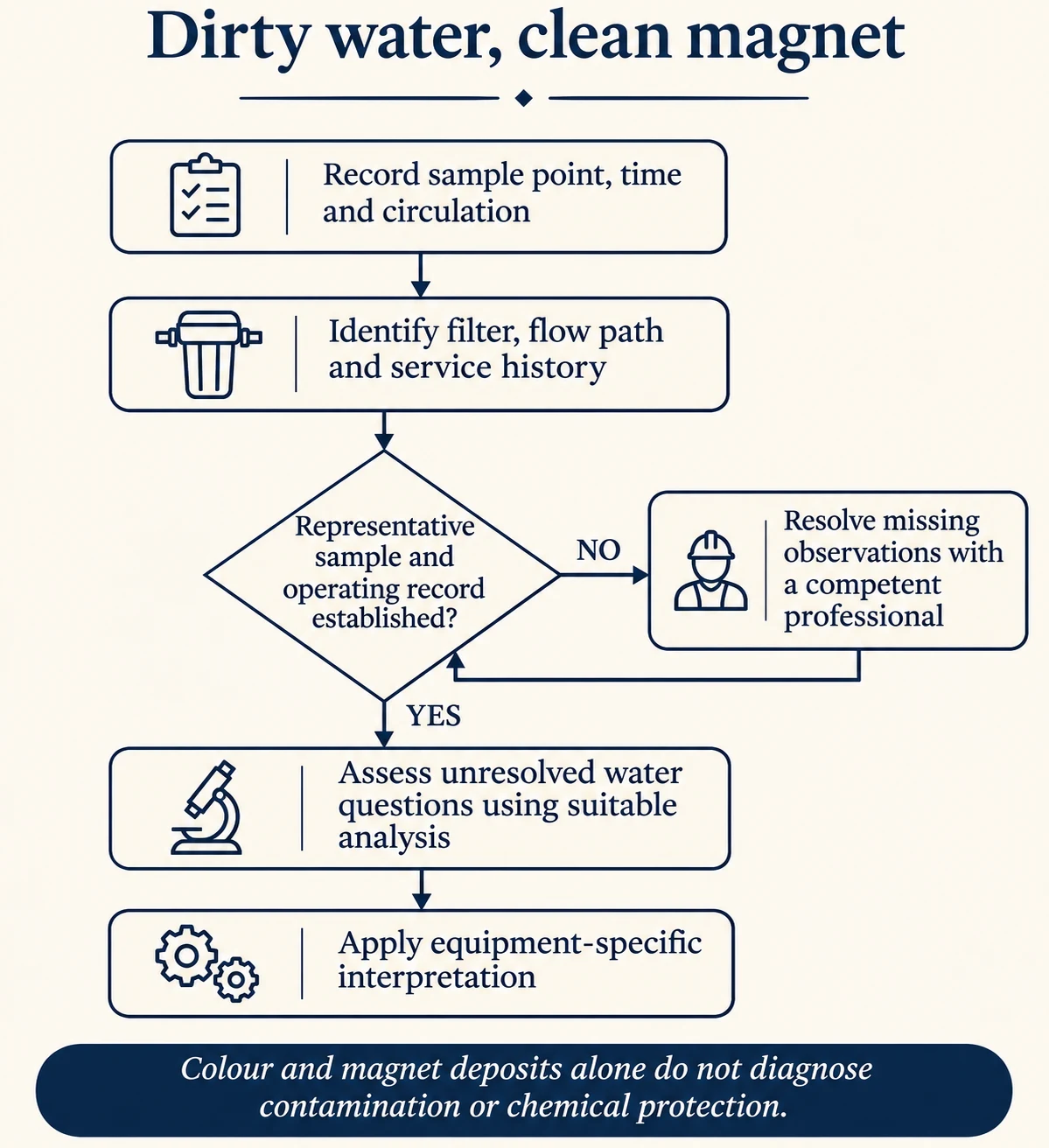

The useful next action depends on the missing field. If filter identity is unknown, obtain its instructions before making claims about what it should capture. If circulation through it is unconfirmed, have the responsible heating professional establish the arrangement and condition. If the sample point is unrepresentative or unknown, obtain a documented representative sample. Do not open hot or pressurised equipment to collect evidence; sampling and servicing must follow the equipment instructions and competent working practices.
Three mismatched records and their defensible next step
Fernox’s appearance guidance treats colour and clarity as qualitative observations and warns that clear-looking water may still have insufficient inhibitor, unsuitable pH, dissolved metals or other dissolved contaminants. It also notes that some treatment products deliberately colour water. Consequently, “dark” is not a complete diagnosis and “clear” is not a complete chemical sign-off.
Consider three illustrative records. Record A has dark water, little magnet deposit and no sample-point history. Its next result is not “add inhibitor”: establish a representative sample and operating record so the observations can be compared. Record B has confirmed circulation through the identified filter and a representative dirty sample. Little capture still does not identify the contaminant; suitable water analysis and professional interpretation can address the unanswered physical and chemical questions. Record C has clear water following filtration but no treatment or chemistry record. The appearance question has improved; chemical protection remains unresolved.
These different outcomes prevent both unnecessary reassurance and automatic escalation. Yesterday’s inhibitor test-strip discussion interprets a specific chemical test response. This task begins before that: it asks why the physical observations disagree and what evidence would connect them.
When to stop guessing and request a competent assessment
Escalate the evidence question, not just the quantity of chemical. Give the responsible professional the sample and filter records, actual appliance and material information, treatment history and any symptoms or recent work. Ask which analysis will distinguish the unresolved possibilities and which equipment-specific criteria will govern interpretation. A generic pH target or a guessed additive dose cannot be derived from a photograph of brown water.
Warmhaus’s manifold troubleshooting context can help locate a separate heating-performance question, but a flow problem and a water-quality problem should each retain their own evidence. The useful outcome here is a clear interpretation boundary and the next missing input. It is not a laboratory service promise, a filter-performance claim for Warmhaus equipment or permission to mix treatment products.
| Record | Conclusion available | Unresolved input |
|---|---|---|
| Dirty sample, little deposit | Two observations disagree | Sample, flow path and contaminant identity |
| Clear sample | Visual appearance only | Treatment and chemical condition |
For a product or documentation availability check, submit the product specification and destination. Include the exact item, intended use and document question. Availability and supporting evidence require confirmation; this is not project acceptance, laboratory analysis or customs clearance.
Conclusion
Read magnet debris, visible appearance and chemical condition as separate observations; identify next evidence without diagnosing bacteria or prescribing chemicals from colour. The decision is useful when its conditions travel with it: preserve the observed facts, identify the rule that applies, and state exactly which conclusion remains open.
Frequently Asked Questions
Does brown water prove bacteria?
No: colour alone does not identify the contaminant. Appropriate sampling, analysis and professional interpretation are needed to resolve the cause.
Does a clean magnet prove the filter is faulty?
No: deposit quantity alone does not establish a fault. Identify the unit, servicing history and actual circulation before assessing its operation.
Can clear water still need chemical assessment?
Yes. Appearance does not establish inhibitor concentration, suitable pH or the absence of dissolved contaminants.