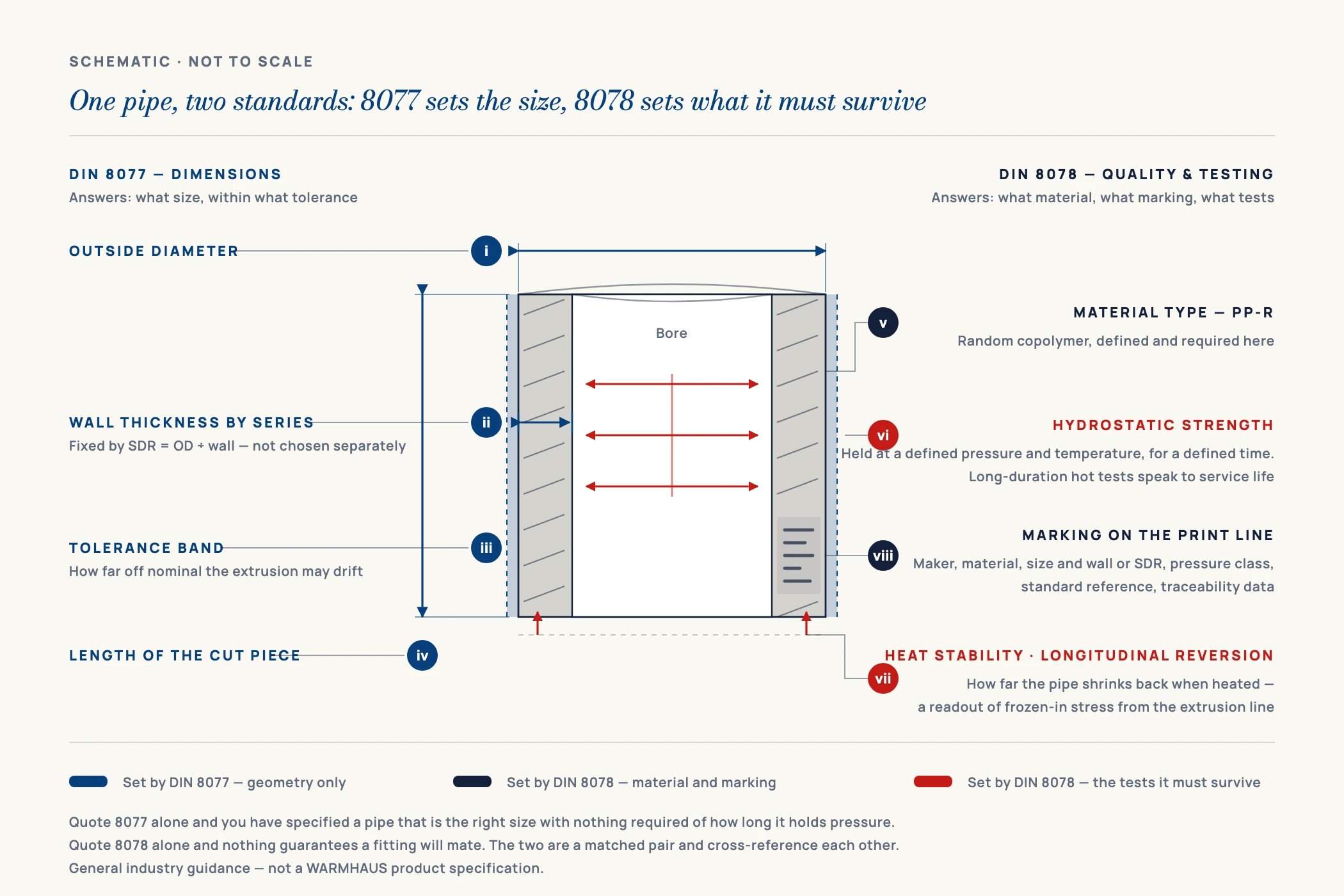
Ask a supplier which standard their PPR pipe is made to and you usually get both numbers back at once: DIN 8077 / DIN 8078. Quoted together they look like a single credential. They are two documents doing two different jobs. DIN 8077 governs the geometry — outside diameters, wall thicknesses, the tolerance bands either may drift within. DIN 8078 governs the material and its behaviour — what the polypropylene has to be, what must be printed on the pipe, and which tests it must pass. A pipe can sit perfectly inside DIN 8077 dimensions and still be a poor pipe. Only DIN 8078 speaks to that.
This guide is written for the person specifying or importing pipe rather than the person laying it. Everything technical below is general industry guidance, not a WARMHAUS-specific specification, and standards are periodically revised — always confirm figures against the current published standard and against the technical datasheet of the pipe you are actually buying.
I. The Division of Labour Between the Two Standards
The cleanest way to hold these apart is to ask what question each answers. DIN 8077 answers what size is it, and how far off nominal may it be. DIN 8078 answers what is it made of, how must it be marked, and what must it survive. Neither is sufficient alone: a dimensional standard with no quality requirements would let anyone extrude correctly-sized pipe from unsuitable material, and a quality standard with no dimensions would leave fittings unable to mate with pipe.
| Aspect | DIN 8077 | DIN 8078 |
|---|---|---|
| Scope | Dimensions of PP pipes | General quality requirements and testing |
| Answers | What size, within what tolerance | What material, what marking, what tests |
| Outside diameter | Where the values and tolerance grades are set | Refers to the dimensional standard |
| Wall thickness | Where the values are set, per SDR / pipe series | Refers to the dimensional standard |
| Material type | Presupposed — the dimension tables are given by PP type (PP-H, PP-B, PP-R) | Where the type is defined and its requirements set |
| Internal pressure behaviour | Not a requirement of this document | Where hydrostatic strength testing is required |
| Thermal stability | Not a requirement of this document | Longitudinal reversion, heat stability |
| Pipe marking | Not a requirement of this document | Where marking content is required |
| Typical use in a quotation | Cited to define the size table | Cited to define the quality claim |
Scope summary given as general industry guidance, not a WARMHAUS-specific specification. Standards are revised over time and the authoritative text is the current published edition. Confirm against the standard itself and against the datasheet of the pipe you are buying.
One qualification on that table, because the division is cleaner on paper than in the documents themselves. These two are a matched pair that cross-reference each other, not two sealed compartments. DIN 8077 is titled for the dimensions of polypropylene pipes, and its tables are organised by polypropylene type — so the material classification is a premise of the dimensional standard even though the material’s requirements are set in DIN 8078. Read the entries above as which document you turn to for that answer, not as a claim that the other document is silent on the subject. In practice they are always cited together for exactly this reason.
DIN 8077 tells you whether the pipe fits. DIN 8078 tells you whether it lasts. Buyers who quote only one have answered only half the question.
II. DIN 8077 — Dimensions, SDR and Where the Wall Thickness Comes From
DIN 8077 sets out a matrix rather than a list. Along one axis are the nominal outside diameters, which for PPR plumbing work run from 16 mm through 20, 25, 32, 40, 50, 63, 75, 90 and 110 mm and beyond. The 16 mm size is genuinely available in some markets for short final branches, though 20 mm is the smallest size stocked as standard almost everywhere — if your range needs 16 mm, confirm availability rather than assuming it, and equally do not assume it does not exist. Along the other are the pipe series, each corresponding to a standard dimension ratio. Pick a diameter and a series and the wall thickness follows; you do not choose it independently.
SDR — standard dimension ratio — is outside diameter divided by wall thickness. A lower SDR means a thicker wall relative to the pipe’s size, and therefore a higher pressure class at any given temperature. This is why SDR is the number that matters when comparing two offers: two pipes with the same 32 mm outside diameter can differ by several millimetres of wall depending on their series, and the price differs accordingly. A quotation listing diameters without stating the series or SDR has not yet said what it is selling. We work through the pressure-class side of this in our guide to PPR pipe pressure ratings and PN classes.
The table below shows the relationship in the form buyers most often need it. Wall figures are indicative of the series logic, not a reproduction of the standard’s tables.
| Nominal OD | SDR 11 wall (approx.) | SDR 7.4 wall (approx.) | SDR 6 wall (approx.) | Common application |
|---|---|---|---|---|
| 16 mm | 1.5 mm | 2.2 mm | 2.7 mm | Short final branches; not stocked in every market |
| 20 mm | 1.9 mm | 2.8 mm | 3.4 mm | Branch runs to fixtures |
| 25 mm | 2.3 mm | 3.5 mm | 4.2 mm | Fixture groups, short risers |
| 32 mm | 2.9 mm | 4.4 mm | 5.4 mm | Apartment mains |
| 40 mm | 3.7 mm | 5.5 mm | 6.7 mm | Floor distribution |
| 50 mm | 4.6 mm | 6.9 mm | 8.3 mm | Risers |
| 63 mm | 5.8 mm | 8.6 mm | 10.5 mm | Building risers |
| 75 mm | 6.8 mm | 10.3 mm | 12.5 mm | Plant room distribution |
| 90 mm | 8.2 mm | 12.3 mm | 15.0 mm | Plant room distribution |
| 110 mm | 10.0 mm | 15.1 mm | 18.3 mm | Main distribution |
Wall thicknesses are general industry guidance illustrating the SDR relationship, not a WARMHAUS-specific specification and not a substitute for the standard’s own tables. Series availability varies by manufacturer and market. Always confirm against the current standard and the datasheet of the pipe and fittings you are using.
Those three columns are the series you will meet most often, and each corresponds to a nominal pressure class: SDR 11 to PN10, SDR 7.4 to PN16, SDR 6 to PN20, with PN25 reached at SDR 5 in fibre-composite construction rather than by thickening a homogeneous wall further. We keep the full class-by-class treatment — including the temperature derating that makes a PN number much smaller in a hot riser than it looks on paper — in one place, in the guide to PPR pipe pressure ratings and PN classes. Use that page as the reference for PN values so you are working from one set of figures rather than reconciling two.
Two practical consequences follow. First, fitting compatibility is a diameter question, not a series question — a socket fusion fitting mates on the outside diameter, so a 32 mm fitting joins 32 mm pipe in any series. Second, bore capacity is a series question: a thicker wall eats internal cross-section, so specifying up a pressure class without recalculating flow is how you end up with an adequate pressure rating and inadequate delivery at the tap.
III. DIN 8078 — Material, Testing and Marking
Where DIN 8077 is a geometry document, DIN 8078 is a behaviour document. It sets out general quality requirements and the associated test regime for polypropylene pipes, and it is the half of the pair a purchasing decision should turn on. Three families of requirement matter most.
I. Material type and designation
Polypropylene is not one material. The distinction between homopolymer, block copolymer and random copolymer determines whether a pipe belongs in a hot-water system at all. PP-R — random copolymer, the material behind the letters in “PPR pipe” — is the type used for pressurised hot and cold water because its molecular structure combines long-term hydrostatic strength at elevated temperature with the impact behaviour installation demands. A pipe correctly designated as PP-R has made a material claim you can check; a pipe described only as “polypropylene” has not.
II. The tests behind the claim
The test regime is where the standard has teeth, and the names are worth knowing because they are what appears on a test report. Hydrostatic (internal pressure) testing holds pipe at defined pressures and temperatures for defined durations — the long-duration tests at elevated temperature are the ones that speak to service life. Longitudinal reversion measures how much the pipe shrinks back when heated, a direct readout of how well the extrusion process was controlled; a pipe with high reversion was extruded with frozen-in stress and will move in service. Heat stability testing addresses the stabiliser package protecting the polymer from thermal-oxidative degradation. Together they answer what a pressure rating alone cannot: not can it hold this pressure now, but will it still hold it after years of hot water.
III. Marking — the standard you can read without a laboratory
The requirement that costs a buyer nothing to verify is the print line. A properly marked PPR pipe carries along its length the information needed to identify it after it leaves the bundle: manufacturer identification, material designation, nominal size and wall thickness or SDR, pressure class, the standard reference and production traceability data. Check it first on any sample — no amount of paperwork substitutes for it. If the print line is missing, illegible, or contradicts the quotation, you have found a problem before spending anything on testing. Our note on PPR pipe storage and UV protection covers why that print line also needs to stay legible through the yard.
IV. What a “DIN 8077/8078 Compliant” Claim Is Worth
Here is the part buyers most often get wrong. Compliance with a dimensional and quality standard is a manufacturer’s declaration about the product, not a certificate issued by a body that audited it. Anyone can write “DIN 8077/8078” on a datasheet. The claim becomes meaningful only when something stands behind it, and three things can:
Third-party test reports on the actual product
An independent laboratory report against the relevant test methods, naming the material designation, dimensions and pressure class tested. Check it covers the size and series you are buying — a report on 20 mm SDR 7.4 says little about 63 mm in another series. WARMHAUS PPR pipe is SGS tested; report scope and certificate documents are available on request.
A quality management system that makes compliance repeatable
One good test report proves one batch. What proves the tenth container is a documented system: incoming raw-material control, in-line dimensional checks, retained samples, batch traceability back to the extrusion run. This is what ISO 9001 addresses — the process, not the product. The difference is worth understanding, and we set it out in our overview of the certifications a pipe manufacturer holds and what each covers.
Market-access marking where it applies
For the European market, CE marking is a declaration of conformity with applicable EU requirements rather than a product quality grade — it governs placing the product on the market, and sits alongside rather than instead of the dimensional and quality standards. Where a market operates its own access scheme, that is a separate exercise again; Russian PT documentation is one example.
The practical rule: treat a bare standard citation as a starting point for questions, not as an answer. A supplier who can send a test report matched to the size you are ordering, explain their in-line dimensional control and produce batch traceability has told you something. One who repeats the standard number louder has not.

V. Five Questions to Put to a PPR Supplier
Before a first order, these five get you further than any amount of catalogue reading. Each has a right answer that is hard to bluff.
| Ask this | What a good answer looks like | What it tells you |
|---|---|---|
| Which SDR series do you supply per diameter? | A size-by-size table, not a single number | Whether they extrude a real range or one wall |
| What is printed on the pipe? | A photograph of an actual print line | Marking discipline and traceability |
| Which material grade and supplier? | A named PP-R grade from a named producer | Raw-material control at the front end |
| Can you send a test report for my size? | Report scope matching the ordered size | Whether testing is real or generic |
| How is wall thickness checked in production? | In-line gauging plus recorded sample checks | Whether tolerance is controlled or hoped for |
Question set offered as general purchasing guidance. Requirements vary by destination market and project specification; confirm against your own technical specification and the datasheet of the pipe offered.
The third question deserves a note. Raw material is the single input a pipe extruder cannot compensate for downstream. A well-controlled line running poor resin produces dimensionally perfect pipe with disappointing long-term behaviour, and no process discipline recovers it. Asking for the grade and the producer by name is fair, and an evasive answer is itself an answer. The same logic runs through our wider quality control process, where incoming material checks sit ahead of everything on the extrusion line.
VI. Reading a Datasheet Without Being Misled
Three habits catch most of what goes wrong. First, always pair a diameter with a series. “32 mm PPR” is not a specification; “32 mm SDR 7.4 PP-R” is. Second, read pressure class and temperature together — a nominal pressure rating is stated at a reference temperature, and continuous hot-water service derates it substantially, so a PN class quoted with no temperature basis is a marketing number. Third, check that the printed pipe agrees with the paper: where datasheet, quotation and print line disagree, the print line is what stays in the wall and what an inspector reads.
One more distinction worth keeping straight: standards for pipe and standards for fittings are not automatically the same document, and a system is only as compliant as its weakest component. If you buy pipe from one source and fittings from another, the burden of proving they belong together sits with you.
VII. How WARMHAUS Handles the Two Standards
WARMHAUS is a manufacturer of PPR, PEX and brass piping systems — not a trading company. Our PPR pipe is produced to DIN 8077 / DIN 8078 and to GB/T 18742.2-2017, on extrusion lines we own and run, with the pipe, the PPR fittings and the valves that complete the system coming off the same quality system rather than being assembled from three suppliers’ interpretations of the same standard number. Raw material comes from Hyosung, Borealis and LG — named, because the third question above is one we expect customers to ask us too.
Manufacturing since 1993 across three plants totalling 100,000 m² of building area, with over 500 staff including a technical team of 50+. ISO 9001 / ISO 14001 / ISO 45001 certified, EU CE marked, SGS tested, with Russian PT documentation for that market. No MOQ — which matters when you want a single trial pallet of one SDR series before committing a container. Standard lead time is 45 days from confirmed order, planned into production slots rather than promised loosely. Request PPR dimension tables, material designations and test report scope — tell us the diameters and pressure classes your market builds around and we will send the matching size-by-size data. Certificate documents and detailed test documentation: available on request.