Polypropylene does not rust, so warehouses treat it as indestructible — and that is exactly how good pipe goes bad before it is ever installed. PPR has three enemies between the container door and the riser, none of them water: ultraviolet light, mechanical impact, and its own weight in a badly built stack. A bundle that sat two summers on an open yard rack can weld, pressure-test and pass, then craze along the sun-facing side years later. A length that took a forklift tine can look perfectly round and still have a bruised wall that opens under pressure. This guide covers PPR pipe storage properly: what UV actually does, how high to stack, how far apart to support, how to handle it in the cold, and what to check before a bundle leaves the yard.
This matters most to two people: the importer or distributor holding stock for months and carrying the risk if it degrades in their own warehouse, and the installer whose weld gets blamed when the real damage happened on a truck bed. Everything below is general industry guidance for PP-R type 3 systems, not a WARMHAUS-specific specification — confirm the figures against the technical datasheet of the pipe you are actually storing.
I. What UV Actually Does to PPR
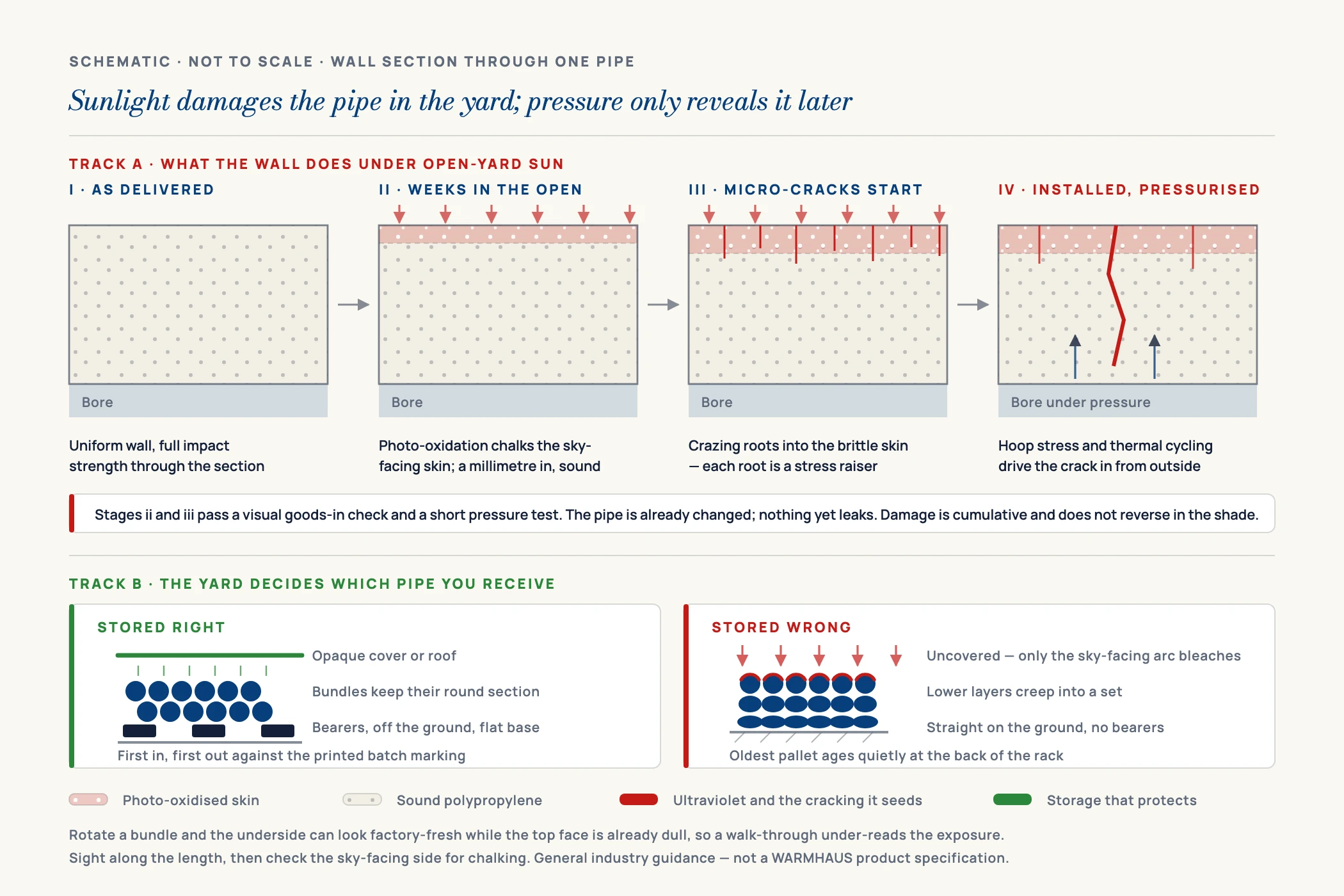
Ultraviolet radiation breaks polymer chains at the surface. In polypropylene this shows up as photo-oxidation: the exposed skin chalks, loses gloss and becomes progressively more brittle, while the material a millimetre deeper stays untouched. The failure mode is not a hole in the pipe — it is a reduction in impact strength and long-term hydrostatic performance on the exposed face. Pipe chalked by the sun can survive installation and only crack later, under thermal cycling or a knock, along the side that faced the sky.
UV damage does not leak on day one. It waits until the wall is closed and the system is hot.
Three practical consequences follow. First, UV exposure is cumulative and irreversible — a pipe that has bleached does not recover by being moved into the shade. Second, one face is not the whole story: rotate a bundle and the underside may look factory-fresh while the top is already dull, which is why chalking is easy to miss on a quick walk-through. Third, indoor storage is the only reliable answer. Opaque covers help, but a tarp over a stack in a hot climate also traps heat, so it is a mitigation for weeks, not a substitute for a roof over months.
A word on the coloured stripes, because they are widely misread in both directions. On many PPR products the stripe is not decoration: it is a co-extruded pigmented layer, and pigment — carbon black most effectively, other pigments less so — genuinely absorbs and blocks ultraviolet, so a striped pipe can carry real UV protection along that band. What it does not do is protect the pipe evenly. The stripe covers a fraction of the circumference; the body between stripes is only as UV-stable as its own compounding and stabiliser package. So the correct reading is neither “stripes mean it is UV-proof” nor “stripes mean nothing” — it is that UV resistance is a property of the compound and any protective layer, stated on the datasheet, not something you can infer from the presence of a stripe. Where a manufacturer claims UV resistance, it should come with a stated exposure period; an unquantified claim is not a specification.
Original film wrap is a separate question, and here the answer is firmer: polyethylene shrink film scatters some light but is not a UV barrier, and it degrades in sunlight itself, which is why yard bundles often show shredded film long before the pipe below looks damaged. In high-insolation climates, treat the film as dust protection only and plan for covered stock. UV is also why PPR is not specified for permanently exposed external runs without a mechanical or painted UV barrier — a design point worth settling before a complete PPR system is quoted for a rooftop plant room.
II. PPR Storage Limits: Stack Height, Support Spacing and Temperature
The table below collects the yard rules that most often get broken. These are typical industry values for general guidance only; stack heights in particular depend on packaging, bundle construction and rack design, so treat them as a starting point and confirm against the datasheet and packing specification supplied.
| Storage factor | General guidance | Why it matters |
|---|---|---|
| Direct sunlight (unprotected) | Avoid; keep exposure to weeks, not seasons | Photo-oxidation chalks the surface and cuts impact strength |
| Preferred storage | Indoors, covered, ventilated, dry | Only reliable protection against UV and heat build-up |
| Outdoor interim storage | Opaque cover, raised off ground, air gap under cover | Blocks light without trapping heat against the stack |
| Support spacing under bundles | Continuous flat base, or bearers at roughly 1 m centres | Point loads on a soft pipe make permanent flats and bows |
| Stack height (bundled straight lengths) | About 1 m is a common conservative working limit; crated or framed packaging and large diameters often permit more, small-diameter loose bundles sometimes less | Lower layers deform under sustained load, worse when warm — the packing specification governs, not the metre |
| Ambient storage temperature | Cool and shaded; avoid sustained high heat | Warm pipe creeps under load and sags between supports |
| Handling below about 0 °C | Handle slowly, no dropping or throwing | Impact resistance falls as temperature falls |
| Distance from heat sources | Clear of heaters, exhausts, welding areas | Local softening distorts bore and socket dimensions |
| Chemical separation | Away from solvents, fuels, oils, paints | Contaminated surfaces will not fuse cleanly |
| Stock rotation | First in, first out, by batch marking | Prevents one pallet quietly ageing at the back of the rack |
Values are general industry guidance, not a WARMHAUS-specific specification. Permitted stack height and support spacing vary with packaging, diameter, wall thickness and ambient temperature. Always follow the datasheet and packing instructions supplied with the pipe.
Two entries deserve expanding. Stack height is a creep problem, not a crushing problem — nothing breaks on the day you build the stack. The bottom bundles slowly take a set, and weeks later you have lengths with a permanent bow that will not sit straight in a bracket run. Heat accelerates this, which is why a stack that is fine through winter goes soft in high summer. Support spacing works the same way: a bundle bridging two widely spaced bearers sags in the middle, and that sag becomes permanent. Store on a flat continuous base where you can, and if you use racking, add bearers rather than assuming the strapping holds the shape.
III. Site Handling: Transport, Unloading and the Damage Nobody Logs
Most physical damage to PPR happens in three minutes of unloading, not three months of storage. Polypropylene is tough but notch-sensitive: a scrape that removes wall material creates a stress concentration, and a hard impact can bruise the wall without leaving an obvious mark. The rule installers use is simple — if it was dropped, dragged or hit, it is scrap until proven otherwise.
Dragging bundles off a truck bed
Drags gouge the lower face along its whole length and grind grit into the surface. Fix: lift with wide slings or a forklift with fitted tines, never drag on the tailgate edge.
Forklift tines straight into a bundle
Bare tines crush the outer lengths and dent the layer beneath, and the dent often springs back so nobody records it. Fix: use pallets or bearers, and keep tines clear of the pipe wall.
Dropping lengths in cold weather
Impact resistance falls with temperature, so a drop that is harmless in summer can crack a socket in winter. Fix: in cold conditions, hand it down, do not throw it.
Storing pipe against rebar or sharp edges
Point contact under the weight of a bundle scores the wall and starts a notch. Fix: a clean flat base, off the ground, clear of steel and formwork.
Loose fittings in an open crate
Sockets pick up dust, grit and moisture, and contaminated fusion faces do not weld — this is a leak that gets blamed on the welder. Fix: keep fittings bagged and boxed until the moment of use.
Cut ends left open in a dusty riser
Debris inside the bore reaches valves and cartridges at commissioning and blocks them. Fix: cap or tape open ends between work sessions.
Mixing batches on one riser without record
If a fault is ever traced, you cannot isolate which batch went where. Fix: record the printed batch marking per riser or per floor — it costs nothing and it is the only traceability you get.
There is a commissioning angle to all of this. When a pressure test fails, the investigation almost always starts at the welds, because that is where failures usually are. But if the pipe arrived bleached, bowed or bruised, the weld may be sound and the wall may not be. Logging condition at goods-in is what lets you tell those two situations apart later. The same discipline runs upstream: consistent wall thickness and dimensional control are what our quality-control process is for, and they are only meaningful if the pipe reaches the job in the condition it left the line.
IV. A Goods-In Inspection You Can Run in Two Minutes
Distributors and contractors receiving deliveries need a check fast enough to actually get done. Five points, in order:
i. Read the print line. Diameter, SDR or PN class, material designation and batch marking should be legible along the pipe; missing print means you cannot prove what you installed. ii. Look along the length. Sight down a length like a carpenter sighting a board — bows and flats show instantly, and they tell you how the pipe was stacked. iii. Check the sun-facing side. A dull, chalky or faded surface on one face only is the signature of open-yard storage; rub it and see if it powders. iv. Check the ends and sockets. Ovality, gouges, and dirty or wet fusion faces are weld problems waiting to happen. v. Count and separate. Damaged lengths go to a marked area immediately, not back into the rack — a rejected length left in the stack will be installed by somebody.
Ovality is worth a note of its own. A pipe that has taken a set — from a stack, a strap or a long bow — may still weld, but socket fusion geometry assumes a round pipe, and an oval end contacts the die unevenly. An end that will not sit round in a fitting is an end to cut back, not an end to force. If out-of-round lengths recur on receipt rather than in your own yard, that is a packing and loading conversation to have with the supplier. Once the pipe is in good condition, the welding parameters themselves are covered in our step-by-step guide to hot-melt welding PPR.
V. Buying Pipe That Arrives in the Condition It Left the Line
Storage discipline in your warehouse is only half the chain. The other half is how the goods were packed, wrapped, marked and loaded before they reached you — a manufacturing question, not a logistics one. WARMHAUS is a manufacturer of PPR, PEX and brass piping systems, not a trading company. The extrusion, injection-moulding and machining lines are our own, so bundle construction, film wrapping, batch marking and container loading are decided in the same building as the pipe, rather than left to whichever consolidator filled the box. Raw material comes from Hyosung, Borealis and LG. Manufacturing since 1993, under ISO 9001, ISO 14001 and ISO 45001 management systems, with EU CE marking and SGS third-party testing.
For distributors building stock, two things matter as much as the pipe: there is no MOQ, so you can hold a shallower, faster-rotating range instead of committing to pallets that sit in a yard for a season, and the standard lead time is 45 days — a planning number you can build a rotation around. For the packing specification, batch-marking format, container loading plan or handling notes for a specific diameter range, request the PPR pipe specifications and packing details and tell us your market and the diameters you stock. The full PPR pipe range and certification files are available the same way.Certificate documents, pricing and detailed packing specifications: available on request.