Two brass ball valves marked 1/2″ can differ in bore area, alloy, wall thickness, thread standard and stem construction, and still both be honestly described as a 1/2″ brass ball valve. That is the entire problem with buying valves on a size and a picture. When a distributor gets a complaint about a stiff lever or a weeping stem, the cause was almost always decided months earlier, in the line of a purchase order that said less than it needed to. This guide covers the brass ball valve variables that genuinely change the part in your hand, and how to write each one down.
It is written for importers, distributors and sourcing agents comparing quotations across suppliers in the Middle East, North Africa, Southern Europe and Latin America, and for specifiers who have to submit a valve schedule. Technical figures given below are general industry guidance, not a WARMHAUS-specific specification — always confirm against the technical datasheet of the actual valve you are buying.
I. What Actually Varies Between Two Brass Ball Valves
Strip away the marketing and a brass ball valve is a machined body, a chrome-plated ball, two seats, a stem with its seals, and a handle. Every one of those elements has a cheap version and a correct version, and none of them is visible in a product photograph.
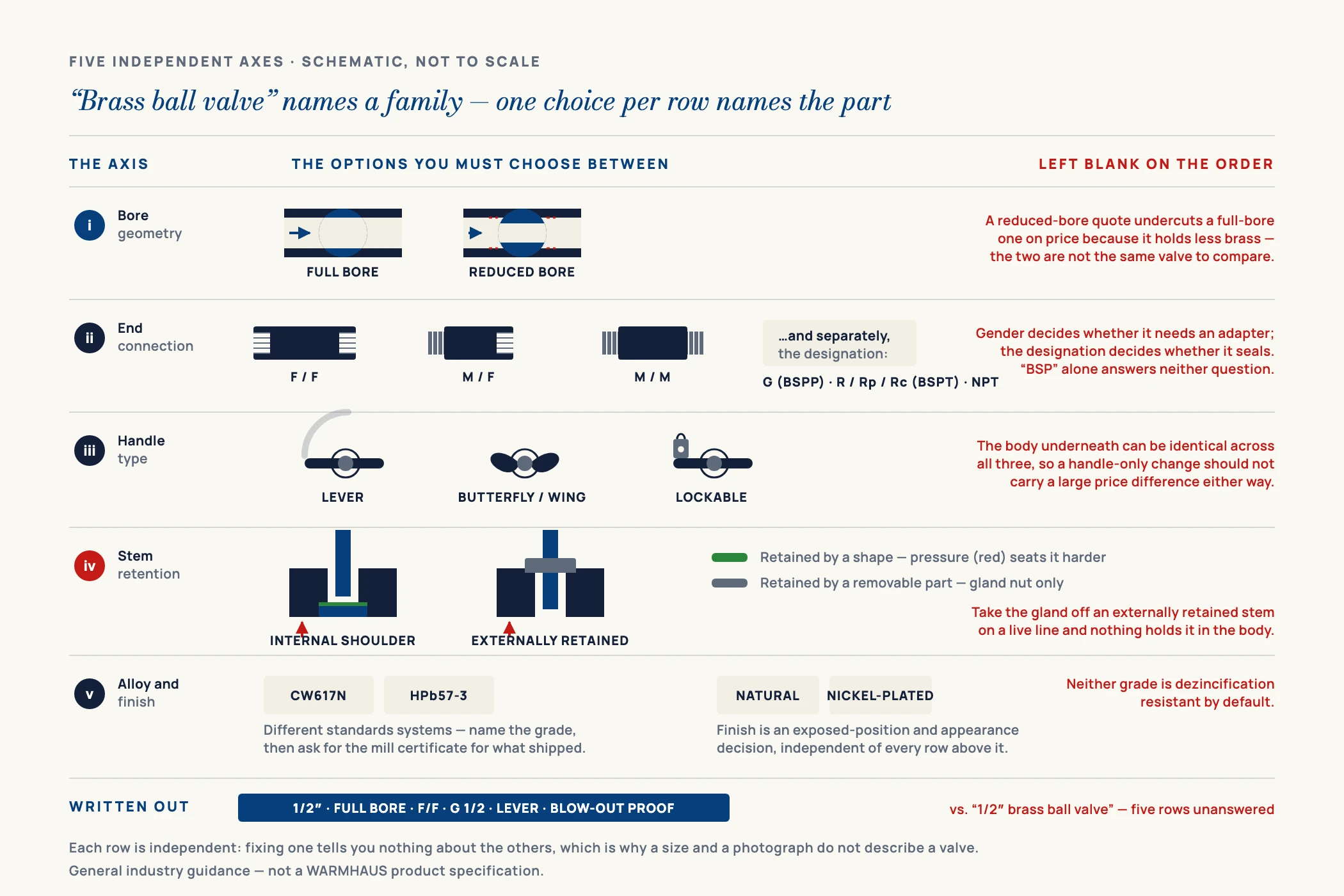
Those five are bore geometry, which sets flow area and, because it changes the mass of brass in the part, price; alloy, since brass is a family rather than a material; end connection, where the thread designation and gender decide whether the valve fits at all; stem construction, which decides whether line pressure can ever eject the stem; and the handle. Sections II to V give the codes and the mechanisms for each, so that every line of the specification table has an answer rather than a placeholder.
Nobody complains about a valve’s bore area. They complain about a stiff lever — usually the stem, the seat or the machining, decided by the same supplier choice.
II. Brass Ball Valve Types by Construction
Suppliers mix several classification schemes freely in the same catalogue, which is where confusion starts. Sort them into independent axes — bore, end configuration, thread designation, handle and service — and every quotation becomes comparable.
I. By bore: full bore versus reduced bore
Full bore keeps the flow area equal to the pipe, so pressure drop across the valve is minimal and the line can be rodded or flushed through. Reduced bore restricts one step and costs less. For riser shut-offs, meter isolation and any line where head is already tight, full bore is the default specification — see the WARMHAUS brass ball valve range for the configurations available. Reduced bore is defensible on short branch isolation where the pressure loss genuinely does not matter — but specify it deliberately, never by accident because it was the cheaper line on a quotation.
II. By end connection: male, female and mixed threads
Ball valves in this class are supplied as female/female (F/F), male/female (M/F) and male/male (M/M). F/F is the general-purpose configuration; M/F saves a nipple and a joint where the valve lands directly on a threaded outlet; M/M suits meter sets and appliance connections. Beyond gender, the thread standard matters more than most purchase orders acknowledge — and it is the one line most enquiries leave blank. The designations are given in full in the next section; put one of them on the order rather than the word “BSP”.
III. The thread designations, written out
Two families cover almost all of this product class, and the difference between them is whether the thread is parallel (constant diameter) or tapered (diameter changes along the thread). Parallel threads do not seal on the flanks — they need a washer, an O-ring or a flat face to seal against. Tapered threads seal by wedging flank against flank, with a sealant or PTFE tape filling the helical leak path. Mixing them is what produces a joint that “goes on but weeps”.
| Designation | Standard family | Form | How it seals | Where you meet it |
|---|---|---|---|---|
| G (BSPP) | ISO 228 — British Standard Pipe Parallel | Parallel, 55° Whitworth | Not on the flanks — needs a washer, O-ring or flat seating face | The common European/Middle East female port on valves and fittings |
| R (BSPT) | ISO 7-1 — British Standard Pipe Taper, external | Tapered 1:16, 55° Whitworth | Flank interference plus sealant or PTFE tape | Male ends intended to seal in a tapered or parallel female |
| Rp | ISO 7-1 — parallel internal, taper-mating | Parallel, 55° Whitworth | Sealed by an R male wedging into it, with sealant | Female ports designed to take an R male |
| Rc | ISO 7-1 — tapered internal | Tapered 1:16, 55° Whitworth | Flank interference plus sealant | Female ports in fully tapered systems |
| NPT | ASME B1.20.1 — American National Pipe Taper | Tapered 1:16, 60° flank angle | Flank interference plus sealant or tape | North-American-influenced specifications and equipment |
| NPSM | ASME B1.20.1 — American parallel, mechanical | Parallel, 60° flank angle | Needs a gasket or seating face | Unions and mechanical joints on NPT-family equipment |
Three practical rules follow from that table. First, the 55° and 60° families do not mix: an NPT male into a G or Rp female engages for a turn or two and then binds, because the flank angles and the pitches differ — that joint is a leak, not a fit. Second, R into Rp is a normal, intended combination and is how a great deal of European-standard plumbing is actually assembled; R into Rc is the fully tapered version. Third, a G male into a G female is a mechanical joint, not a seal — if there is no washer, O-ring or flat face in the design, no amount of tape makes it right for long.
On the purchase order, write the designation and the size together in the form the standards use — for example G 1/2 for a parallel female port or R 1/2 for a tapered male end — and ask the supplier to confirm the same string back on the datasheet and the packing list. “1/2 inch BSP” is ambiguous between parallel and tapered and should be treated as an incomplete specification. If you sell into more than one thread market, treat the designation as a separate SKU dimension rather than a substitution you can make at the warehouse.
Thread designations and standard references above are general industry guidance for identifying what to write on an order, not a WARMHAUS-specific specification and not a substitute for the standards themselves. Confirm the designation, size and sealing method for each item against the supplier’s datasheet and the requirements of your destination market.
IV. By handle: lever, butterfly and lockable
The handle is the only part of the valve a person ever touches, so it drives more perceived quality than any figure on a datasheet. A lever handle gives fast quarter-turn operation and is usually colour-coded red and blue for hot and cold. A butterfly or wing handle is compact, which is what you want behind a panel or inside a shallow chase where a lever cannot swing. A lockable handle takes a padlock or locking provision and belongs at meters and any controlled shut-off where an unauthorised turn has consequences. The body underneath can be identical across all three — which is exactly why a handle-only difference should not carry a large price difference.
V. By service: water supply, heating and specialist duties
Most of the 1/2″–2″ market is potable cold water, domestic hot water and heating circuits, and one well-built full-bore line covers all three. Specialist duties — gas, compressed air, aggressive media — carry different approvals, and a general water-and-heating valve should not be offered into them because the size matches.
III. Stem Construction — What “Blow-Out Proof” Actually Describes
This is the variable most often listed on a datasheet as two words and never explained, so it gets copied onto a purchase order without anyone checking what the supplier means by it. The stem is the shaft that carries the handle torque down to the ball, and it passes through the valve body — which means it passes through the pressure boundary. Line pressure acts on the exposed cross-section of that shaft and pushes it outwards. The question is what stops it.
A blow-out proof stem is fitted from the inside. Its lower section carries a shoulder or collar larger than the bore it passes through, so the stem is assembled into the body from within before the ball goes in, and the shoulder bears against a machined seat inside the body. Pressure pushes the stem against that internal shoulder, which is the direction the geometry is strongest in — the harder the line pushes, the tighter the shoulder seats. Removing the gland nut, the handle and the packing then cannot release the stem into the room, because there is no path for it to travel through. The retention is a shape, not a fastener.
A conventional or externally retained stem is inserted from the outside and held by whatever is threaded onto it — a gland nut, a packing nut, a circlip or the handle assembly. That works while the retaining part is intact and correctly torqued. If the nut corrodes, backs off under repeated operation, or is removed by somebody trying to cure a weeping stem while the line is still pressurised, the only thing holding the stem is gone. That is a different class of event from a leak.
A blow-out proof stem is retained by a shoulder inside the body. Take every external part off a pressurised valve and the stem still cannot come out.
Sealing is a separate question from retention, and a datasheet should answer both. The stem is normally sealed with one or more O-rings seated in grooves on the shaft, sometimes with a thrust washer or PTFE bearing between the stem shoulder and the body to keep the operating torque low and steady. Ask three things: is the stem blow-out proof by internal shoulder, how many O-rings are on it, and what elastomer are they — because the elastomer, not the brass, is what sets the temperature limit of the whole valve. A valve rated for hot water on the body and fitted with a seal that is not is a valve rated for cold water.
Stem construction descriptions above are general industry guidance for reading a datasheet, not a WARMHAUS-specific specification. Retention method, seal count and seal material vary by manufacturer and series — confirm each against the datasheet of the valve you are buying.
IV. Brass Alloy: the Variable Buyers Skip
Alloy is the biggest source of unpleasant surprises in valve procurement: it is invisible, it is expensive, and it is the easiest place for a supplier to save money without changing the photograph. Two designations dominate this product class, and they come from different standards systems rather than being two names for one material. CW617N is the European wrought copper designation for the hot-stamping brass used across most European-market valve and fitting production. HPb57-3 is a Chinese national (GB) designation for a free-machining leaded brass in the same broad family. Their composition ranges overlap but do not coincide — HPb57-3 carries a higher nominal lead addition, and the copper ranges differ slightly.
That distinction matters commercially, because the two are not automatically substitutable. If a specification names one designation, accepting the other is a change that has to be agreed on the submittal, not made quietly at the factory because the compositions look close. The side-by-side comparison is set out in our guide to CW617N versus HPb57-3 brass. Name the grade you want on the order and require the mill certificate for the material actually supplied.
Two properties then decide whether the grade suits the job. Lead content is the commercial issue: drinking-water regulations in a growing number of markets set limits on the lead that may leach from wetted metal components, and each jurisdiction runs its own approval scheme, so the requirement is set by the country you sell into rather than by the factory. Ask for the material certificate for the grade being supplied instead of a general assurance that the valve is “low lead”, and check it against your own market’s rule before committing a container. Dezincification resistance is the second, and it is frequently assumed rather than checked: neither CW617N nor HPb57-3 is a dezincification-resistant grade — both are duplex as forged, so both carry the zinc-rich phase that leaches preferentially in aggressive water. Genuine DR behaviour comes from a different formulation, and where the water profile demands it the grade has to be specified as such. The mechanism and the questions to ask are in our guide to dezincification in brass fittings.
WARMHAUS machines brass ball valves from 57-3 and CW617 brass. The material documentation issued with an order is the mill certificate for the stock supplied and the dimensional datasheet for the series — request those for the specific item rather than relying on a catalogue statement.
Alloy designations and composition comparisons above are general industry reference information drawn from the published standards, not batch values and not a WARMHAUS-specific specification. Confirm the grade, the mill-certificate figures and the applicable drinking-water requirements for your destination market against the supplier’s material documentation before ordering.
V. The Specification Table — What to Put on the Purchase Order
Work down this table before you send an enquiry. Fill in the right-hand column and a quotation becomes comparable across suppliers; leave a row blank and you are trusting the supplier to guess your intent. Values are general industry guidance, not a WARMHAUS-specific specification — always confirm the final figures against the technical datasheet of the pipe, valve and system you are using.
| Specification line | Options in this product class | Why it changes the part | Typical default |
|---|---|---|---|
| Nominal size | 1/2″, 3/4″, 1″, 1-1/4″, 1-1/2″, 2″ | Sets body, ball and handle size | Match the line size |
| Bore geometry | Full bore · reduced bore | Flow area and pressure drop; changes brass mass and price | Full bore |
| Body alloy | CW617 · 57-3 | Machinability, strength, lead content, market acceptance | State grade explicitly |
| End connection | F/F · M/F · M/M | Decides whether it fits without an adapter | F/F for general shut-off |
| Thread designation | G (BSPP) · R / Rp / Rc (BSPT family) · NPT | Sealing method and flank angle; 55° and 60° families do not mix | Write the code and size, e.g. G 1/2 or R 1/2 |
| Handle type | Lever · butterfly/wing · lockable | Clearance needed, security, hot/cold coding | Lever, colour-coded |
| Stem construction | Blow-out proof (internal shoulder) · externally retained | Whether pressure can eject the stem when the gland is removed | Blow-out proof, retained by internal shoulder |
| Stem sealing | Number of O-rings; elastomer type; thrust washer | Where a valve weeps first, and what sets the temperature limit | State O-ring count and elastomer on the datasheet |
| Pressure class (PN) | PN16 · PN20 · PN25 · PN40 are the classes commonly seen in this size band | Governs the application it may be submitted for; the figure is a nominal rating at a reference temperature | Ask for a pressure–temperature pair, not a bare bar figure |
| Temperature range | Cold and hot water service; the limit is normally set by the seat and stem seals rather than the brass | A body that tolerates the heat is irrelevant if the seals do not | Require the rated maximum continuous service temperature for the series |
| Seat material | PTFE is the conventional seat material in this class; reinforced variants exist for higher duty | Sets torque, sealing behaviour and the temperature ceiling | State the seat material explicitly |
| Surface finish | Natural brass · nickel-plated | Appearance and exposed-position corrosion | Per market preference |
| Marking | Size, brand, pressure marking on body | Site verification and traceability | Specify what must be cast |
| Packing | Bulk · individual box · retail card | Landed cost, shelf presentation, damage rate | Match your channel |
Values are general industry guidance, not a WARMHAUS-specific specification. Pressure class, temperature range, bore diameters and thread standards vary by size and construction — follow the technical datasheet issued for the valve you are actually buying.
Working through that table before you enquire is the fastest way to compare offers honestly. Request the WARMHAUS brass ball valve size and specification datasheet and fill your requirement against it — tell us the thread designation your market uses and the sizes you sell, and we will come back with the matching series.
VI. Seven Specification Mistakes That Cost Money Later
These are the recurring errors in valve purchasing — each cheap to avoid at enquiry stage, expensive to fix once a container has landed.
Comparing a full-bore price to a reduced-bore price
A reduced-bore valve contains meaningfully less brass, so it will always quote lower. If the two offers are not the same bore geometry, you are not comparing valves. Fix: put bore geometry on the enquiry line, not just the nominal size.
Accepting “low lead” or “good quality brass” without a designation
Neither phrase carries a fixed meaning across markets, and neither tells you whether the alloy resists dezincification — CW617N and HPb57-3 do not. Fix: ask for the alloy designation, the mill certificate for the material supplied, and a direct answer on whether the material is supplied as dezincification resistant. Check all three against what your destination market requires.
Writing “BSP” instead of a thread designation
“BSP” does not say whether the thread is parallel or tapered, and those seal by different mechanisms. An NPT male into a G female is worse still — different flank angles, so it binds after a turn or two. Fix: write the actual code and size on the order — G 1/2, Rp 1/2, R 1/2 or NPT 1/2 — and require the same string back on the datasheet and packing list.
Ignoring stem construction
The stem seal is where a valve weeps first, and an externally retained stem is a safety issue rather than a service issue — remove the gland nut on a pressurised line and there is nothing left holding it. Fix: specify a blow-out proof stem retained by an internal shoulder, and ask separately how many O-rings seal it and in what elastomer.
Buying handle colour instead of handle function
A lockable handle at a meter and a wing handle behind a panel solve real installation problems; a colour change solves nothing. Fix: map handle types to the actual installation points in your market before you build the stock list.
Over-tightening on installation
Excess torque on a threaded brass body distorts the seat geometry and the lever goes stiff, which the market reads as a bad valve. Fix: tighten to the datasheet figure and hold the body with a second wrench so torque never passes through the valve.
Splitting the valve order away from the pipe order
When valves, fittings and pipe come from different sources, thread and dimension mismatches surface on site, and the responsibility for them is disputed. Fix: keep the metal and the pipe under one supplier and one certificate set — see the full brass system range.
VII. How the Valve Fits the Rest of the System
A brass ball valve rarely stands alone. On a PPR line it either threads into a brass-insert fitting or sits between two threaded transitions; on a PEX line it lands on a compression or press connection; at a manifold it is part of the isolation set. Each interface is a dimensional agreement between two parts. When both sides come from the same production standard, the interface is a non-issue; when they come from different sources, the tolerance stack becomes your problem on site.
This is the practical argument for treating valves as part of a system rather than a line item. If you already stock a PPR range, the valve threads should match the brass inserts in that range; if you supply underfloor heating, the isolation valves should match the manifold ends. That coherence is easier to buy than to assemble, and it is why the brass line sits inside the same catalogue as the pipe on the full WARMHAUS product range rather than beside it.
VIII. Specifying With WARMHAUS
We manufacture brass ball valves on our own machining lines — WARMHAUS is a manufacturer of PPR, PEX and brass piping systems, not a trading company. That matters for a specification conversation because every question in the table above has a single answer traceable to one production line and one QC process, rather than an average across whichever castings were available that month. The ball valves are machined from 57-3 and CW617 brass; bore geometry, thread designation, handle type and the available sizes for a given series are confirmed on the datasheet issued against your enquiry.
Two commercial points matter to a distributor building a first order. There is no MOQ, so you can trial a specification across a handful of sizes before committing a full container — and because valves, brass fittings and manifolds, PPR and PEX come from one source, a mixed container does not mean opening three supplier accounts. Standard lead time is 45 days from confirmed order, so plan your production slot accordingly. The factory is ISO 9001, ISO 14001 and ISO 45001 certified, EU CE marked and SGS tested, with Russian PT market approval — the documentation set most tender and customs files ask for. Certificate documents and the size and specification datasheet for the series you are quoting: available on request.