Choosing an underfloor heating manifold supplier for the Middle East is a sourcing decision, not a product decision. The hardware itself is mature — a brass or stainless bar, a set of ports, flow meters on the supply side, valve inserts on the return — and any competent factory can build something that looks right in a photograph. What separates suppliers is everything around the bar: which brass alloy is actually in the billet, whether the port centres match the actuators you already stock, whether the crate survives a sea container in August, and whether the paperwork clears customs without a week of emails. This guide is written for importers and purchasing agents who are about to send an RFQ and want to know what to put in it.
The regional context matters. Across the Gulf, the Levant and North Africa, underfloor heating sits in a narrower band of applications than in colder markets — villas and towers in the mountain and inland zones, hotels, and a growing share of mixed systems where the same manifold set serves heating in winter and chilled-floor cooling in summer. That changes the brief: you are buying for high ambient storage temperatures in a warehouse without climate control, for water chemistry ranging from desalinated to hard well supply, and for a project cycle where a missing gasket in a crate stops a screed pour.
I. What You Are Actually Buying
A manifold is a system component, not a fitting. When an importer prices “a 6-port manifold” against another “6-port manifold”, the two quotations usually describe different scopes. Before you compare numbers, agree what is inside the box.
At minimum, a complete set is the supply bar and the return bar, the mounting brackets, an end-set carrying fill and drain valves plus automatic air vents, and the isolating valves connecting the bars to the primary circuit. Then the variables begin: flow meters or plain flow-limiting valves on the supply side; thermostatic valve inserts on the return side ready for actuator heads, or plain manual knobs; pipe connection adaptors sized to the pipe the installer is running; and optionally a pump and mixing group where the manifold is fed from a high-temperature source.
Two quotations for “a 6-port manifold” are almost never quotations for the same thing. Fix the scope before you compare the price.
The most common costing error is the adaptor. Manifold outlets are typically supplied with a Eurocone-style threaded port, and the compression adaptor converting that port to the installer’s pipe — PEX, PE-RT or multilayer, in the diameter actually used on the job — is a separate part. A quotation that includes adaptors and one that does not can differ by a meaningful percentage, and the gap does not surface until the first site call. Specify the adaptor thread, the pipe outside diameter and the wall thickness in the RFQ itself, not in a follow-up email.
II. The RFQ Specification Table
This is the table to paste into your enquiry. Fill the right-hand column before you send it and you will get comparable quotations back instead of three suppliers each answering a different question. The figures shown are general industry guidance describing how manifolds are commonly specified — they are not a WARMHAUS-specific product specification, and the actual figures for any product must be confirmed against the technical datasheet of the manifold and pipe you are using.
| Specification item | Typical range / options | Why it matters on your order |
|---|---|---|
| Bar material | Machined brass bar, or stainless steel | Decides alloy declaration, weight, price band and finish expectations |
| Brass alloy | CW617N or equivalent machining brass | Ask for the alloy designation in writing; it is the material claim you rely on |
| Bar size | Commonly 1″ or 1¼” body | Sets the flow capacity of the whole assembly and the primary connection |
| Port count | Commonly 2 to 12 ports per pair, per set | One loop per port; count loops first, then choose the bar. State the count you need — do not assume a supplier’s range covers it |
| Port centres | Typically 45–55 mm, with 50 mm the most common | Must match your actuator body width or heads will foul each other. Ask for the figure, not the family |
| Outlet thread | Eurocone-type, commonly G¾” (parallel, sealed on the cone) | Determines which compression adaptors fit; the usual costing trap |
| Adaptor for pipe | Ø16, Ø17, Ø20 mm; wall thickness stated | Adaptors are separate parts — state pipe OD and wall in the RFQ |
| Actuator thread | Commonly M30 × 1.5 | Wrong thread makes existing actuator stock unusable |
| Flow measurement | Flow meter per supply port, or flow-limiting valve | Flow meters make balancing visual; valves are cheaper but blind |
| Working pressure | Product datasheet value | Never quote a number you have not read off the datasheet |
| Working temperature | Product datasheet value | Screed-embedded circuits run low; the primary side may not |
| End-set contents | Fill/drain valves, automatic air vents, end caps | Missing air vents stop commissioning dead |
| Bracket type | Wall bracket, or cabinet-mounted rail | Cabinet depth and bracket type must be agreed together |
| Labelling | Neutral, distributor brand, or private label | Agree artwork and language before the production slot opens |
| Packing | Carton per set, then export crate or pallet | Determines container fill and how much damage you absorb |
Values are general industry guidance on how manifolds are commonly configured, not a WARMHAUS-specific specification. Port centres, thread standards and adaptor sizes vary between systems and between markets. Always confirm every dimension against the technical datasheet of the manifold, actuator and pipe you are actually using before you place an order.
Three lines in that table deserve emphasis because they cause the most expensive mistakes. Port centres decide whether two adjacent actuator heads physically fit side by side. The industry does not run on a single figure — 45, 50 and 55 mm are all in use — and 50 mm is merely the most common, not a default you can assume. Order a manifold with tighter centres than your actuator body is wide and half the heads will not seat, so ask for the actual dimension in millimetres and check it against the widest actuator you stock. Actuator thread decides whether the actuator stock already sitting in your warehouse can be used at all. And port count is a range across the industry, not a promise from any one factory: state the counts you need in the RFQ and let each supplier confirm what they can actually build. How to arrive at the right count for a given floor is worked through in our manifold sizing guide. All three are cheap to confirm before an order and impossible to fix after one.
The thread designations, written out
“Confirm the thread” is useless advice unless you know what the codes mean, and threads are where mixed-origin shipments actually fail. There are two families in play on a manifold, and they are not interchangeable even where the nominal size matches.
| Code | Family | Form | How it seals |
|---|---|---|---|
| G (e.g. G¾”) | ISO 228 — BSPP, British Standard Pipe Parallel | Parallel (straight) 55° thread | Not on the thread. Needs a washer, an O-ring or a cone seat — which is why Eurocone outlets are a G thread |
| Rp | ISO 7 — parallel internal thread | Parallel female 55° | Designed to receive an R taper male; sealed with compound or tape |
| R (e.g. R½”) | ISO 7 — BSPT, British Standard Pipe Taper | Tapered 55° thread | On the thread flanks, by interference, assisted by sealant |
| NPT | ANSI/ASME B1.20.1 — American National Pipe Taper | Tapered 60° thread, different pitch to BSPT | On the thread flanks. Will not correctly mate with BSPT despite similar nominal sizes |
| M30 × 1.5 | ISO metric — actuator connection | Parallel metric, 1.5 mm pitch | Not a pressure seal — it is the mechanical fixing between the actuator head and the valve insert |
Thread designations are general industry guidance describing the public standards commonly used on heating manifolds, not a WARMHAUS-specific specification. Which thread appears on any given product is a design choice by its manufacturer. Confirm the designation, the size and the sealing method against the technical datasheet of the manifold, actuator and fitting you are actually buying.
The two lines to put in the RFQ are the outlet thread — Eurocone connections are commonly G¾” parallel, sealing on the cone rather than the thread, so tape on a Eurocone is a symptom that something has been misunderstood — and the actuator thread, commonly M30 × 1.5, which is what determines whether the actuator heads already in your warehouse will fit. The trap worth naming explicitly is BSPT against NPT: both are tapered, the nominal sizes read alike, and they will start to engage by hand. They have different thread angles and different pitches, so the joint that results is a leak with a delay on it. Where a manifold connects to a primary circuit built to a different thread family, use a proper transition fitting rather than forcing the mate.
III. Qualifying the Supplier, Not Just the Product
Once the specification is fixed, the remaining risk sits with the supplier. These are the questions that separate a manufacturer from a trading company holding a catalogue, and they are worth asking directly.
Do you machine the bars, or buy them?
A factory machining its own brass bars controls port centres, thread forms and surface finish to one internal standard. A trader assembles bars from whichever sub-supplier quoted lowest that month, which is why dimensions drift between shipments of the “same” item.
Which alloy, stated in writing?
Machining brass for potable and heating components is normally specified as CW617N or an equivalent. Get the designation into the pro-forma invoice and the specification sheet, not just the sales email — it is the material claim your own customers will ask you to stand behind.
What certification actually exists, and can I see it?
Ask for the certification file rather than a list on a web page. Management-system certificates such as ISO 9001, ISO 14001 and ISO 45001 certify the company and its processes; CE marking is a market-access declaration for the EU; third-party testing such as SGS is a report on a sample. These are different categories and should not be used interchangeably.
Can you run a mixed container?
For most importers this is the decisive commercial question. If manifolds, pipe, fittings and thermostats come from four suppliers, you open four accounts, run four inspections and consolidate at your own cost and risk. One manufacturer covering several lines fills one container against one order and one set of documents.
What is the minimum order, honestly?
A stated “no MOQ” is only meaningful if it survives the first trial order. Test it with a genuinely small mixed shipment before you commit to a programme. A supplier that accepts a trial mix is one you can grow with; one that quietly imposes a minimum after the enquiry is one you will fight with every season.
How is it packed for sea freight?
Manifold sets travel badly when packed loose. Ask what protects the flow meter sight glasses, whether each set is cartoned before palletising, and how crates are secured. Damage discovered at your warehouse is your problem to argue, so settle packing before shipment rather than after.

IV. Regional Details That Change the Order
Sourcing into the Middle East and North Africa adds constraints a generic European specification sheet does not cover. Three recur often enough to design into the order.
Storage before installation. Goods frequently sit in an uncooled warehouse or a site container for months between arrival and the screed pour. Packaging adequate for a short European supply chain can degrade over a long hot storage period, so ask for cartons robust enough to be re-stacked and for components such as vents and gaskets to stay sealed in their bags until fitting.
Cooling as well as heating. Where the same floor circuit carries chilled-floor cooling in summer, condensation control becomes a design issue for the consultant, and the specification has to cover a wider operating temperature range. Confirm the working temperature range on the datasheet rather than assuming a heating-only figure applies.
Documentation and market access. This is the constraint that is most often described vaguely and most expensive to get wrong, so here are the schemes by name. Each state in the region runs its own conformity system, and a certificate issued for one does not clear another.
| Market | Authority / standards body | Conformity route | What the importer typically obtains |
|---|---|---|---|
| Regional layer | GSO — GCC Standardization Organization | GSO standards; the G-mark scheme for specified regulated categories | The harmonised standards the national schemes reference; G-mark only where the category falls inside it |
| Saudi Arabia | SASO | SABER platform | A Product Certificate of Conformity (PCoC), then a Shipment Certificate of Conformity (SCoC) per consignment before clearance |
| United Arab Emirates | MoIAT (formerly ESMA) | ECAS; EQM for the voluntary quality mark | Certificate of conformity under ECAS for regulated products |
| Qatar | QGOSM — Qatar General Organisation for Standards and Metrology | Conformity assessment against adopted QS / GSO standards | Conformity documentation per product category; a pre-shipment route may apply |
| Kuwait | Public Authority for Industry | KUCAS | Technical evaluation and a conformity certificate for regulated goods |
| Oman | MoCIIP / DGSM | National scheme on GSO / OS standards | Conformity documentation, product registration where required |
| Bahrain | BSMD — Bahrain Standards and Metrology Directorate | National scheme on GSO / BS standards | Conformity documentation as required for the HS code |
Scheme names and responsible bodies are given as general industry orientation, not legal, regulatory or customs advice, and are not a statement of which route applies to any particular consignment. Scopes, platform names and responsible authorities are revised periodically and differ by HS code. Confirm the current position with your licensed customs broker and the appointed conformity-assessment body before ordering.
Two structural points follow, and they change how you sequence an order. First, GSO sits underneath most of these schemes, so the technical evidence file assembled to satisfy one Gulf market — test reports, datasheets, material declarations, management-system certificates — is usually a large part of what the next market needs. Build it once, properly. Second, and more often misunderstood: these certificates are registered by the importer, not issued to the factory. The manufacturer supplies the underlying evidence; the certificate itself is raised for the importer or the consignment through a notified body. A supplier who tells you they “hold SABER” has either misunderstood the scheme or is counting on you to. What you should require from the factory is a complete, consistent evidence file that arrives before the vessel does — because a registration started after sailing is how containers accrue demurrage. For a wider view of the markets we ship to, see the countries we supply.
V. Building a Programme Rather Than an Order
A one-off container of manifolds is a transaction. A manifold programme is what makes money for a distributor, and it rests on three decisions taken early.
First, standardise your port range. Most distributors find that a small number of port counts cover the majority of villa and apartment jobs, and that the extremes tie up capital. Track what you actually sell for two seasons and let the stocked range shrink to fit.
Second, stock the manifold and its accessories as one kit. Selling a manifold without matching actuators, adaptors and cabinet leaves the installer sourcing the balance elsewhere — and next time they will buy the whole kit from whoever supplied the missing part. Kitting defends the margin.
Third, decide early whether you are distributing or private-labelling, because artwork, cartons and labelling must be agreed before a production slot opens, not after. Terms for both routes are set out on the distributor partnership page.
VI. Working With WARMHAUS as Your Manifold Supplier
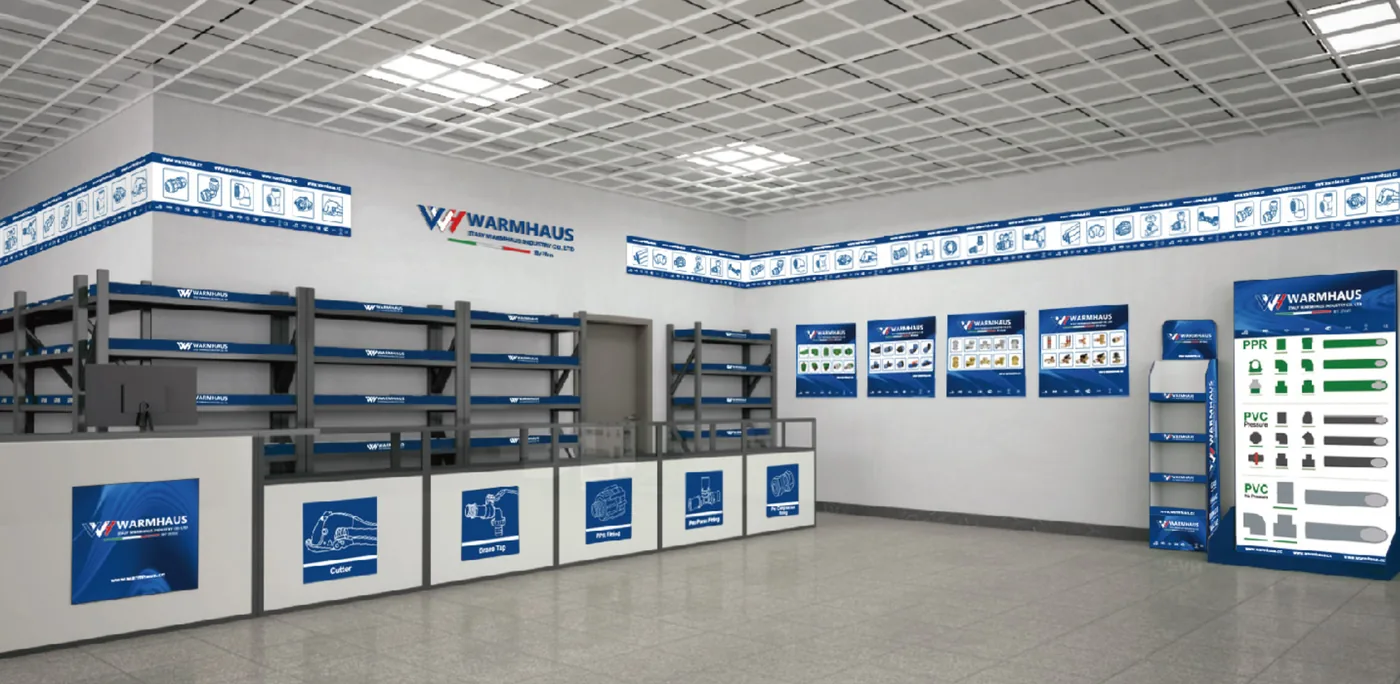
WARMHAUS is a manufacturer of PPR, PEX and brass piping systems — not a trading company. The extrusion, injection-moulding and machining lines are our own, which is why manifold bars, brass ball valves and brass fittings are machined to one internal standard instead of averaged across sub-suppliers. We have been manufacturing since 1993, across three plants totalling 100,000 m² of building area, with over 500 staff including a technical team of 50 or more. The company holds ISO 9001, ISO 14001 and ISO 45001 management-system certification, carries EU CE marking, and works with SGS third-party testing; certificate documents are available on request.
For an importer, the practical argument is scope. Because the same factory makes underfloor heating manifolds, PEX pipe, PPR systems, brass fittings, ball valves and thermostatic controls, a single order can fill a mixed container without opening four supplier accounts, and one certification file covers the shipment. There is no minimum order quantity, so a first order can be a genuine trial mix rather than a full container of one item. Standard lead time is 45 days from confirmed order, against a planned production slot.
Tell us your port counts, your pipe diameter and the actuator thread you already stock, and we will send the manifold specifications, the accessory range and distributor terms for your market. Request manifold specifications and distributor terms — pricing, packing details and certificate documents supplied on enquiry.