Choose a PPR ball valve the way you choose the pipe, not the way you choose an accessory. On a hot-water line the pipe is a continuous fused polymer wall with no seams; the moment you introduce a valve you introduce a body, a stem, a seat and — depending on the type you picked — a thread. Every one of those is a component that ages at a different rate to the pipe around it. The valve selection decision is therefore not “which one is in stock in this diameter”, it is which connection type, which body material and which bore you are willing to live with for the service life of the riser.
This guide is for installers specifying valves on hot-and-cold water systems, and for distributors and sourcing agents deciding which types to stock across the Middle East, North Africa, Southern Europe and Latin America. Figures given here are general industry guidance, not a WARMHAUS-specific specification — always confirm against the technical datasheet of the valve and pipe you are using.
I. Why the Valve Is the Decision, Not the Pipe
A hot-melt welded PPR line has one useful property that dominates everything else: it has no joints in the mechanical sense. Socket fusion melts pipe and fitting into one continuous piece of polypropylene, so there is nothing to loosen, nothing to gasket, nothing to re-torque. That property is the whole argument for the PPR system in domestic hot water.
Every threaded valve you weld into a fused line is a deliberate decision to put one mechanical joint back into a system that had none.
So the question at each control point is simple: does this location genuinely require a demountable connection, or are you adding one out of habit? A riser shut-off opened twice in twenty years does not need a thread. A connection to a meter, a circulation pump or an appliance does — those are replaced on a maintenance cycle and you cannot cut the pipe every time. Getting that distinction right at specification stage is most of the job.
II. The Four PPR Ball Valve Types — and the Metal Alternative
Across PPR product ranges you will be offered four distinct constructions. They are not interchangeable and price-comparing across them is meaningless.
All-PPR ball valve, hot-melt sockets both ends
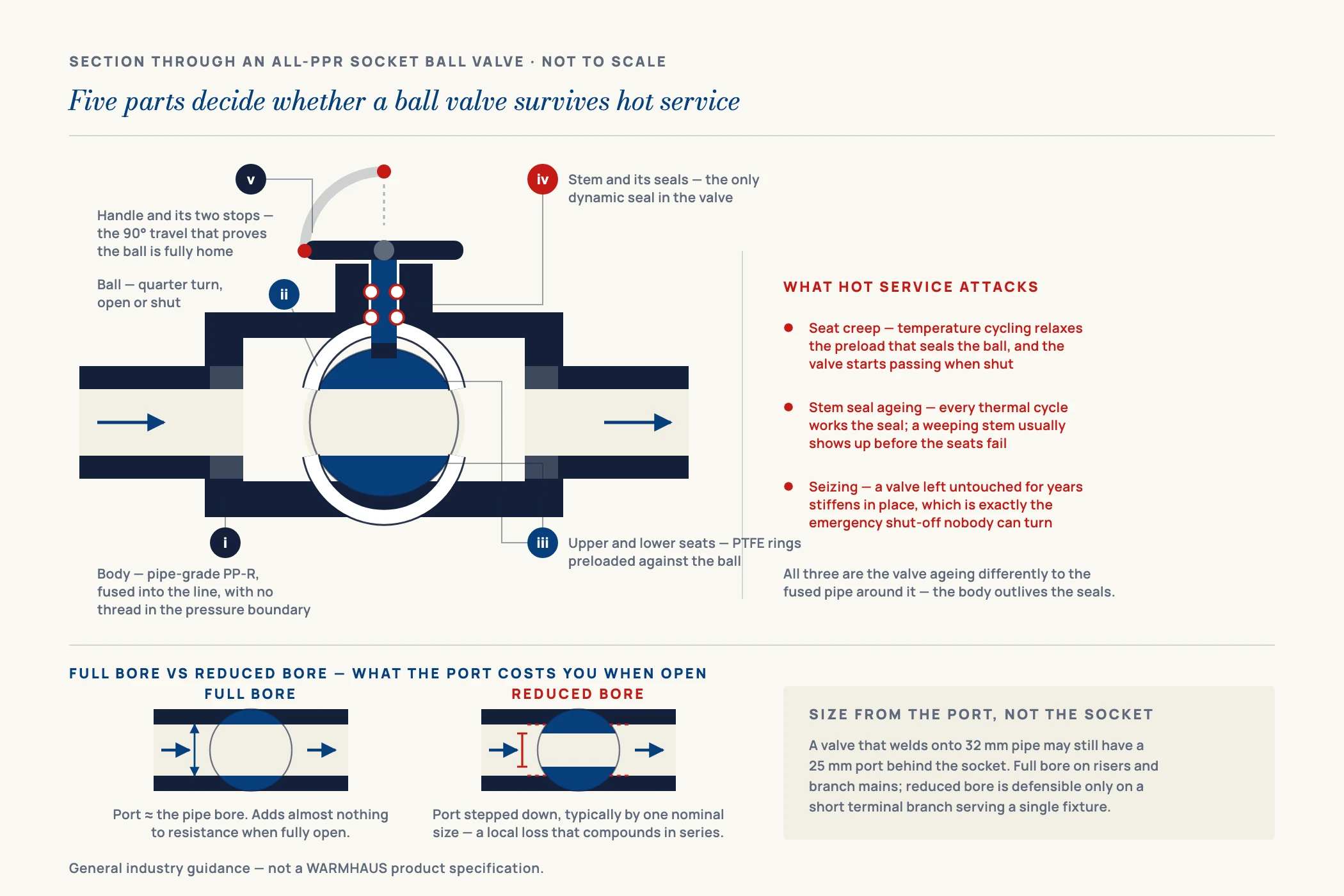
A PP-R body with fusion sockets, welded directly into the pipe. There is no dissimilar material and no thread anywhere in the pressure boundary — the valve becomes part of the pipe wall. Use for: riser isolation, branch shut-off, anywhere the valve is buried, boxed or otherwise not going to be serviced. This is the default specification on a hot line and should be your highest-volume line item.
Ball valve with brass-insert threaded end
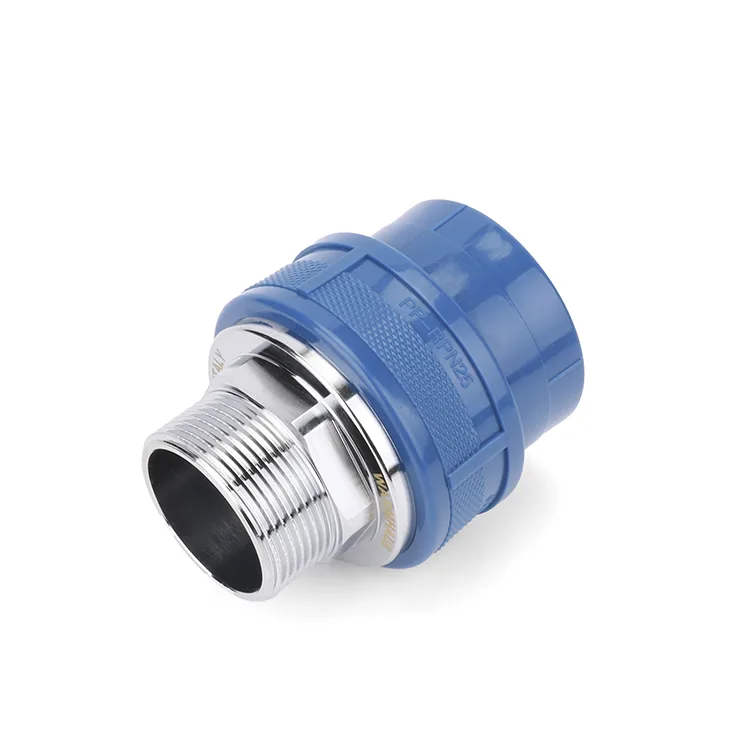
PP-R body, fusion socket on one side, a moulded-in brass thread on the other. The thread is where you transition to metal. Use for: meters, pumps, boiler and appliance connections, and any component with a factory-threaded inlet. Do not use merely because it is convenient — each one is a mechanical joint added to a seamless system.
Ball valve with union
A serviceable valve with a demountable union nut, so the valve or the equipment downstream can be removed without cutting the line. Use for: plant-room positions, pump isolation pairs, filter and manifold assemblies — anywhere the maintenance plan involves taking something out. The union carries a seal, so it belongs in accessible locations, never inside a wall chase.
PPR stop valve (regulating valve)
Not a ball valve at all — a seat-and-disc design intended for throttling. A ball valve regulates badly: partial opening puts the ball edge into the flow stream and erodes the seat. Use for: branch balancing and any position where the valve will sit part-open in normal service. If flow needs to be set rather than switched, this is the correct component.
Full metal brass ball valve
Outside the PPR body family but part of the same decision. Where the position is entirely in metal — plant rooms, meter sets, manifold groups, high-cycle duty — a full brass ball valve avoids the polymer-to-metal transition altogether. Specify metal on the metal side of the system, PPR on the PPR side, and put one clean transition between them rather than several.
III. PPR Ball Valve Selection Table
The table below is a specification aid: read down the connection type you are considering, and check it against the position on the line. The size ranges shown are what the market commonly catalogues for PPR water-supply systems — general industry guidance, not WARMHAUS product specifications. Actual port sizes, pressure classes and temperature limits vary by manufacturer, body design and PP-R grade — confirm against the datasheet of the valve you are buying before you specify it into a project.
| Valve type | Connection | Size range commonly catalogued | Bore | Best position on the line | Serviceable |
|---|---|---|---|---|---|
| All-PPR ball valve | Hot-melt socket, both ends | 1/2″–4″ | Full bore | Riser and branch isolation; concealed runs | No — cut and re-weld |
| Brass-insert ball valve | Socket one end, threaded brass the other | 1/2″–2″ | Full or reduced | Meter, pump and appliance transitions | At the thread only |
| Ball valve with union | Socket plus demountable union nut | 1/2″–2″ | Full bore | Plant room, filter and pump assemblies | Yes |
| PPR stop valve | Hot-melt socket, both ends | 1/2″–2″ | Reduced (seat) | Branch throttling and flow setting | Head removable on most designs |
| Brass ball valve | Threaded, both ends | 1/2″–4″ | Full bore | All-metal plant and meter sets | Yes |
Values are general industry guidance on what the market commonly offers, not a WARMHAUS-specific specification. Size ranges, bore type and pressure class differ between manufacturers and between body designs within one range. Always confirm the sizes, ports and classes actually available against the technical datasheet supplied with the valve and the pipe you are welding it into.
If you are specifying a mixed order, the practical move is to fix the connection type per position first and only then price it. Request the PPR valve datasheet and current range list and we will confirm which types and sizes are available against your position schedule. The live range with photographs sits on the PPR valves page.
IV. Hot Water Changes the Arithmetic: Pressure Derating
The single most common specification error on hot-water valves is reading the PN number as a working pressure. It is not. PN is a nominal rating referenced to water at 20 °C. Polypropylene loses strength as temperature rises, so the pressure a valve body will actually hold at 60 or 70 °C is materially below the number stamped on it. The same derating logic that governs the pipe governs the valve body, because on an all-PPR valve the body is pipe-grade material.
Two practical consequences follow. First, never specify a valve of a lower pressure class than the pipe it sits in — the system is only as strong as the weakest component in the pressure boundary, and a PN16 valve in a PN20 riser has just made the whole riser PN16. Second, on hot circulation lines allow for the fact that the valve sits in the hottest, most thermally cycled part of the system.
The class you specify should therefore be read against the service condition, not against the number alone. As general industry guidance for PP-R water systems, the four classes map to service roughly as follows — and the mapping, not the bar figure, is what belongs on a purchase specification.
| Class | Nominal basis | Wall geometry | Where it is normally specified |
|---|---|---|---|
| PN10 | ~10 bar at 20 °C | SDR 11 (thinnest) | Cold water distribution only |
| PN16 | ~16 bar at 20 °C | SDR 7.4 | Cold at higher mains pressure; intermittent warm service |
| PN20 | ~20 bar at 20 °C | SDR 6 | The general-purpose hot and cold sanitary class |
| PN25 | ~25 bar at 20 °C | SDR 5, fibre-composite | Hot water risers, heating circuits, higher-temperature duty |
General industry guidance, not a WARMHAUS-specific specification. PN is a nominal rating at 20 °C over a nominal design life; permissible working pressure at 60–70 °C is substantially lower and is set by the temperature-pressure curve for the specific PP-R grade. Always confirm against the datasheet of the valve and pipe you are buying.
There is no published derating table for a valve body as such — the correct source is always the manufacturer’s own temperature-pressure curve for the specific PP-R grade, because the derating depends on the material, not on the component. The general principle — derate for temperature, match the class to the pipe — together with the full class-by-class treatment of PN, SDR and wall thickness, is set out in our guide to PPR pipe specifications and in the reference on PPR pressure ratings and PN classes. The same reasoning transfers directly to valve bodies, because on an all-PPR valve the body is pipe-grade material.
A third factor is thermal cycling rather than steady temperature. A valve on a recirculating loop sees the same expansion and contraction cycles as the pipe, thousands of times over its life — and this is where a threaded joint underperforms a fused one. The fused joint moves as a single piece of material; a thread relies on a mechanical seal being worked loose and tight by every cycle.
V. Sizing: Full Bore, Reduced Bore and What It Costs You
A full-bore ball valve has a ball port approximately equal to the pipe’s internal diameter, so the valve adds very little to system resistance when fully open. A reduced-bore valve steps the port down, typically by one nominal size, which is cheaper to manufacture and perfectly acceptable in many positions — but it introduces a local pressure loss that matters when several are in series, or when the system already has marginal head.
The selection rule that holds up in the field: use full bore on anything that is a main isolation point — risers, branch mains, anything where the valve is normally open and its only job is to shut off in an emergency. Reduced bore is defensible on short terminal branches serving a single fixture, where the local loss is trivial against the fixture’s own resistance. What you must not do is size the valve from the socket dimension without checking the port: a valve that welds onto 32 mm pipe may still have a 25 mm port behind the socket.
The valve follows the pipe rather than leading it: size the pipe for design flow first, then match the valve to the pipe at that point. Do not oversize to “reduce restriction” — an oversized ball valve in a small line is simply a larger, costlier component with the same shut-off function.
VI. Five Selection Errors That Show Up on Site
These are the failures that appear at commissioning or in the first two years of service. Every one is a specification decision, not an installation fault.
Using a ball valve to throttle flow
A partly open ball puts its machined edge directly in the flow path, eroding the seat until the valve no longer shuts off cleanly. Fix: ball valves are open or closed. Specify a stop or regulating valve at any position that will be set part-open.
Threaded valves where a socket valve belongs
A brass-insert valve specified for convenience inside a concealed chase gives you a mechanical joint you cannot inspect, in the one place you cannot reach it. Fix: all-PPR socket valves for concealed and buried positions; reserve threads for accessible transitions.
Mixing pressure classes in one line
A lower-class valve silently derates the whole riser to its own rating, and nobody notices until the pressure test or a hammer event. Fix: specify the valve class to match or exceed the pipe class, and check it on receipt rather than on the drawing.
Buying valve bodies from a different source to the pipe
Socket dimensions and PP-R grades drift between manufacturers. A socket that is nominally the same size but dimensionally off gives you an inconsistent fusion zone — welds that pass a pressure test and fail later. Fix: take pipe, fittings and valves from one production system with one set of socket tolerances.
Overheating the valve during welding
A valve body has more mass and a machined internal assembly compared with a plain fitting; over-holding on the die can distort the seat or push flash into the ball chamber. Fix: weld the valve to the diameter’s heating time, not longer, and keep the valve in the fully open position while welding — the technique is covered in the PPR hot-melt welding guide.
VII. One Welded System, One Source
The reason valve selection turns into a sourcing question is that the valve only performs as specified if it fuses correctly into the pipe around it. WARMHAUS manufactures the pipe, the fittings and the valves — we are a manufacturer of PPR, PEX and brass piping systems, not a trading company, and the extrusion, injection-moulding and machining lines are our own. That is what lets socket dimensions and PP-R grades be held to one internal standard instead of averaged across three suppliers, and it is why the valve, the socket and the pipe weld into one continuous piece of the same polymer.
The PPR valve range covers socket, brass-insert, union and regulating types, and for the all-metal side of a system we machine the brass ball valve line from 57-3 and CW617 brass bar on our own lines. Manufacturing since 1993, ISO 9001 / ISO 14001 / ISO 45001 certified, EU CE marked and SGS tested, with no MOQ and a standard lead time of 45 days. Certificate documents: available on request. For distributors that means one supplier account instead of three, and one certificate set for the tender file rather than three that have to be reconciled. Sizes and configurations are confirmed per type against the current range list when you send your position schedule.
Tell us the positions you need to cover and the diameters you install, and we will match valve types to your schedule against the confirmed PPR valve range and the wider PPR system.