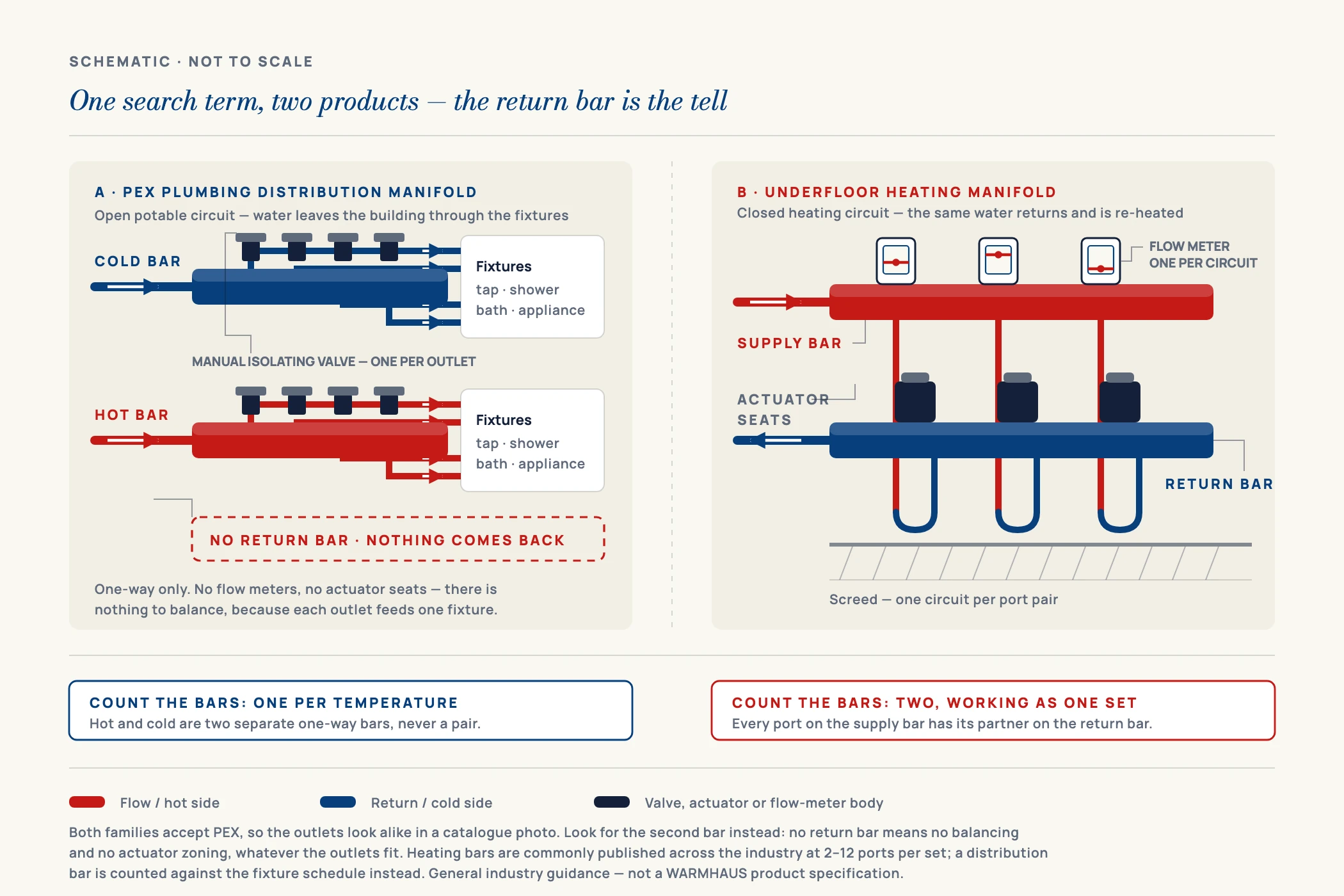
Two different products answer to the same search term, and that is where the ordering mistakes start. A PEX manifold can mean a plumbing distribution manifold — a bar with many small outlets running one dedicated line to each tap, shower and appliance — or a hydronic underfloor heating manifold, which feeds floor loops and exists mainly to meter and balance them. Both are usually brass and both connect to PEX, but they are not substitutes: order one when the job needed the other and the parts connect, yet the system never balances or the ports never reach the fixture count.
The distinction matters commercially. Across the Middle East, North Africa, Southern Europe and Latin America, importers often stock one manifold line and assume it covers “PEX manifold” enquiries from both plumbers and heating contractors. It does not, and the returns arrive months later. Everything technical below is general industry guidance — confirm figures against the datasheet of the manifold and pipe you are actually buying.
I. Why One Search Term Covers Two Products
The confusion is linguistic: “PEX manifold” describes the connection, not the function. Any bar terminating in PEX-compatible outlets qualifies — but the two families were designed around opposite problems.
A plumbing distribution manifold solves a branching problem. Instead of a trunk-and-branch layout where a shower loses pressure whenever a tap opens, it gives every fixture its own uninterrupted run back to a central point, each outlet carrying an isolating valve so one tap can be shut off without draining the building. Outlets are numerous and small — commonly 16 mm — and the intent is pressure stability and isolation.
A hydronic underfloor heating manifold solves a balancing problem. Floor loops are rarely equal in length, and an unbalanced set sends most of the flow through the shortest circuit while the far bedroom stays cold. So it carries a supply bar with flow-metering valves and a return bar with actuator-fitted valves, plus vents, fill and drain valves and often a gauge. Outlets are fewer and larger — commonly 16 mm or 20 mm — and the intent is measured, adjustable flow per circuit.
A plumbing manifold divides water. A heating manifold measures it. That single difference explains almost every other difference between them.
Everything else follows from that. For the heating side in component detail, the underfloor heating manifold range shows how bars, valves, brackets and end fittings should arrive as one matched assembly rather than a parts hunt.
II. What a PEX Plumbing Distribution Manifold Actually Does
In a home-run layout, the manifold sits after the main isolation and, on the hot side, after the water heater. From there one continuous PEX line runs to each fixture with no joints buried in walls or slabs — the strongest argument for the format. The benefits are pressure stability, since fixtures do not share a branch, and isolation, since each outlet valve shuts one fixture for repair while the rest of the building stays live.
The trade-offs are practical too. A home-run layout uses considerably more pipe in total metres than trunk-and-branch, and bars are installed in pairs, cold and hot, with the hot bar fed at domestic hot-water temperature — a different regime from a floor loop. Potable service also wants PEX pipe rated for hot and cold water duty, with the series and pressure class read from the datasheet rather than assumed from the colour of the coil.
III. What an Underfloor Heating Manifold Actually Does
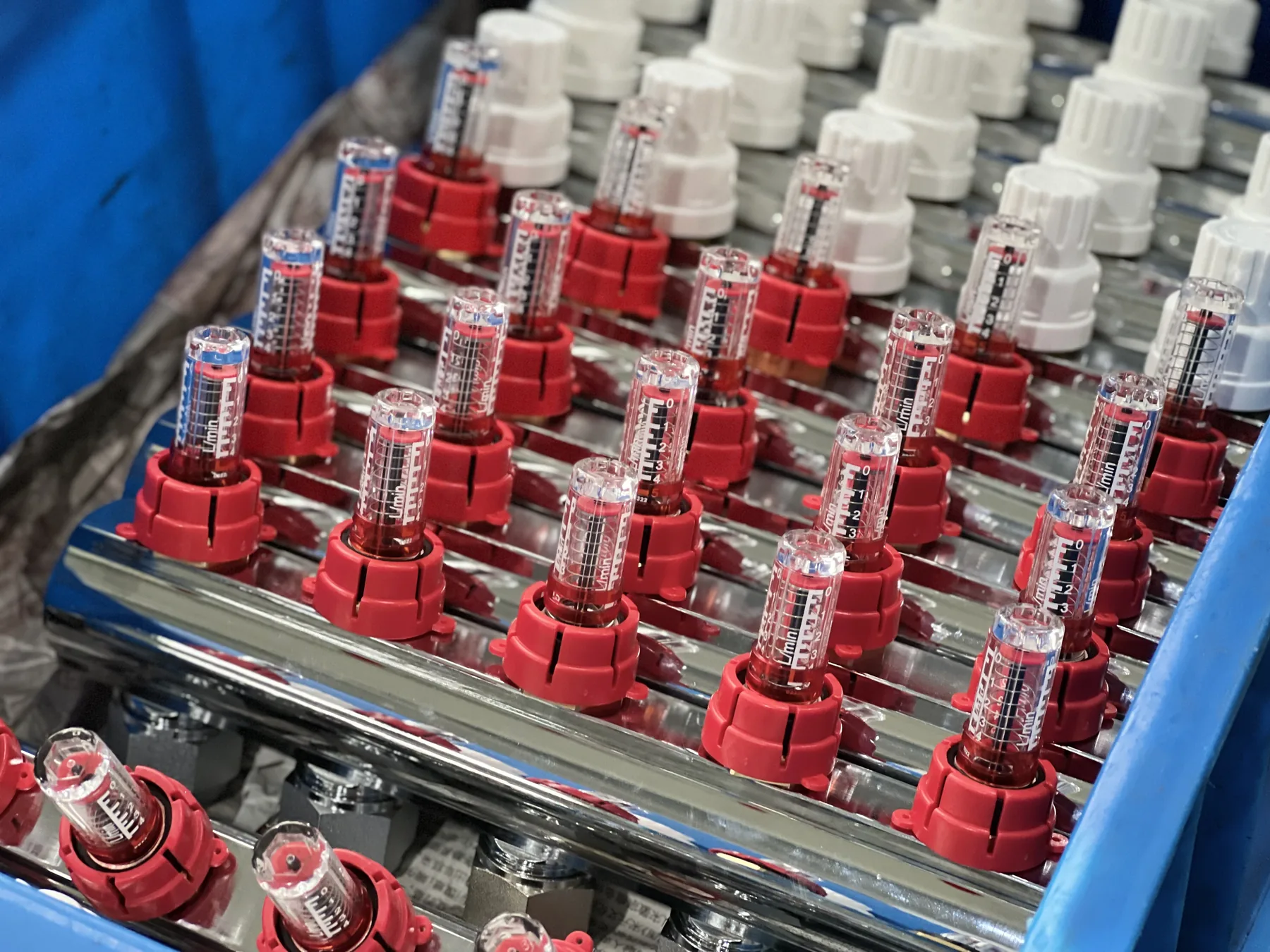
A heating manifold is a small hydraulic machine rather than a splitter. It takes flow from the heat source, distributes it across floor circuits, and lets the commissioning engineer set how much goes to each. On the supply bar, flow meters or regulating valves show and set litres per minute per loop. On the return bar, valves take thermal actuators driven by room thermostats, so each room becomes a controllable zone.
Around the bars sit the components that make the assembly commissionable: air vents, fill and drain valves, end caps and isolation valves, mounting brackets, usually a temperature gauge, and often a pump and mixing group, because floor circuits run at a lower flow temperature than the boiler or heat pump supplies. So a heating manifold is never sold as a bare bar — it is an assembly, and every accessory has to be re-orderable years later when an actuator fails. That is why machining quality matters more here than on a plumbing bar, and the reasoning behind our machined brass manifolds, where ports, threads, seats and the flow-meter housing are cut into one continuous piece of bar stock.
IV. PEX Manifold vs Underfloor Heating Manifold — Side by Side
The table sets the two families against each other on the points that change a purchase decision. These are general characteristics of the two product types, not the specification of any product line, and the ranges given are typical industry practice that varies by manufacturer and market.
| Criterion | PEX plumbing distribution manifold | Underfloor heating manifold | What it means for the buyer |
|---|---|---|---|
| Primary function | Splits potable supply into one dedicated line per fixture | Distributes, meters and balances hydronic floor loops | Decides which trade buys it |
| Circuit type | Open potable circuit, water leaves the system | Closed heating circuit, same water recirculates | Changes the water-treatment conversation |
| Typical outlet count | Often 6–12 or more outlets per bar | Commonly 2–12 loops per bar | Fixture count vs circuit count |
| Typical outlet size | Commonly 16 mm to fixtures | Commonly 16 mm or 20 mm floor loops | Outlets look alike; the bars are not interchangeable |
| Flow measurement | None — no balancing required | Flow meters or regulating valves on the supply bar | The most visible difference in a catalogue photo |
| Valve type per port | Manual isolating valve, set once | Regulating valve on flow, actuator-ready valve on return | Actuator thread fit is a stocking decision |
| Zone control | Not applicable | Thermal actuators driven by room thermostats | Heating bars pull controls into the same order |
| Supplied as | Bar plus outlet valves and end fittings | Flow and return bar set, valves, vents, drains, brackets, gauge | Very different part counts per unit |
| Operating temperature | Domestic hot and cold water service temperatures | Reduced flow temperature, normally below a radiator circuit | Confirm the rating on the datasheet |
| Usual mounting | Wall or service riser, accessible for isolation | Recessed or surface cabinet near the heated zones | Cabinets and brackets belong in the heating order |
| Common body material | Brass or engineered polymer | Brass or stainless steel | Ask for the alloy designation in writing |
| Sizing driver | Number of fixtures, hot and cold bars in pairs | Number and length of floor circuits, heat load per room | Two separate take-offs — do not merge them |
Values are general industry guidance, not a WARMHAUS-specific specification. Outlet counts, connection sizes, temperature and pressure ratings and accessory content vary by manufacturer and product line. Always confirm against the technical datasheet of the manifold and pipe you are actually buying.
Request the manifold specifications for your project — available port counts, brass grade, outlet and actuator thread designations, flow-meter options and distributor terms for your market.
V. Where Buyers Get It Wrong
These are the mistakes that generate returns and warranty arguments, all from treating the two products as one line item.
Ordering a plumbing bar for a heating job
The pipe connects and the system fills, but the floor never balances — the short loop takes the flow, distant rooms stay cold, and there are no flow meters to diagnose why. Fix: if the drawing shows floor circuits, it is a heating manifold whatever the customer typed.
Ordering a heating manifold for a plumbing riser
The port count is too low for the fixture list, and you are paying for flow meters and actuator threads nobody will use. Fix: count fixtures first — a hot-and-cold pair of distribution bars is a different take-off from a floor-loop schedule.
Assuming the outlets fit because both say “16 mm”
A nominal size is not a connection standard. Compression fittings, adaptor threads and insert designs vary between makers, so a matching size can still refuse to seat. Fix: confirm the adaptor type and thread designation in writing — using the designations in the table below, not the word “standard” — and buy pipe and adaptors from the same source as the bar.
Buying the bar and sourcing accessories separately
The classic false economy on the heating side. Actuators, flow meters, brackets and vents from a second supplier may fit on day one and be unobtainable in year five — and a manifold arriving without its cabinet or mixing group is not installable. Fix: quote, stock and pack the assembled system, not the bar.
VI. The Thread Designations You Should Be Quoting
“Confirm the thread” is useless advice unless you know what to write in the email. Manifold connections are described by a small, stable set of designations, and using the right one turns a vague enquiry into a specification a factory can answer. These are the codes that appear on manifold drawings and adaptor catalogues.
| Designation | What it is | Sealing method | Where it turns up on a manifold |
|---|---|---|---|
| G (BSPP) | British Standard Pipe Parallel, ISO 228. Written G½, G¾, G1 | Parallel flanks do not seal on the thread — sealing is on a washer, O-ring or flat face | Bar end connections, ball-valve tails, flow-meter bodies, pump-group unions |
| R / Rc (BSPT) | British Standard Pipe Taper, ISO 7. R = external taper, Rc = internal taper, Rp = internal parallel | Taper interference on the thread flanks, made up with sealant or PTFE tape | Adaptors into fittings, drain and fill cocks, gauge pockets |
| NPT / NPTF | American National Pipe Taper, ASME B1.20.1. Written ½" NPT | Taper thread with sealant. Different thread angle and pitch from BSPT — never interchangeable | Manifolds and components specified to North American practice |
| Eurocone | The de-facto European pipe-connection thread at the outlet, commonly G¾ with a 24° internal cone, widely written as 3/4" EK | Compression: nut compresses a split ring and support sleeve onto the pipe, sealing on the cone, not the thread | The outlet ports themselves — where the floor loop lands |
| M-series metric | Straight metric machine threads, e.g. M30 × 1.5, M28 × 1.5 | O-ring or gasket | Actuator seats on the return bar — the most common mismatch of all |
Designations are general industry guidance describing widely used thread standards, not a WARMHAUS-specific specification. Which designation and size any particular manifold, adaptor or actuator uses varies by manufacturer and product line — always confirm against the technical datasheet and drawing of the parts you are buying.
Three practical consequences. First, G and R are not the same thread even at the same nominal size: a parallel male into a taper female may start and then fail to seal. Second, BSP and NPT look close enough to start by hand and are not compatible — the flank angle differs (55° against 60°) and so does the pitch at most sizes, which is why a cross-threaded joint that “went on fine” is a classic warranty argument in markets where both systems circulate. Third, the actuator thread is a separate question from the pipe thread; a manifold whose outlets accept your pipe can still refuse the actuators you stock, so ask for both designations on the same drawing.
On tightening: eurocone compression nuts are hand-started, then made up with a spanner to a modest torque — general industry practice for the 3/4" eurocone nuts used on 16–20 mm loop pipe falls in the region of roughly 25–35 N·m, and actuator bodies are usually hand-tight only. Treat those as magnitudes for planning a toolkit, not as a setting: the binding figure is the one printed in the installation instructions for the specific manifold, insert and pipe you are using, and over-torquing a compression joint on plastic pipe damages the support sleeve rather than improving the seal.
VII. How to Size Each One
The two sizing exercises share nothing except the word manifold, so never do them in the same spreadsheet column.
I. Sizing a plumbing distribution manifold
Start from the fixture schedule. Count every outlet that needs its own line — basin, sink, shower, bath, WC, washing machine, dishwasher, outside tap — then add spare ports, because retro-fitting an outlet to a full bar is not practical. Hot and cold are separate bars, so a dwelling needs cold outlets for every fixture and hot outlets only for those taking hot water. Size the inlet to the incoming service and keep the assembly accessible.
II. Sizing an underfloor heating manifold
Start from the floor plan and the heat load, not the fixture list. Each heated zone needs at least one circuit; large rooms need several, because loop length is capped by pressure drop. Divide the heated area into circuits of comparable length, count them, and that is your port count — plus a spare if the layout may change. Heating bars are commonly available in 2 to 12 ports per bar as general industry practice, so a large apartment or a small commercial floor plate does not automatically need splitting into two groups; the full sizing method, including when a second manifold genuinely is the right answer, is set out in the underfloor heating manifold sizing guide. Then confirm whether the manifold needs a pump and mixing group, whether every circuit takes an actuator, and whether the cabinet is recessed or surface-mounted. Circuit lengths, spacing and flow temperature are outputs of the heat-loss calculation.
One rule covers both: specify the pipe and the manifold in the same conversation, because the outlet adaptors have to match the pipe series and diameter you will actually install.
VIII. What This Means for Your Shelf
Most importers do not need both families in depth, but they do need to know which enquiry is which. Structurally, the heating manifold is the higher-attachment line of the two: it is sold as an assembly, so a single order tends to pull floor-loop pipe, actuators, thermostats, cabinets and mixing groups along with it, where a distribution bar is largely self-contained. That is a property of the product, not a claim about any particular market. So carry it as a system — bars in the port range your enquiries actually show, with matching accessories — and quote distribution bars against a specific fixture schedule.
That is the case for buying the assembly from one manufacturer. We make PPR, PEX and brass piping systems — not a trading company; extrusion, injection-moulding and machining lines are our own, which is why manifold bodies, valve seats and outlet threads are held to one internal standard rather than averaged across subcontractors. The underfloor heating manifold assembly and the PEX pipe that connects to it come from one source against one set of drawings — so the adaptor question is answered before the order, not after the container lands.
Two commercial points matter here. There is no MOQ, so a distributor can trial a port range, a pipe series and a set of actuators in one shipment instead of committing to a full container of one item — the practical way to find out which manifold your market actually buys. And standard lead time is 45 days, planned into production slots, which is the number to build a reorder cycle on. Manufacturing since 1993, ISO 9001 / ISO 14001 / ISO 45001 certified, EU CE marked and SGS tested, with raw material from Hyosung, Borealis and LG.
Tell us your market, the port counts you quote most often and the diameters your installers use, and we will send manifold specifications, the PEX pipe range, certification files and distributor terms. Pricing and certificate documents — available on request.