Buy a PPR welding machine on price alone and you will find out what you paid for on the second job, not the first. The first job runs fine: the plate is new, the dies clean, and nobody has welded 63 mm yet. The failures arrive later — a thermostat that swings between joints, a die coating that starts shedding onto the pipe, a plate that cannot hold temperature under continuous welding, a die set that stops at 50 mm where the riser is 63 mm. The specification that matters is not headline wattage. It is die range, thermal recovery, temperature control and die surface — the four things a cheap listing is quietest about.
This guide is for the people who place the order: contractors buying one or two machines for a crew, and importers or distributors buying tooling by the carton to sell alongside pipe. Figures below are general industry guidance, not a specification for any one product — always confirm against the datasheet of the pipe and machine you are using.
I. Start With Your Diameter Range, Not the Price
Every decision follows from one question: what is the largest pipe you weld, and how often? Socket-fusion machines are sold in capacity classes defined by the die sizes they carry and the heat they put into them. Buying a class below your real work is the most expensive mistake, because there is no workaround on site: you cannot weld 63 mm with a 50 mm die.
In most residential and light-commercial plumbing across the Middle East, North Africa, Southern Europe and Latin America, the working range is 20–63 mm: branches at 20 and 25 mm, distribution at 32 and 40 mm, risers at 50 and 63 mm. Above 63 mm the method changes character — parts get heavy, hand alignment becomes unreliable, and the market moves to bench-mounted or clamped socket-fusion frames.
Size the machine to the largest diameter you will ever weld on a job, not to the diameter you weld most days.
You may weld 20 mm a hundred times a day and 63 mm twice a month, but those two joints are usually on the riser — under the most pressure, least accessible for repair. A crew that has to borrow a machine for them will improvise, and improvising on a 63 mm joint is how a wall gets opened twice. If your PPR pipe range goes to 63 mm, the machine should too.
II. The Five Specifications That Actually Matter
Listings for socket-fusion machines are full of numbers. Only a handful predict how the tool behaves on the fourth hour of a shift.
I. Die range and the number of die pairs included
A machine is only as capable as the dies bolted to it. Check the largest die the plate is built to carry and which pairs are actually in the box. Kits are often advertised by maximum size but shipped with three or four pairs, meaning an immediate second purchase. A full 20–63 mm set is six pairs: 20, 25, 32, 40, 50 and 63 mm. Check how the dies attach too — one that loosens as it expands heats unevenly, giving inconsistent joints with no obvious symptom.
II. Heating power and thermal recovery
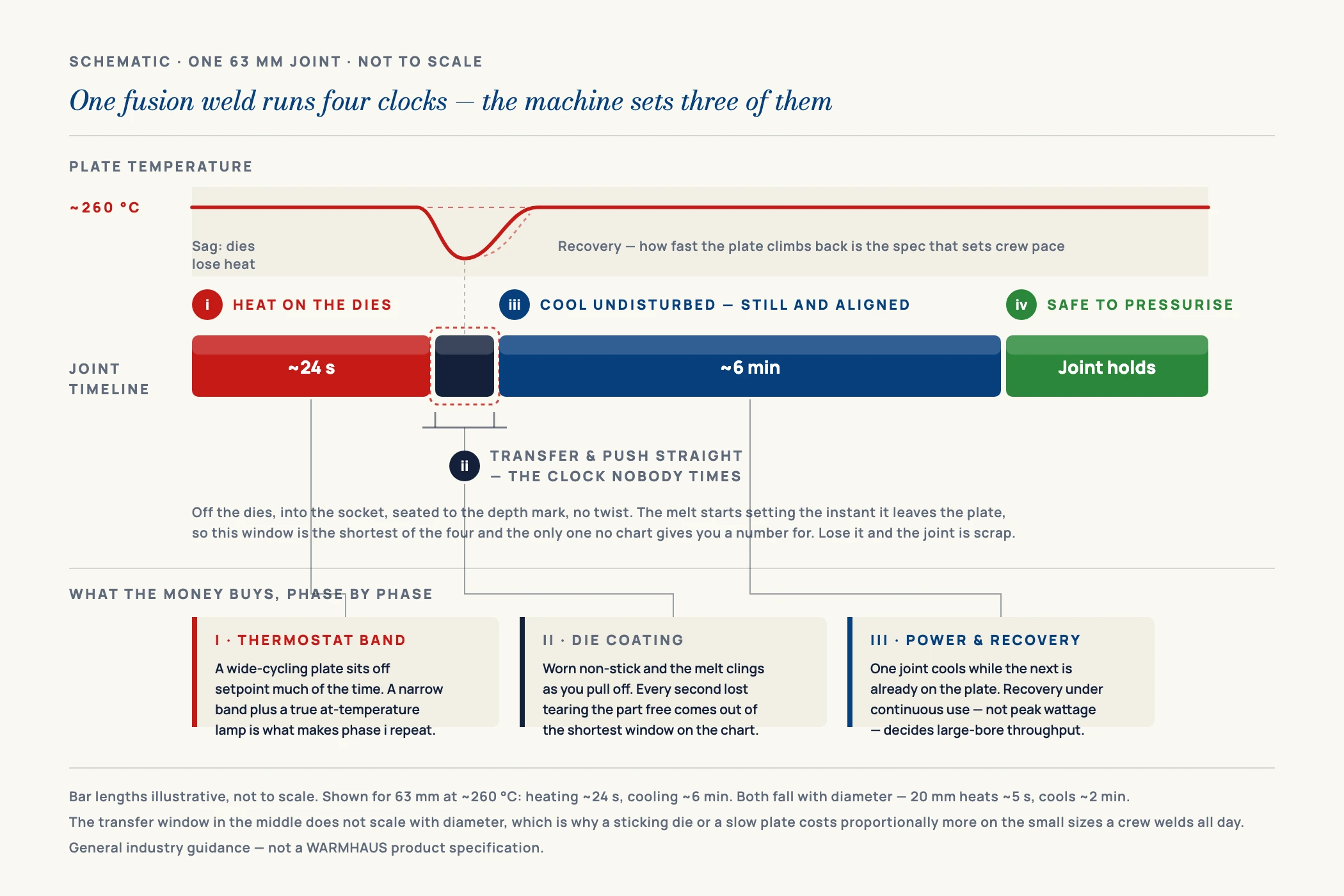
Wattage matters, but not for the reason most buyers assume. It has little to do with how hot the plate gets — the thermostat sets that — and everything to do with how fast the plate returns to working temperature after a joint pulls heat out of it. An under-powered machine sags and needs recovery time between joints; a crew working to a schedule welds through the sag and produces under-heated joints that look perfect and fail under pressure. If the specification does not describe recovery under continuous use, ask for the figure.
III. Temperature control and stability
Socket fusion for PPR runs at roughly 260 °C as general industry practice. What separates a professional machine from a hardware-store one is not that number but how tightly it is held. A simple bimetallic thermostat cycles around the setpoint with a wide band; better machines use an adjustable controller with a narrower band and an indicator showing when the plate is genuinely at temperature rather than merely powered on. That is worth paying for — but keep the claim honest. A stable plate removes one family of defects, the under- and over-heated joints that come from a plate sitting off setpoint. It does nothing about the other family, which is at least as common on site: insufficient heating time, a pipe not inserted to full depth, an angled or burred cut, twisting the joint while seating it, or disturbing it during the cooling period. Section IV covers the cutting and chamfering tools that govern that second family. A good machine makes a correct technique repeatable; it does not substitute for one. The full method, with per-diameter heating and cooling times, is in our step-by-step PPR welding guide.
IV. Die coating and surface condition
Dies are normally aluminium with a non-stick coating so molten polypropylene releases cleanly. When the coating wears, melted material sticks and every subsequent joint drags contamination into the fusion zone. A crew ends up scraping dies with a screwdriver, destroying the remaining coating and the die geometry with it. Coated dies are a consumable: confirm before you buy that spare pairs are available in the sizes you use most.
V. Voltage, plug and safety marking
An import detail that becomes an installation problem. Confirm supply voltage and frequency against your market before the container is booked, along with plug type or a suitable lead. For goods entering the EU, confirm the electrical product carries appropriate CE marking and that conformity documentation is available for your file — easier to request up front than to reconstruct after arrival.
III. PPR Welding Machine Comparison by Capacity Class
The table below compares the capacity classes a contractor or distributor will be quoted. Figures are typical industry values for general orientation only — power ratings and die counts vary considerably between builds, so confirm every line against the specification sheet of the machine you are buying.
| Class | Typical die range | Die pairs | Typical power band | Suits | Check before ordering |
|---|---|---|---|---|---|
| Compact hand-held | 20–32 mm | 3 pairs | ~600–800 W | Repairs, service calls, small domestic branches | Cannot be upgraded past its plate size — verify you never weld 40 mm+ |
| Standard hand-held | 20–63 mm | 6 pairs | ~800–1,200 W | Everyday residential and light-commercial plumbing, intermittent duty | Confirm all six pairs are in the box, not just the small three |
| Heavy-duty hand-held | 20–63 mm | 6 pairs | ~1,200–2,000 W | Continuous production welding, larger crews, repeated 50–63 mm joints | Ask for thermal recovery under continuous use, not peak wattage |
| Bench / clamped frame | 75–160 mm | Per project | Varies by build | Commercial risers and plant rooms above 63 mm | Alignment jig, bench mounting and floor space on site |
| Spare die pairs | Per diameter | Sold singly | — | Replacing worn coating on high-use sizes | Stud thread and plate hole spacing must match your machine |
Values are general industry guidance, not a WARMHAUS-specific specification. Power bands and die counts differ between builds; always confirm against the datasheet supplied with the machine and the pipe you are welding.
For most buyers the decision sits between the second and third rows — and the power column is the worst way to tell them apart. The bands overlap in the market, a well-designed 1,200 W plate can outperform a poorly designed 1,800 W one, and two machines quoted at the same wattage can behave completely differently. Wattage is a rough proxy; the class is really defined by duty. Four questions separate them properly:
i. How long does the plate take to return to setpoint after a 63 mm joint? This is the single number that distinguishes the classes, and it is the one least often published — ask for it explicitly. ii. Can it weld continuously, or does it need idle time? A standard machine is built for intermittent domestic work; a heavy-duty one is specified for back-to-back joints through a shift. iii. How tight is the temperature control band around the setpoint? A narrow band with a genuine at-temperature indicator is a heavy-duty trait regardless of wattage. iv. Is the plate thick enough to hold heat? Plate mass and heater distribution matter more than headline power, because a thin plate with a big element still sags locally where the die sits.
In practice: a standard hand-held machine covering 20–63 mm with a full six-pair die set is the default for a plumbing contractor doing residential and light-commercial work, matching the diameters that make up the bulk of a complete PPR system. Move up to heavy-duty when the crew welds continuously, when 50 and 63 mm joints are routine rather than occasional, or when more than one installer works off the same machine — those are the conditions under which recovery time, not power, becomes the constraint.
IV. What Else Goes in the Kit
A welding machine on its own does not produce a joint. Three supporting items decide whether the weld is repeatable, and all three are cheap enough that omitting them is a false economy.
The first is a proper pipe cutter — a ratcheting scissor cutter for small sizes, a wheel cutter for larger ones. A hacksaw leaves an angled end that fuses on one side before the other. The second is a chamfer and deburring tool, which removes the cutting burr so the pipe enters the socket without shaving material into the fusion zone. The third is the most often skipped: a marker and a depth scale, so the installer marks insertion depth before heating and can see when the joint is fully home. These ship alongside the machine in the WARMHAUS tools and accessories range, on the same packing list as the pipe.
V. Six Buying Mistakes That Show Up Later
These are the errors that turn a cheap purchase into an expensive one — worth reading before you approve a quotation.
Buying to the diameter you weld most, not the largest
A 20–32 mm machine covers most joints and none of the risers. Fix: specify against the top of your pipe range, not the average.
Assuming the advertised size means a full die set
Kits sold as “20–63 mm” often arrive with three or four die pairs. Fix: have the die pairs itemised on the proforma invoice before payment.
Reading wattage as quality
Peak power says nothing about how the plate holds temperature between joints. Fix: ask about thermal recovery under continuous welding and the temperature control band.
Ignoring die coating and spare availability
Coated dies wear out, and a worn die contaminates every weld after it. Fix: confirm spare pairs are stocked in your high-use sizes before committing.
Mixing machine, dies, pipe and fittings from four sources
Socket tolerances and die geometry drift between suppliers, and the drift lands in the fusion zone. Fix: source tooling from the manufacturer that makes the pipe it welds.
Overlooking voltage, plug type and CE marking
A machine that cannot be plugged in, or whose paperwork is missing at customs, is a stranded asset. Fix: confirm voltage, lead and documentation before booking the container.
VI. For Distributors: Stocking Machines Alongside Pipe
For an importer or distributor the calculation is different. A welding machine is a low-volume, high-attachment item: nobody buys PPR pipe over the counter and goes elsewhere for the tool if it is on the shelf beside it. Stock the range your customers weld, not the widest available — the standard 20–63 mm hand-held class in depth, with spare die pairs in the fastest-moving sizes, usually 20, 25 and 32 mm. Keep the tooling and the pipe on one packing list, rather than running two suppliers for an item that adds a fraction of a container’s volume. And keep the conformity file complete — the machine is an electrical product and is asked about separately from the pipe in tender and customs documentation.
Tooling is not a margin line. It is the reason the installer buys the pipe from you instead of the counter down the road.
VII. Machine, Pipe and Fittings From One Manufacturer
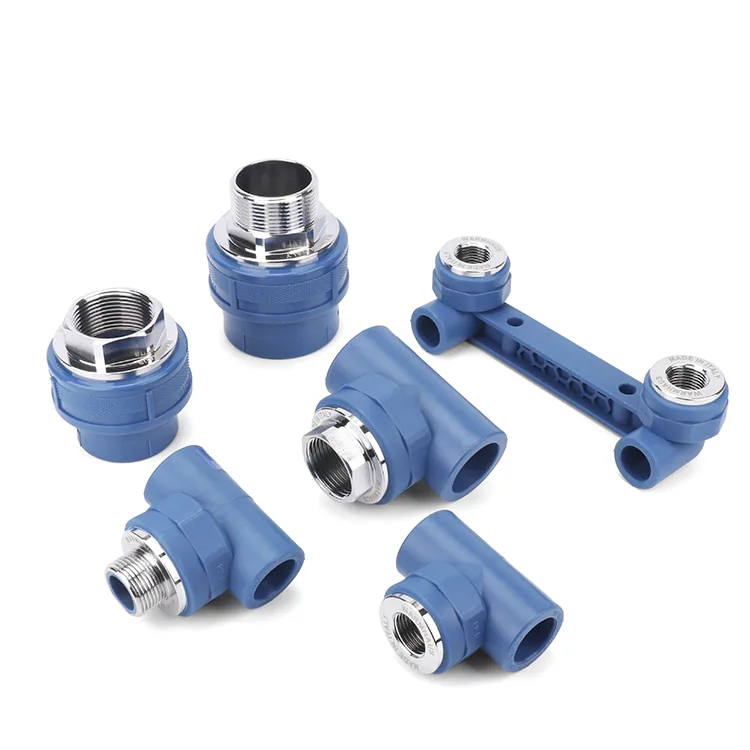
A repeatable weld depends on three things fitting each other: the machine, the pipe and the fitting. When they come from three sources, die geometry, wall thickness and socket tolerance drift independently, and the drift shows up as inconsistent joints that no amount of technique corrects. WARMHAUS builds all three. We are a manufacturer of PPR, PEX and brass piping systems, not a trading company — the extrusion, injection-moulding and machining lines are our own, which is why socket dimensions and pipe tolerances are held to one internal standard rather than averaged across suppliers. We supply PPR hot-melt welding machines for the 20–63 mm range, with dies matched to the pipe and fitting dimensions we produce in that span, alongside the PPR pipe, fittings and valves they weld. Manufacturing since 1993, ISO 9001 / ISO 14001 / ISO 45001 certified, EU CE marked and SGS tested, no MOQ, standard lead time 45 days.
Tell us the diameters your crews install and the market the goods are entering, and we will send the machine specification, the die schedule, the matched PPR pipe range and certification documentation. Request the welding machine specification and tools list — pricing, pack quantities and certificate documents available on request.