A PPR pipe price is not a number, it is a stack. Ask three manufacturers for “20 mm PN20, 4 metre lengths” and you can get three prices 30 % apart while every one quotes exactly what you asked for. The request left out the variables that set the cost: which polypropylene random copolymer went into the extruder, how much of it is in every metre, how it is packed, and who pays the freight. This article takes the stack apart layer by layer, so two offers side by side are the same product rather than two different products wearing one label.
This is written for the importer, sourcing agent and distributor buying by the container rather than by the coil. If you are building a stock programme for the Middle East, North Africa, Southern Europe or Latin America, the sections on packing, Incoterms and landed cost are where the money actually moves.
I. Why Two Quotes for the “Same” Pipe Differ
PPR pipe is sold by the metre or the bundle, but it is made by the kilogram. The largest line in the cost of a plain PPR pipe is resin, and everything else — extrusion energy, labour, packing, overhead, margin — layers on top of a raw-material figure that moves with the polymer market. When you buy a metre of pipe, you are mostly buying a mass of polypropylene. Two suppliers quoting the same nominal diameter and PN class but shipping pipe of different metre weight are not selling you the same object.
PPR pipe is quoted by the metre but built by the kilogram. Until you know the metre weight, you do not know the price.
The second is that “PN20” is a nominal rating, not a wall thickness you can assume. The class implies a standard dimension ratio and therefore a minimum wall — but a pipe can be produced at the low end of the tolerance band or comfortably inside it, and the difference shows up in the invoice. A wall running consistently near the minimum is legal, saleable and cheaper. A wall running mid-band uses more resin per metre and costs more. Both may be marked identically. This is why the PN class alone is not a purchasing specification, and why serious buyers ask for metre weight or wall thickness in the quotation rather than after the container lands.
The third is scope. One supplier quotes bare pipe on a pallet, ex works. Another quotes pipe in printed cartons, strapped, with a test report and certificate pack, CFR to your port. Comparing the two headline numbers tells you nothing.
II. The PPR Pipe Cost Stack, Layer by Layer
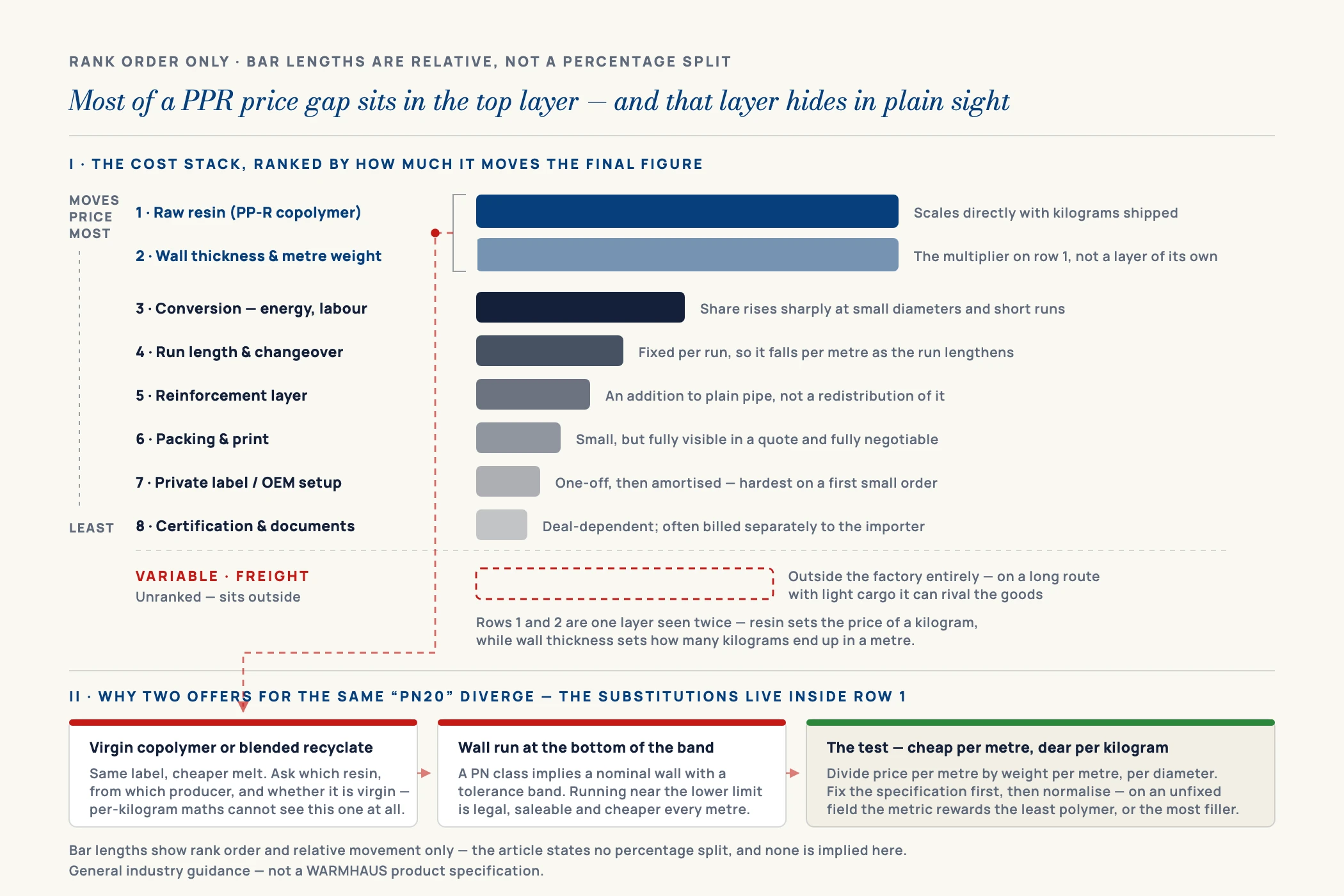
Below is the structure of a PPR pipe cost, ordered by how much it typically moves the final figure. The point of the table is the rank order and the direction each layer moves, because that is what survives across markets — the absolute split between resin and conversion shifts with the polymer market, the diameter mix and the electricity tariff of the country you are buying from. Composite pipes, small diameters and short runs redistribute the stack substantially. Confirm the actual figures against the specification and quotation of the pipe you are buying.
| Cost layer | Rank | How it behaves | What moves it | What the buyer can control |
|---|---|---|---|---|
| Raw resin (PP-R copolymer) | 1 | Scales directly with kilograms shipped; tracks a published polymer market | Polymer market, grade, virgin vs recycled content, colour masterbatch | Specify virgin material and a named resin source; accept market-linked pricing |
| Wall thickness & metre weight | 2 | Not a separate cost — it is the multiplier on layer 1. More wall, proportionally more resin per metre | PN class, SDR, where in the tolerance band the line runs | Ask for g/m or wall thickness in the quote, not just “PN20” |
| Conversion (energy, labour, tooling) | 3 | Largely per-kilogram-throughput; its share rises sharply at small diameters and short runs | Electricity tariff, line automation, output per hour, local wage base | Little direct control; reflected in the factory you choose |
| Run length & changeover | 4 | Fixed per run, so it falls per metre as the run lengthens — the reason small orders of odd sizes price badly | Changeover time, scrap at start-up, number of sizes and colours | Consolidate diameters and colours; avoid one-off sizes in small volumes |
| Reinforcement layer (fibre / composite) | 5 | An addition to plain pipe, not a redistribution: extra material and slower line speed | Extra extruder, extra material, reduced output | Use composite only where thermal expansion or class demands it |
| Packing & print | 6 | Small but fully visible in a quotation, and fully negotiable | Bulk vs cartons, printed film, custom print, bundle count | Choose the simplest packing your market accepts; print costs money |
| Private label / OEM setup | 7 | One-off, then amortised — punishing on a first small order | Print cylinders, artwork, dedicated changeovers | Amortise across an agreed volume; hold artwork stable |
| Certification & documentation | 8 | Deal-dependent and often billed separately or borne by the importer | Which market-access documents your customs and tender require | Ask up front which files exist, and who pays for the destination certificate |
| Freight & Incoterm | Variable | Sits outside the factory entirely and on a long route with light cargo can rival the goods | Container utilisation, route, season, EXW vs FOB vs CFR | Optimise cube; compare on a landed basis, never on unit price |
The rank order and behaviour described above are general industry guidance for plain, unreinforced PP-R pipe in commodity diameters — not a WARMHAUS cost sheet, and not a claim about any specific percentage split. Resin markets, diameter mix, order size and freight routes all change the distribution, and no supplier’s actual cost breakdown is public. Confirm against the actual quotation and technical datasheet of the pipe you are buying.
Note what rows 1 and 2 mean together: the first two layers are one layer seen twice. Resin is the price of a kilogram; wall thickness decides how many kilograms are in a metre. That is why the whole comparison method in section VI reduces to finding the kilograms — and why the one number you can compute yourself, before any supplier tells you anything, is the metre weight the specification implies. Section IV does that arithmetic.
III. Resin: The Line That Decides Everything Else
If you interrogate one line of a PPR quotation, interrogate the resin. Polypropylene random copolymer is a commodity with a published market, and although producers genuinely do differ on landed resin cost — volume contracts, regional feedstock, freight from the resin supplier, off-peak power on the extrusion side — those advantages are incremental, and they compound with the other layers rather than appearing as one dramatic gap. So a modest spread between honest offers is normal and expected. What deserves a question is the outlier: when one price sits far below the cluster while quoting the same specification, material substitution is the common explanation — recycled content blended into the melt, an off-grade lot, or a filler that adds mass cheaply. Treat a large gap as a prompt to re-verify the specification, not as proof of anything. Recyclate is not automatically a scandal in every application, but in a pressurised hot-water pipe with a design life measured in decades it is a substitution the buyer should know about — the consequence lands years later as brittleness under thermal cycling.
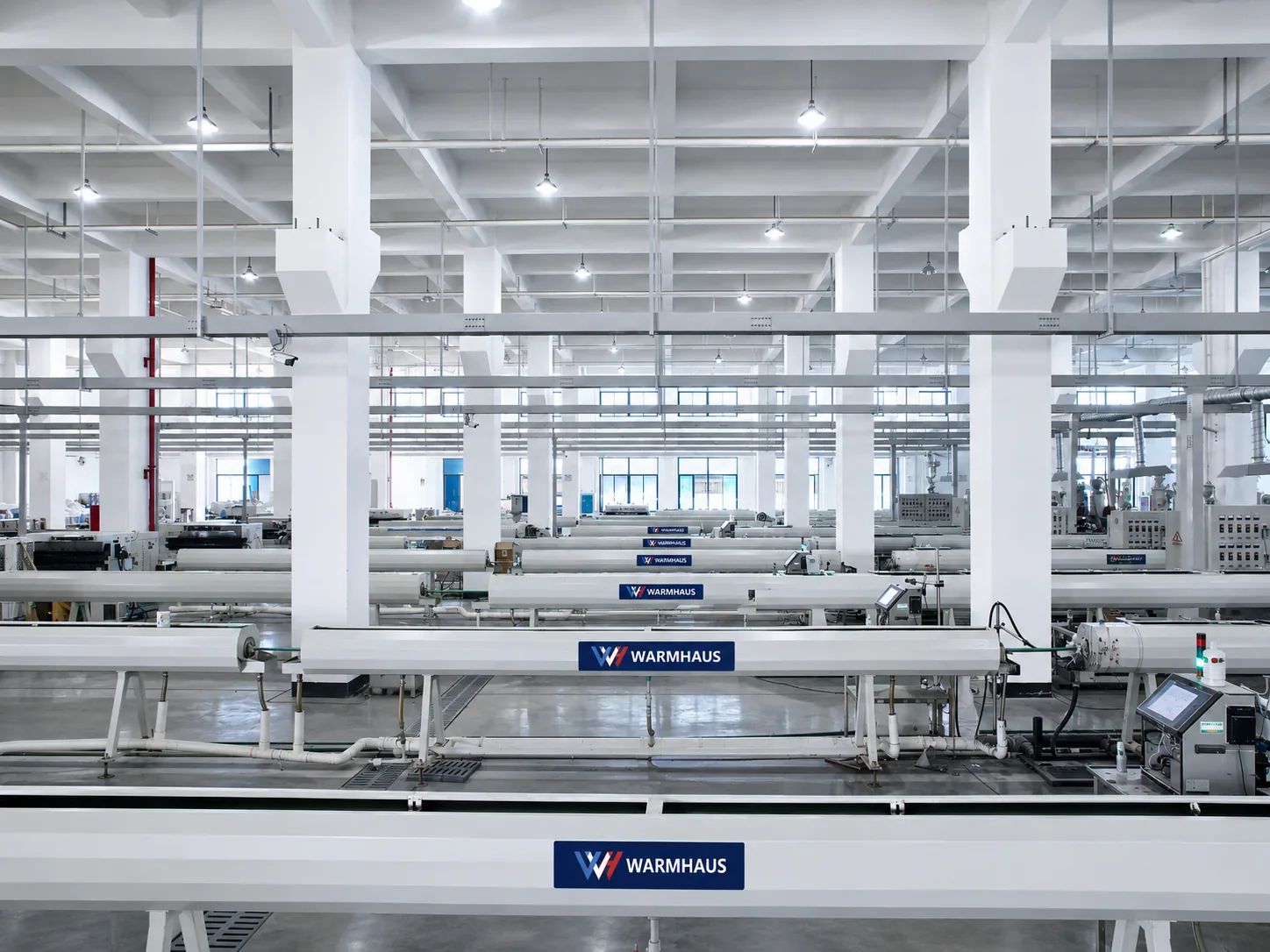
The question to put in an enquiry is simple: which resin, from which producer, and is it virgin? A manufacturer running its own extrusion knows immediately; a trading company has to ask. At WARMHAUS the PPR, PEX, HDPE and PERT raw materials come from Hyosung, Borealis and LG, and the extrusion lines are our own — see the factory page.
The second resin question is colour. Masterbatch is a small percentage of the mass but it is not free, and a non-standard colour in small volume carries changeover and purge costs that go somewhere. A private-label programme in three colours across four diameters has multiplied its changeovers by twelve — visible as a higher unit price or a longer production window, never as a printed line.
IV. Wall Thickness, PN Class and the Metre-Weight Test
Once resin is settled, the quantity per metre is the next lever. For a given outside diameter, a higher PN class means a thicker wall, more resin and a higher price — that part is intuitive. What is less intuitive is how much room exists within a single class. Dimensional standards such as DIN 8077 and DIN 8078 set nominal walls with tolerance bands, and a line can be tuned to sit anywhere inside that band. Running near the lower limit saves material on every metre for the whole life of the order.
So the most useful single number a buyer can request is weight per metre in grams. It collapses diameter, PN class and wall thickness into one figure you can divide into the price. And you do not have to wait for a supplier to tell you what it should be — the geometry gives it to you. A pipe is an annulus, so:
g/m ≈ π ⁄ 4 × [ OD² − (OD − 2 × wall)² ] × density, with OD and wall in mm and density in g/cm³.
PP-R random copolymer has a density in the region of 0.90–0.91 g/cm³. Working the arithmetic at 0.905 against nominal walls gives the indicative metre weights below. Use them as a sanity check on a quotation: an offer whose stated metre weight sits well under the figure for its class has less polymer in it than the class implies, and an offer that will not state one at all has told you something too.
| Outside Ø | PN10 — wall / indicative g/m | PN16 — wall / indicative g/m | PN20 — wall / indicative g/m |
|---|---|---|---|
| 20 mm | ~1.9 mm / ~98 g | ~2.8 mm / ~137 g | ~3.4 mm / ~160 g |
| 25 mm | ~2.3 mm / ~148 g | ~3.5 mm / ~214 g | ~4.2 mm / ~248 g |
| 32 mm | ~2.9 mm / ~240 g | ~4.4 mm / ~345 g | ~5.4 mm / ~408 g |
| 40 mm | ~3.7 mm / ~382 g | ~5.5 mm / ~539 g | ~6.7 mm / ~634 g |
| 50 mm | ~4.6 mm / ~594 g | ~6.9 mm / ~846 g | ~8.3 mm / ~984 g |
| 63 mm | ~5.8 mm / ~943 g | ~8.6 mm / ~1,330 g | ~10.5 mm / ~1,567 g |
Wall thicknesses are general industry guidance for PP-R dimensions; the metre weights are calculated from those walls at an assumed 0.905 g/cm³ and are arithmetic, not measured data or a WARMHAUS specification. Real pipe varies with actual density, tolerance and any masterbatch or reinforcement. Treat these as an order-of-magnitude check and confirm against the datasheet and the standard cited in your contract. PN25 is normally a fibre-reinforced or composite construction, so a single-material calculation does not apply to it and it is omitted here.
The per-kilogram test — and where it misleads
Convert every offer to a price per kilogram and the field often reorders itself: pipe that looked cheaper per metre turns out dearer per kilogram of polymer delivered. But be clear about what the metric does, because used carelessly it argues for exactly the wrong pipe. Price per kilogram ranks the cost of delivered polymer. It does not know whether that polymer should be there. A pipe running near the bottom of its tolerance band and a correctly walled pipe can show the same price per kilogram, and a heavy pipe with a mineral filler can look excellent on it, because filler is mass.
So the sequence matters: fix the specification first, then normalise. Settle diameter, PN class, standard and resin type so that every offer is quoting the same object, and only then divide price by weight — at that point the metric is comparing suppliers rather than comparing products. Two guards make it safe. Check the offered metre weight against the geometry above, so a suspiciously light pipe is caught before the per-kilogram sum flatters it; and keep the resin question separate, because per-kilogram economics cannot distinguish virgin copolymer from a blend at any price. If a supplier will not put metre weight in writing, that reluctance is itself information.
A parallel check is length tolerance and bundle count. A “4-metre” length measuring a little under, multiplied across a container, is a quiet discount to the seller. Specify both in the purchase order and count on arrival for the first shipment from any new source. Our guide to PPR pipe specifications sets out how diameter, SDR and wall thickness relate.
V. The Costs That Sit Outside the Pipe
Buyers who have normalised resin and wall thickness still get surprised, because a large part of the delivered cost never touches the extruder. These are the lines to raise before comparing totals.
Packing format
Bulk pallets, strapped bundles, printed shrink film and individual cartons are four different costs for identical pipe. Ask: what is the price in the simplest packing my market will accept?
Print and branding
Pipe marking is standard; custom brand print, multi-colour artwork and cylinder setup are not. On a private-label programme these one-off costs need amortising over an agreed volume, not absorbing into a first small order.
Container utilisation
Pipe is low-density cargo — you run out of cube long before weight. Mixing dense items such as brass fittings and valves with light pipe in the same container is the most effective way to lower cost per delivered metre.
Incoterm
EXW, FOB and CFR quotations are not comparable numbers. Freight moves independently of the factory and can, on light cargo over a long route, rival the value of the goods. Restate offers on one Incoterm before ranking them.
Documentation and market access
The paperwork your customs office and tender require costs preparation time even when no fee is charged. Establish early which documents a supplier can actually issue for your destination, rather than discovering the gap at the port.
Minimum order quantity
An MOQ is a price term in disguise. A low headline price behind a high minimum forces you to finance stock you do not need yet; the cash cost of that inventory belongs in your comparison alongside the unit price.
Lead time and stock cover
Lead time is a planning input, not an afterthought. Ours is 45 days from confirmed order, and knowing that number lets you size safety stock properly instead of paying air freight on a gap you could have forecast.
VI. How to Compare PPR Pipe Quotes Without Guessing
A workable comparison takes about an hour and removes most of the ambiguity. It runs in five moves.
I. Fix the specification before you ask for prices
Send every supplier the same line list: outside diameter, PN class, length, wall thickness or metre weight, resin type, colour, packing and destination port. A request that says only “PPR pipe price list” returns documents you cannot compare.
II. Convert everything to price per kilogram — after step I, never before
Divide the offered price per metre by the offered weight per metre. Do it per diameter — the ranking can differ between 20 mm and 63 mm because line economics differ by size. The order of these two steps is the whole point: run this on offers whose PN class and wall are already fixed and it compares suppliers; run it on a mixed field and it rewards whoever ships the least polymer, or the most filler. Cross-check each stated metre weight against the geometry table in section IV before you trust the division.
III. Restate every offer on one Incoterm
Pick the term you actually buy on and rebuild the other quotations to match, adding your own freight assumption where a supplier has not quoted it. Compare only after this step.
IV. Price the container, not the metre
Build the loading plan you would really ship, fittings and valves included, and calculate cost per delivered metre for the whole box. A supplier who can fill it from one range often wins here while losing on a single line, because you stop paying freight on air.
V. Cost the risk of the cheapest offer
Put a number on what happens if the material is not what was specified: replacement pipe, site labour to reopen walls, credibility spent with a customer. Then ask whether the saving covers it. On hot-water pressure pipe it usually does not. Our guide to vetting a PPR pipe manufacturer is the practical version of this step.
VII. Buying PPR Pipe at a Price You Can Defend
Durable pricing does not come from pushing hardest on one quotation. It comes from buying a defined product from a source whose cost structure you understand — knowing the resin, the metre weight and the packing, and consolidating enough range with one manufacturer that container economics work in your favour.
WARMHAUS is a manufacturer of PPR, PEX and brass piping systems, not a trading company — extrusion, injection-moulding and machining lines are our own, manufacturing since 1993. Raw materials come from Hyosung, Borealis and LG, so the resin question has a documented answer. PPR pipe and fittings, PEX pipe and brass fittings and valves load into one container from one account, which is where cost per delivered metre actually falls. And there is no MOQ, so a first order can be sized to test a market rather than to hit somebody’s minimum. Standard lead time is 45 days; ISO 9001 / ISO 14001 / ISO 45001 certified, EU CE marked and SGS tested, with certificate documents available on request.
Tell us the diameters, PN classes and annual volumes you are planning and we will quote against a written specification including metre weight, so the comparison is real. Request a specification-based PPR pipe quotation . Building a territory rather than buying one container? The distributor programme covers stock planning and terms over a full year.