Two brass elbows can carry the same catalogue number, the same nominal size and the same photograph, and only one will still be watertight in five years. The differences that matter — alloy composition, thread standard, wall thickness at the thread root, and machining finish — are invisible in an image and rarely stated on a price list. That is the whole problem with buying brass pipe fittings by picture and price. This guide covers the fitting types, how to read a thread callout so BSP and NPT never get mixed in one shipment, what an alloy designation tells you about corrosion life, and the specification questions that separate a sellable container from one that sits in a warehouse.
Technical figures below are general industry guidance, not WARMHAUS-specific specifications — the datasheet of the actual fitting and pipe you are using always takes precedence.
I. What Brass Fittings Are For — and Why Plastic Systems Still Need Them
A modern building rarely uses one material end to end. A riser may be PPR, the underfloor circuits PEX, and the boiler, water meter, pump and mixing group all present threads in metal. Brass bridges those worlds: it machines to a precise thread, takes repeated assembly and disassembly, and can be overmoulded into a plastic body. A thread moulded directly in polypropylene relaxes over time under heat and torque; a brass insert in the same body does not. This is why almost every serious PPR system uses brass-insert transition fittings at every threaded interface, and why the brass content of a PPR order is higher than a first-time buyer estimates.
Brass is not a legacy material in a plastic system. It is the interface layer — every point where plastic has to meet a thread, a valve or a meter.
Serviceability is the second reason. A fused joint is permanent by design; a threaded brass connection is meant to be broken and remade — for a meter swap, a pump replacement, a strainer clean. Anywhere maintenance expects a component to come out, the connection will be brass, which makes a complete brass system a maintenance-driven line, not just a construction one.
II. The Main Types of Brass Pipe Fittings
Catalogues run to hundreds of references, but the range resolves into a handful of families — and knowing which one a request belongs to tells you what to ask next.
Threaded fittings — elbows, tees, sockets, nipples, unions, plugs
The core range, in equal and reducing configurations. Ask about: thread standard, parallel or taper, and the sealing method the market expects — a taper thread seals on the thread, a parallel thread needs a washer or O-ring seat.
Compression fittings — for copper, PEX and multilayer pipe
A nut and an olive (ferrule) compress onto the pipe outside diameter to seal without tools beyond two spanners. Ask about: which pipe OD the body is cut for, whether an insert sleeve is supplied for plastic pipe, and whether the olive is brass — it is a consumable customers reorder separately.
Transition and insert fittings — plastic to metal
A brass thread carried in a plastic body, or a brass body with a socket for fusion or crimping — the workhorse of a PPR or PEX installation. Ask about: how the insert is retained against pull-out and rotation, and whether the plastic body is the same material grade as the pipe it welds to.
Valves and valve-adjacent parts
Ball valves, angle valves, check valves, strainers and their tail pieces. A separate line functionally, but ordered on the same purchase order and sharing the same thread standard — see the brass ball valve range for how body and handle options change the specification.
Manifolds and distribution bars
Machined bar or forged bodies with multiple outlets, for underfloor heating circuits and riser distribution — effectively a multi-port fitting with accessories bolted to it. The brass manifold range shows how port count and outlet thread drive the rest of the assembly.
Flexible connectors and tails
Braided hoses and rigid tails with a brass nut at one or both ends, for appliances, sanitaryware and pumps. Ask about: nut thread, seal type and length range — a high-turnover, low-value line that fills out a container efficiently.
III. Thread Standards and Size Reference
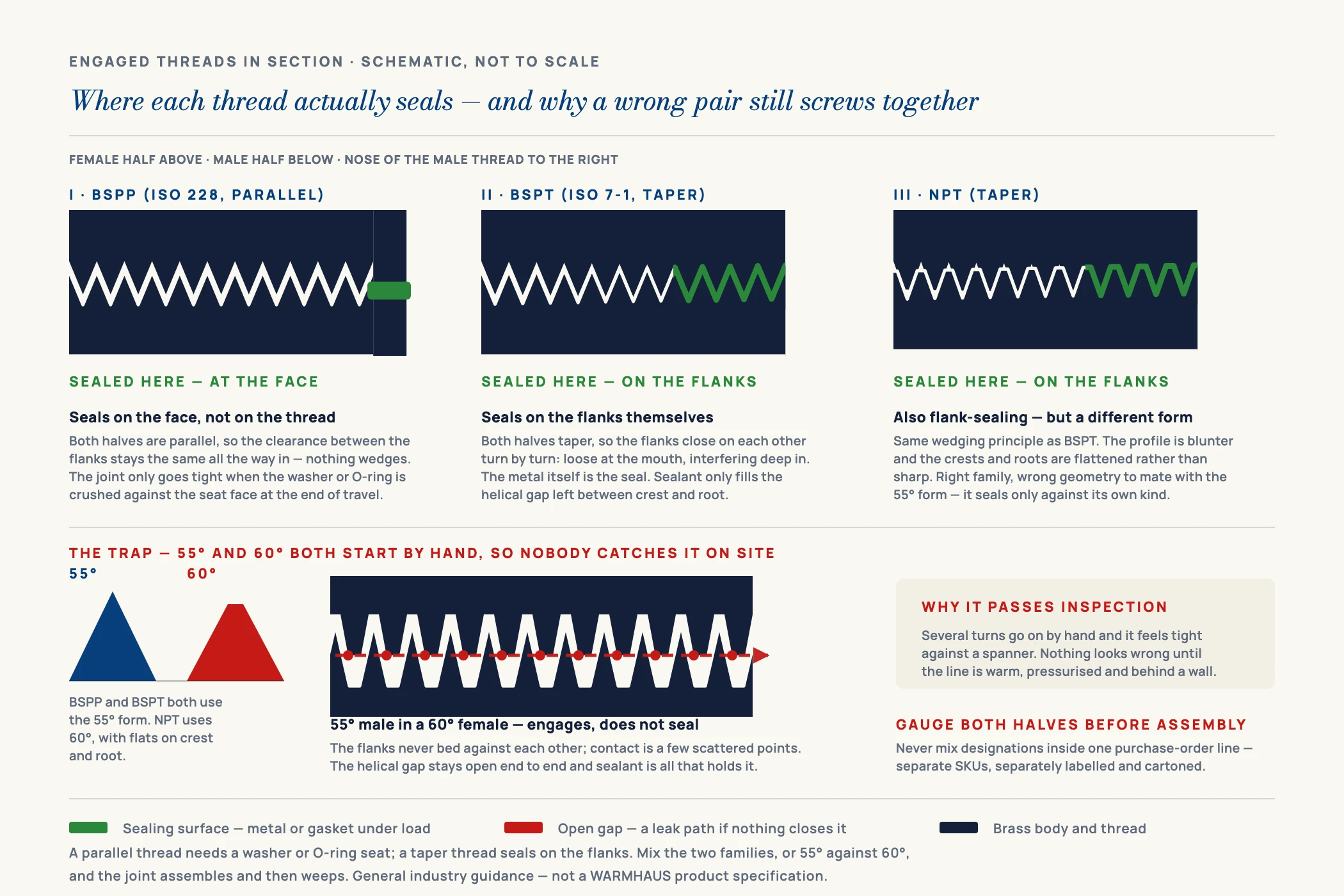
More rejected shipments come from thread mismatches than from any material problem. A fitting marked 1/2″ can be BSP parallel, BSP taper or NPT, and those three do not reliably seal against each other even though they engage by hand. Treat the table as general industry guidance for cross-checking an enquiry, not a substitute for the dimensional drawing.
| Designation | Full name | Profile | Seals on | Typically specified in |
|---|---|---|---|---|
| G (BSPP) | British Standard Pipe Parallel | 55° parallel | Washer / O-ring face | Europe, Middle East, much of Asia |
| R (BSPT) | British Standard Pipe Taper, male | 55° taper | Thread flanks + sealant | Europe, Middle East, Commonwealth markets |
| Rp | BSP parallel internal thread | 55° parallel | Mates with R taper male | Common female counterpart to R |
| NPT | National Pipe Taper | 60° taper | Thread flanks + sealant | North America, parts of Latin America |
| NPS | National Pipe Straight | 60° parallel | Washer / gasket | North America, mechanical joints |
| M (metric) | ISO metric parallel | 60° parallel | O-ring or washer | Manifold accessories, actuators, sensors |
Values are general industry guidance, not a WARMHAUS-specific specification. Thread designations, tolerance classes and sealing practice vary by national code. Always confirm against the dimensional drawing and datasheet of the fitting you are ordering, and against the local plumbing code of the destination market.
Two rules follow. Never assume a standard from a size: an enquiry written as 1/2″ tells you nothing, and the answer is a two-line email that prevents a five-figure mistake. And never mix standards inside one purchase-order line — where a project needs both BSP and NPT, they should be separate SKUs, separately labelled and cartoned.
IV. Reading an Alloy Specification
Brass is copper and zinc, with small additions that make it machinable. The copper-to-zinc ratio determines how the fitting behaves in water over years, and it is the part of the spec most often left blank. A quotation that names no alloy is itself the finding — two quotations for different alloys are not comparable.
The two designations you will meet most often here are CW617N and HPb57-3, both leaded, hot-forging and free-machining brasses widely used for water fittings and valve bodies. CW617N is the European material designation; HPb57-3 is the corresponding Chinese national designation. They are not identical — permitted composition ranges differ, and so does typical copper content — which is why a specification should name one rather than saying “brass”. Beyond the designation, the properties below drive real-world performance:
| Property | What it governs | What to ask the supplier |
|---|---|---|
| Copper content | Corrosion resistance, particularly dezincification | Which alloy designation, and a material certificate per batch? |
| Lead content | Machinability and drinking-water compliance | Is a low-lead option available for this market? |
| Dezincification resistance | Service life in aggressive or high-chloride water | Is a DR alloy option offered for this item? |
| Wall thickness at thread root | Burst and torque resistance — the usual failure point | Drawing dimension, and is it checked in production? |
| Surface finish | Sealing on parallel threads, appearance on exposed work | Natural, nickel- or chrome-plated, to what coverage? |
General industry guidance for structuring an enquiry. Alloy suitability for potable water is set by the destination market’s regulations — confirm against the applicable local code and the material datasheet for the specific item.
Dezincification — the slow selective loss of zinc, leaving a weakened, porous copper structure — is more likely in soft, acidic or high-chloride water and at elevated temperature. Where the destination market has that water profile, specify a dezincification-resistant alloy for items that are buried, embedded or otherwise not serviceable. For fittings in an accessible service cupboard the calculation differs, because they can be replaced.
V. Forged, Machined or Cast — How the Body Is Made
Three production routes dominate, each leaving a different signature on the finished part — which lets you read a sample in your hand rather than trusting a description.
Hot forging presses heated brass bar into a die. It gives a dense grain structure following the shape of the part, which is why forged bodies handle pressure and torque well; most elbows, tees and valve bodies are forged, and show a parting line where the die halves met. Bar machining turns the whole part from solid rod, giving excellent dimensional control at the cost of more material removed — nipples, adaptors, olives, tails and most manifold bodies are made this way, showing concentric turning marks instead. Casting suits complex shapes but is more prone to porosity, and porosity in a pressure-carrying wall is a slow leak waiting for a thermal cycle.
A blunt but effective incoming check: weigh a sample against the drawing mass. Under-weight almost always means thin walls somewhere, and thin walls at the thread root are the most common cause of a fitting splitting under normal installation torque. It is the cheapest quality signal you can measure without a laboratory.
VI. Specifying an Order — the Ten Lines That Matter
Most disputes on a brass order trace back to a specification that was too short. The ten lines below, filled in per SKU, remove almost all of them — and force competing quotations onto the same basis.
| # | Specification line | Why it matters |
|---|---|---|
| 1 | Fitting type and configuration | Equal or reducing; MxF orientation |
| 2 | Nominal size, both ends | Reducers are misquoted more than any other item |
| 3 | Thread standard and form | BSPP / BSPT / NPT / metric — top cause of rejected goods |
| 4 | Alloy designation | CW617N, HPb57-3 or a DR alloy — not simply “brass” |
| 5 | Surface finish | Natural, nickel- or chrome-plated; coverage expectation |
| 6 | Working pressure and temperature | Must match the system class, not just the pipe |
| 7 | Marking and branding | Private-label marks need lead time in the die |
| 8 | Packing unit and carton | Polybag and carton counts, marks, gross and net weight |
| 9 | Documentation required | Which certificates and test reports ship with the goods |
| 10 | Inspection basis | What is checked, at what sample rate, by whom |
General industry guidance for drafting an enquiry. Pressure and temperature ratings are properties of the specific item and must be confirmed against its technical datasheet and against the system design.
Line 9 is where paperwork problems begin. Decide before production which documents travel with the container: packing list and invoice always, but also — depending on destination — a certificate of origin, quality-system certification and third-party test reports. Requesting these after shipment is slow and sometimes impossible. Request the brass fittings specification sheet and documentation list and we will set it out against your market.
VII. Common Failure Modes and What They Tell You
When a brass fitting fails in service, the failure mode names its own cause. Work through this list when a claim comes back.
Split at the thread root, shortly after installation
Wall too thin at the root, or an over-torqued taper thread. Check: drawing dimension and sample weight. If several fail across different installers, it is the part, not the technique.
Weeping thread that no amount of sealant fixes
Almost always a standard mismatch — a 55° thread engaged into a 60° form, or a taper male into a parallel female without the correct seat. Check: gauge both threads before blaming the sealant.
Pink or porous surface under a white deposit
Classic dezincification: the zinc has gone, copper is left behind. Check: water profile and alloy specified. On a repeat order into that market, move to a DR alloy for non-serviceable positions.
Insert spinning inside a plastic transition body
The insert was not adequately keyed against rotation, or the plastic was over-heated during welding. Check: insert knurling and retention geometry, and welding time.
Plating flaking at edges within months
Insufficient plating thickness or poor surface preparation before plating. Check: whether the finish specification stated a coverage expectation, or only said “chrome”.
Nut cracking on a compression fitting
Over-torque, or a nut cut from stock that is too hard or too thin. Check: the recommended torque figure and whether the olive matches the pipe outside diameter.
Two of these — the thread mismatch and the spinning insert — are avoidable entirely at the purchase-order stage. The rest are alloy, dimension or process questions a manufacturer with its own machining lines can answer directly.
VIII. Buying Brass Fittings from a Manufacturer
Everything above narrows to one commercial decision: who you buy from, and how much of the answer they own. WARMHAUS is a manufacturer of PPR, PEX and brass piping systems — not a trading company. The extrusion, injection-moulding and machining lines are our own, which is why a question about wall thickness at the thread root, insert retention geometry or plating coverage gets a direct answer rather than a forwarded email. Manufacturing since 1993 across three plants totalling 100,000 m².
Two things matter most for a brass buyer. First, one source for four product lines: brass fittings, brass ball valves, brass manifolds and the PPR and PEX systems they connect to — one supplier account, one set of documents and one set of tolerances instead of four, with the brass insert in a transition fitting dimensioned against the same pipe we extruded. The full range is on the products overview, the brass line under brass fittings. Second, no MOQ: a new distributor can order a genuine trial mix rather than committing a full pallet of one reference to find out whether the threads gauge correctly. Standard lead time is 45 days, planned into production slots.
For a tender file: ISO 9001, ISO 14001 and ISO 45001 management-system certification, EU CE marking, SGS third-party testing and Russian PT market approval. Tell us your destination market, its thread standard and the size range you sell, and we will send dimensional data, alloy options and distributor terms. Pricing, packing and certificate documents — available on request.